2
 Call Kai
 Learn
 Practice Test
 Spaced Repetition
 Match
 Flashcards
 Knowt Play
1/99

There's no tags or description
Looks like no tags are added yet.
100 Terms
literacy
Why it matters: This is the strictly traditional definition. Any 21st-century answer that stops at "reading and writing" is incomplete by this lesson's standard.
"the quality of being literate; knowledge of letters; condition in respect to education, esp. ability to read and write"
OED Online (2nd ed.)
A: Yes, under the traditional definition — but it is insufficient for 21st-century literacy. The OED definition is limited to "knowledge of letters" and "ability to read and write."
Gotcha: Do not confuse this with Functional Literacy, which adds numeracy and daily-life coping skills.
A school administrator says, "Our students are literate—they can read and write." Based on the traditional OED definition, is this claim fully accurate?
Functional Literacy
Nuance: The key phrase is "daily demands of life" — this distinguishes it from Basic Literacy Skills.
"the level of literacy which includes not only reading and writing but also numeracy skills that would help people cope with the daily demands of life." (National Statistics Authority)
Early literacy / Emergent Literacy — "what children know about reading and writing before they can actually read and write."
Situational cue: Age below formal reading instruction + pre-reading knowledge = Emergent Literacy.
A mother asks, "What does my 4-year-old know about reading before she can actually read?" Which literacy concept answers her?
Basic Literacy Skills
Gotcha: Basic Literacy Skills are the three skills; Functional Literacy is the application of those skills to daily life. A student who can read, write, and count but cannot budget a household is basically literate but not functionally literate.
"the skills of reading, writing and numeracy."
A: Basic = Bare three R's (Reading, wRiting, aRithmetic/numeracy). Functional = For daily life.
Why it works: Alliteration + contrast encoding improves retrieval under exam pressure.
Mnemonic to distinguish Basic Literacy Skills from Functional Literacy?
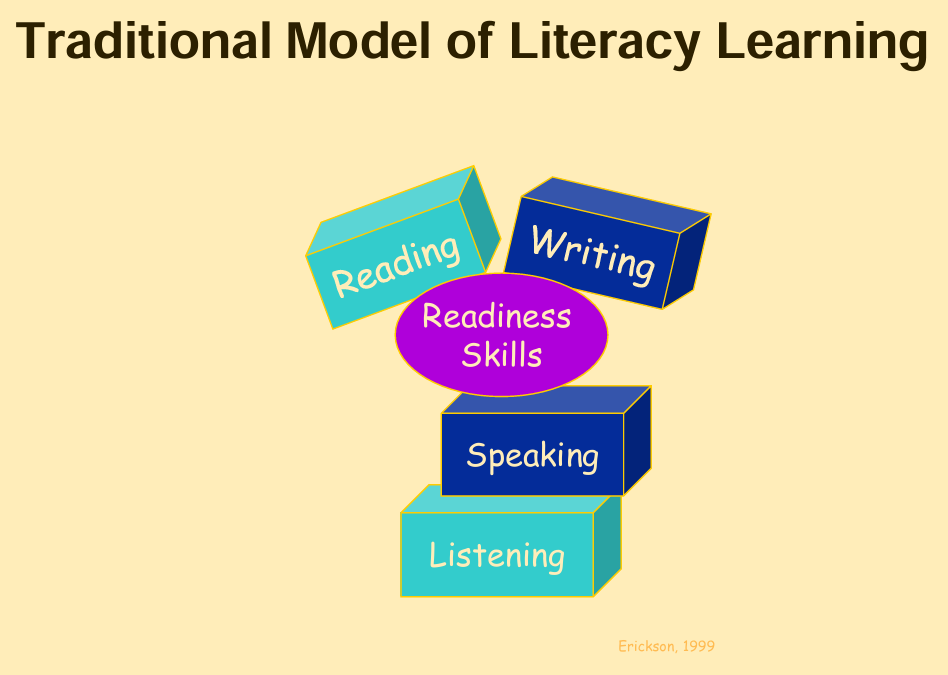
Four components surrounding "Readiness Skills":
Reading
Writing
Speaking
Listening
Figure reference: Page 6 diagram — Readiness Skills sit at the center, with Reading & Writing (top) and Speaking & Listening (bottom).
Rationale: Traditional literacy is language-arts centered, not technology- or society-centered.
What is the Traditional Model of Literacy Learning (Erickson, 1999) composed of?
Readiness Skills
Gotcha: Students often mistakenly place "Reading" at the center. The diagram shows Readiness Skills as the hub.
In the Traditional Model of Literacy Learning (Erickson, 1999), which component is at the center, surrounded by reading, writing, speaking, and listening?
"Literacy is for ALL!"
Nuance: This slogan frames the shift toward 21st-century literacies as expanding access, not narrowing it.
It signals the inclusive premise of literacy — literacy is not reserved for a select group; it is a universal goal.
A: R-W-S-L → "Read Write Speak Listen" — the Four Language Arts.
Technique: Acronym chunking + verbal rehearsal (proven in educational psychology for list retention).
Mnemonic for the Traditional Model of Literacy Learning components?
A: Functional Literacy (National Statistics Authority).
Reasoning: The rationale explicitly includes numeracy + daily-life coping — beyond reading and writing alone.
A curriculum designer argues, "Literacy should include numeracy because people need to cope with daily demands." Which concept is she advocating?
A: False.
Why wrong: Early/Emergent Literacy = pre-reading/pre-writing knowledge in young children. Basic Literacy Skills = actual skills of reading, writing, and numeracy. One is developmental; the other is skill-based.
True or False: "Early literacy" and "Basic literacy skills" are interchangeable terms.
Functional Literacy
Three elements to remember: Reading + Writing + Numeracy (applied to daily life).
It includes not only reading and writing but also numeracy skills that help people cope with the daily demands of life.
A: R-W-N-D → Read, Write, Numeracy for Daily life.
Why it works: Adding "D" for daily demands emphasizes the application element that distinguishes functional from basic literacy.
Memory hook for Functional Literacy's three elements?
A: Early/Emergent Literacy — "what children know about reading and writing before they can actually read and write."
Case link: Pre-instructional knowledge = emergent literacy.
A kindergarten teacher assesses whether a child recognizes letters before formal reading instruction. This is an example of assessing what?
Functional Literacy is broader in application — it subsumes basic skills (reading, writing, numeracy) and adds daily-life coping. Basic Literacy Skills is the narrower, skill-only category.
Nuance: "Broader" here means "includes more components," not "more fundamental."
Which is broader: Basic Literacy Skills or Functional Literacy?
A: It implies that literacy learning requires a readiness phase before formal reading/writing — a developmental prerequisite.
Why it matters: This is a hallmark of traditional models, which tend to be stage-based and sequenced.
What does the phrase "Readiness Skills" imply about the Traditional Model of Literacy Learning?
WHAT PHASE?
Top: Reading and Writing; Center: Readiness Skills; Bottom: Speaking and Listening.
List the four language arts in the Traditional Model and their arrangement (Erickson, 1999).
No. Functional literacy also requires numeracy skills and the ability to cope with daily demands of life. Reading + writing alone = basic literacy at best.
A teacher claims, "If a child can read and write, they are functionally literate." Is this correct per the lesson?
Chain logic: Traditional is narrowest (read/write), Basic adds numeracy, Functional adds application.
TRADITIONAL/BASIC/FUNCTIONAL
Chain logic: ____ is narrowest (read/write), ___ adds numeracy, ___ adds application.
Early literacy focuses on what children know before they can read/write (pre-literacy knowledge), whereas Basic Literacy Skills refer to the actual skills of reading, writing, and numeracy.
____ literacy focuses on what children know before they can read/write (pre-literacy knowledge), whereas ___ Literacy Skills refer to the actual skills of reading, writing, and numeracy.
National Statistics Authority
According to the lesson, what is the source for the Functional Literacy definition?
A: Functional Literacy — the numeracy/daily-life application component.
Why not Basic? She has reading/writing, so Basic may be present; the functional application is what fails.
If a student can read a newspaper but cannot compute a grocery budget, which literacy is she lacking?
A: Traditional Model of Literacy Learning by Erickson, 1999.
Exam tip: The year (1999) is a "gotcha" — it is the traditional model, not a 21st-century one.
What is the full title and author of the model on Page 6?
A: "R-W-S-L" + "R" → Reading, Writing, Speaking, Listening, surrounded by Readiness Skills.
Memory technique for the four components of the Traditional Model?
Globalization and Multi-cultural Literacy
Key verbs: Awareness + Appreciation.
"the awareness and appreciation of different beliefs, appearances and lifestyles." (Bsndev, 2004)
A: Globalization and Multi-cultural Literacy (Bsndev, 2004).
Gotcha: Do not confuse with Social Literacy — multicultural literacy is about awareness/appreciation of different beliefs, appearances, lifestyles; social literacy is about interacting/building relationships.
A student learns about Diwali, wears traditional clothing from another culture, and respects different religious practices. Which 21st-century literacy is demonstrated?
Social Literacy
Three verbs: Interact → Maintain → Build (relationships).
"a person's ability to interact, maintain and build relationships with others." (Universita Delle Libereta, 2012)
A: Social Literacy (Universita Delle Libereta, 2012).
Reasoning: The definition centers on interacting, maintaining, and building relationships
A team leader successfully mediates conflict and sustains long-term working relationships. Which literacy does this illustrate?
Media Literacy
Four verbs: Access → Analyze → Evaluate → Produce.
"the ability to access, analyze, evaluate, and produce communication in a variety of forms." (Schwarz, 2005; Silverblatt, 2008)
Media Literacy (Schwarz, 2005; Silverblatt, 2008).
Why not Digital/Cyber? The definition emphasizes communication in a variety of forms (access, analyze, evaluate, produce), not digital technology/data protection.
A student fact-checks a viral TikTok video, evaluates its bias, and creates a counter-video. Which literacy is she demonstrating?
Financial Literacy
Money-matter scope: Acquiring → Managing → Investing → Helping others.
"the skill to comprehend all money matters from acquiring to managing, investing, and helping others."
Financial Literacy.
Reasoning: The definition explicitly includes acquiring, managing, investing, and helping others.
A person creates a budget, invests in a mutual fund, and donates to charity. Which literacy is demonstrated?
Cyber/Digital Literacy
Four actions + one safeguard: Find → Evaluate → Create → Communicate + Protect (self, data, others).
"the ability to find, evaluate, create, and communicate information using digital technology while protecting yourself, your data, and others online."
Cyber/Digital Literacy.
Gotcha: The phrase "protecting yourself, your data, and others online" is the distinguishing clause that separates Cyber/Digital Literacy from Media Literacy.
A student uses strong passwords, enables two-factor authentication, and evaluates the credibility of an online article. Which literacy is shown?
Eco Literacy
"the ability to understand the natural systems that make life on earth possible."
Core idea: Understanding natural systems and their life-sustaining role.
Eco Literacy.
Reasoning: It requires understanding natural systems that make life on earth possible — pollinators are such a system.
A community leader explains how pollinator decline affects food systems and proposes a habitat restoration plan. Which literacy is demonstrated?
Arts and Creativity Literacy
Two halves: (1) Understand/Critique/Produce art; (2) Generate original ideas + solve problems imaginatively.
"combines the ability to understand, critique, and produce artistic works with the capacity to generate original, useful ideas and solve problems imaginatively."
A: Arts and Creativity Literacy.
Why not just "Arts"? The lesson's definition combines art critique/production with original, useful idea generation and imaginative problem-solving.
A student critiques a painting in a museum AND invents a novel solution to a school problem. Which literacy is demonstrated?
A: G-S-M-F-C-E-A → "Great Students Must Fully Comprehend Every Aspect."
Globalization & Multi-cultural
Social
Media
Financial
Cyber/Digital
Eco
Arts & Creativity
Technique: First-letter acrostic + narrative (proven in educational psychology for ordered list recall).
Mnemonic for the seven 21st Century Literacies in order of appearance?
A: G-S-M-F-C-E-A
Globalization and Multi-cultural Literacy (Bsndev, 2004).
Which 21st-century literacy is defined as "the awareness and appreciation of different beliefs, appearances and lifestyles"?
Social Literacy (Universita Delle Libereta, 2012).
Which 21st-century literacy is defined as "a person's ability to interact, maintain and build relationships with others"?
Media Literacy (Schwarz, 2005; Silverblatt, 2008).
Which 21st-century literacy is defined as "the ability to access, analyze, evaluate, and produce communication in a variety of forms"?
Financial Literacy.
Which 21st-century literacy is defined as "the skill to comprehend all money matters from acquiring to managing, investing, and helping others"?
Cyber/Digital Literacy.
Which 21st-century literacy is defined as "the ability to find, evaluate, create, and communicate information using digital technology while protecting yourself, your data, and others online"?
Eco Literacy.
Which 21st-century literacy is defined as "the ability to understand the natural systems that make life on earth possible"?
Arts and Creativity Literacy
Which 21st-century literacy "combines the ability to understand, critique, and produce artistic works with the capacity to generate original, useful ideas and solve problems imaginatively"?
A: Media Literacy ("access, analyze, evaluate, and produce communication") and Cyber/Digital Literacy ("find, evaluate, create, and communicate information").
Difference: Media Literacy emphasizes communication forms; Cyber/Digital emphasizes digital technology + protection of self, data, and others.
Which TWO 21st-century literacies involve evaluation as a core verb? How do they differ?
A: Cyber/Digital Literacy.
Why it's a differentiator: No other literacy in the lesson has an explicit safety/protection clause.
Which 21st-century literacy explicitly mentions "protecting yourself, your data, and others online"?
Access
Analyze
Evaluate
Produce
Mnemonic to remember the four verbs of Media Literacy?
A: A-A-E-P → "All Articles Evaluated Properly."
A: F-E-C-C → "Find, Evaluate, Create, Communicate" + Protect.
Extension: "Find Every Cyber Crime" reminds you of the protect clause.
Mnemonic to remember the four actions of Cyber/Digital Literacy?
Acquiring
Managing
Investing
Helping others
Mnemonic to remember Financial Literacy's money-matter scope?
A: A-M-I-H → "All Money Is Handled."
A: Globalization and Multi-cultural Literacy.
Case cue: Beliefs, appearances, lifestyles → multicultural.
A school integrates lessons on world religions, cultural festivals, and global cuisines. Which 21st-century literacy is being addressed?
A: Social Literacy.
Case cue: Interact, maintain, build relationships → social.
A teacher assigns a group project requiring negotiation, active listening, and relationship-building. Which 21st-century literacy is primarily targeted?
A: Media Literacy.
Case cue: Access, analyze, evaluate, produce communication → media.
A class analyzes advertisements for persuasion techniques and creates a public service announcement. Which 21st-century literacy is targeted?
A: Financial Literacy.
Case cue: Acquiring, managing, investing, helping others → financial
A personal finance class teaches budgeting, investing, and charitable giving. Which literacy is targeted?
A: Cyber/Digital Literacy.
Case cue: Find, evaluate, create, communicate + protect → cyber/digital.
A digital citizenship module teaches students to verify sources, create content, and protect personal data. Which literacy is targeted?
A: Eco Literacy.
Case cue: Natural systems that make life possible → eco.
A science class studies ecosystems and human impact on natural systems. Which literacy is targeted?
Arts and Creativity Literacy.
Case cue: Understand/critique/produce art + original, useful ideas + imaginative problem-solving → arts and creativity.
An art class critiques masterpieces and runs a design-thinking challenge to solve a community problem. Which literacy is targeted?
Media Literacy (specifically analyzing and evaluating communication).
Nuance: Skill at using a medium ≠ literacy in analyzing/evaluating it.
A student who is highly skilled at social media but cannot detect fake news is lacking which literacy?
No. The lesson presents them as separate literacies with different definitions. Media = access/analyze/evaluate/produce communication; Cyber/Digital = find/evaluate/create/communicate information using digital tech + protect.
Is "Digital Literacy" the same as "Media Literacy" in this lesson?
Globalization & Multi-cultural (society-wide)
Social (interpersonal)
Technique: Grouping by domain (society vs. individual vs. systems) reduces cognitive load.
Mnemonic for the three "relational" literacies (those about people/society)?
A: G-S → "Good Society."
Media (communication systems)
Financial (economic systems)
Cyber/Digital (technological systems)
Eco (natural systems)
Technique: Thematic chunking + acrostic.
Mnemonic for the two "systems" literacies (those about information/environment)?
A: M-F-C-E → "My Future Comes Early."
Cyber/Digital Literacy.
Why: It is the only definition with "protecting yourself, your data, and others online."
Which 21st-century literacy is most directly tied to protecting data?
A: Financial Literacy ("from acquiring to managing, investing, and helping others").
Nuance: This makes financial literacy not purely self-interested — it includes prosocial money behavior.
Which 21st-century literacy explicitly mentions "helping others"?
Arts and Creativity Literacy.
Nuance: Creativity is framed as problem-solving, not just artistic expression.
Which 21st-century literacy explicitly involves "solving problems imaginatively"?
Globalization and Multi-cultural Literacy (Bsndev, 2004).
Nuance: This is an attitudinal/dispositional literacy — awareness + appreciation — unlike skill-based literacies.
Which 21st-century literacy is defined by "awareness and appreciation" rather than by a skill verb?
A: Because Eco Literacy is "the ability to understand the natural systems that make life on earth possible." Recycling is a behavior; the literacy is systemic understanding.
Gotcha: Behavior ≠ literacy.
A teacher says, "Eco Literacy is just recycling." Why is this an incomplete understanding?
A: Not fully. Media Literacy requires the ability to produce communication, not just analyze/evaluate it.
Nuance: Production is an explicit component.
A student can identify fake news but cannot create a media message. Is the student fully media literate per the lesson's definition?
Arts and Creativity Literacy.
Rationale: The definition explicitly "combines the ability to understand, critique, and produce artistic works with the capacity to generate original, useful ideas and solve problems imaginatively."
Which 21st-century literacy combines two traditionally separate domains (art + idea generation)?
A: The world of teachers and students.
Rationale: The introduction frames the entire lesson around ongoing, dramatic change in education.
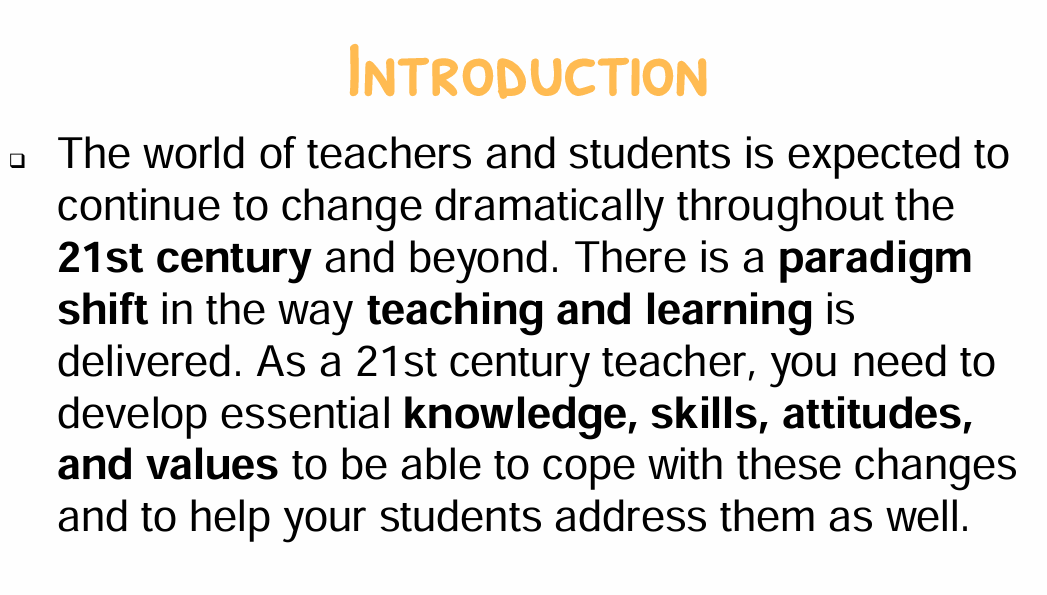
According to the lesson's Introduction (Page 20), what is expected to continue to change dramatically throughout the 21st century and beyond?
A: A paradigm shift.
Definition in context: A fundamental change in the approach to teaching and learning — not just a change in tools, but in the underlying model.
What is the term used in the lesson to describe the shift in the way teaching and learning is delivered?

Knowledge
Skills
Attitudes
Values
Gotcha: It is K-S-A-V, not just "skills." Attitudes and values are explicitly included.
What four things must a 21st-century teacher develop to cope with change?
A: No. The language is normative: "As a 21st century teacher, you need to develop essential knowledge, skills, attitudes, and values."
Nuance: "Need to" signals an expectation/requirement, not a suggestion.
Does the lesson state that the paradigm shift is optional for teachers?
A: It signals that the dramatic change is not time-bound to the 21st century — it is an ongoing, open-ended trajectory.
Nuance: This prevents a "we'll be done by 2100" misreading.
What does the lesson mean by "beyond" in "throughout the 21st century and beyond"?

A: The world of teachers and students — i.e., the entire educational ecosystem, not just curriculum or technology.
Rationale: The scope is systemic.
What is the scope of the change described on Page 20?
"There is a paradigm shift in the way teaching and learning is delivered."
Complete the lesson's phrase: "There is a ______ in the way ___ and ___ is delivered."
A: No. The lesson requires knowledge, skills, attitudes, AND values — all four. Skill-only development is incomplete.
Gotcha: The "AND" is conjunctive, not optional.
A teacher focuses only on acquiring new skills (e.g., learning apps) but ignores attitudes and values. Is this consistent with Page 20?
A: "Cope and Enable" → Cope with changes (self) + Enable students (others).
Technique: Contrast pairing (self vs. others) improves recall
Mnemonic for the two-part rationale on Page 20 (why teachers must develop K-S-A-V)?
knowledge, skills, attitudes, AND values

A: The literacies are the content/domains; the Critical Attributes section provides the meta-framework — the paradigm shift and the K-S-A-V requirements for teachers to deliver them.
Nuance: Literacies = what; Critical Attributes = how/why.
What is the relationship between the 21st-century literacies and the "Critical Attributes"?
A: The literacies are the ___/___; the Critical Attributes section provides the ___-____ — the paradigm shift and the K-S-A-V requirements for teachers to deliver them.
Ongoing — "The world of teachers and students is expected to continue to change dramatically."
Nuance: "Continue to change" implies the shift is in motion, not finished.
is the paradigm shift described as complete or ongoing?
The lesson frames the change as continuing ("continue to change dramatically throughout the 21st century and beyond"). The paradigm shift is a process, not a one-time implementation.
A principal says, "We've implemented 21st-century literacies, so the paradigm shift is done." What is wrong with this statement per the lesson?
A: T-L → "Teaching and Learning."
Why it works: Pairing the two nouns as a unit (chunking) prevents the common error of remembering only "teaching."
Mnemonic for the two key nouns in the paradigm-shift sentence?
A: The teacher is both a recipient of change (must cope) and an agent of change (must help students address the changes).
Dual role: Coping + enabling.
Q: What does the lesson imply about the role of the teacher in the paradigm shift?
A: The teacher is both a r___of c___ (must cope) and an a__ of c___ (must help students address the changes).
traditional
Reading, writing, speaking, listening + readiness skills — language-arts centered.
TRADITIONAL OR 21ST CENTURY?
21st Century
Seven literacies spanning culture, society, media, finance, technology, environment, and arts — multidimensional and society-centered.
TRADITIONAL OR 21ST CENTURY?
A: An expansion. The lesson presents traditional literacy as foundational (reading, writing, speaking, listening) and adds seven new literacies on top.
Nuance: Traditional literacy remains necessary but insufficient.
Is 21st-century literacy a replacement for traditional literacy, or an expansion?
Knowledge, skills, attitudes, and values (K-S-A-V) — to cope with change and help students address it.
A curriculum integrates all seven 21st-century literacies. Which critical attribute must teachers also develop to deliver this effectively?
Media Literacy (produce communication) and Arts and Creativity Literacy (produce artistic works).
Nuance: Both require production, but in different domains — communication vs. art.
Which literacy is most associated with "producing" as a required skill?
Media Literacy ("analyze, evaluate, and produce") and Cyber/Digital Literacy ("find, evaluate, create").
Why: Evaluation is the critical-thinking core of both information-facing literacies.
Which two literacies explicitly mention "evaluate"?
No. The definition requires awareness AND appreciation (Bsndev, 2004). Awareness alone is insufficient.
A student is aware of different cultures but does not appreciate them. Is she fully multi-culturally literate?
Not fully. Social Literacy requires the ability to interact, maintain, and build relationships (Universita Delle Libereta, 2012). All three verbs are required.
A person can interact with others but cannot maintain or build relationships. Is he socially literate?
A: No. Cyber/Digital Literacy requires protecting yourself, your data, and others online — the protection clause is mandatory.
Gotcha: This is a common "partial credit" trap.
A person can find and evaluate information online but does not protect their data. Is she cyber/digital literate?
Media Literacy (analyzing/evaluating communication) and Cyber/Digital Literacy (evaluating information + protecting data).
Rationale: Fake news = media analysis; phishing/data privacy = digital protection.
A teacher designs a unit on fake news, phishing, and data privacy. Which two 21st-century literacies are most directly involved?
Eco Literacy (ecosystem science), Financial Literacy (budgeting), Media Literacy (social media campaign).
Nuance: This shows literacies are interconnected, not siloed.
A school garden project integrates ecosystem science, budgeting for supplies, and a social media campaign. Which three 21st-century literacies are involved?
Arts and Creativity Literacy — "combines the ability to understand, critique, and produce artistic works with the capacity to generate original, useful ideas and solve problems imaginatively."
Nuance: "Combines" is a semantic signal that this literacy is dual-domain.
Which literacy is defined with "combines" as its first verb, signaling integration of two domains?
Universita Delle Libereta, 2012.
Exam tip: Do not confuse with Bsndev, 2004 (Multi-cultural) or Schwarz/Silverblatt (Media).
What is the source attribution for Social Literacy?
Bsndev, 2004.
What is the source attribution for Globalization and Multi-cultural Literacy?
Schwarz, 2005; Silverblatt, 2008.
What is the source attribution for Media Literacy?
Erickson, 1999.
What is the source attribution for the Traditional Model of Literacy Learning?