Atomic Structure

0.0(0)
Studied by 4 people
call kaiCall Kai
learnLearn
examPractice Test
spaced repetitionSpaced Repetition
heart puzzleMatch
flashcardsFlashcards
GameKnowt Play
Card Sorting

1/42

flashcard set

Earn XP

Description and Tags

Last updated 9:31 PM on 6/4/24
Name
Mastery
Learn
Test
Matching
Spaced
Call with Kai
Chat

No analytics yet

Send a link to your students to track their progress

43 Terms

1
New cards
What is an atom?
An atom is the smallest part of an element that can exist.
2
New cards
What is an element?
An element is a substance made up of only one type of atom
3
New cards
How are the elements listed and approximately how many are there?
They are listed in a periodic table and there are approximately 100 elements.
4
New cards
Elements can be classified into two groups based on their properties; What are these groups?
Metals and Non-metals
5
New cards
Elements may combine through chemical reactions to form new products; what are these new substances called?
Compounds
6
New cards
What is a compound?
two or more elements chemically combined in fixed proportions
7
New cards
Do compounds have the same properties as their constiteunt element
No, they have different properties
8
New cards
What is a mixture? Does it have the same chemical properties as its constituent materials?
A mixture consists of two or more elements or compounds not chemically combined together. It does have the same chemical properties.
9
New cards
What are the methods which involve separating mixtures? (there are five!) Do these involve chemical reactions?
Filtration, Crystallisation, Chromatography, Simple Distillation and Fractional Distillation; they do not involve chemical reactions.
10
New cards
Describe and explain simple distillation.
Simple distillation is used to separate liquid from a solution - the liquid boils off and condenses in the condenser. The thermometer will read the boiling point of the pure liquid. Contrary to evaporation, we get to keep the liquid.
11
New cards
Describe and explain evaporation.
Evaporation is a technique for separation of a solid dissolved in a solvent from a solvent (e.g. salt from H2O). The solution is heated until all the solvent evaporates; the solids stays in the vessel.
12
New cards
Describe and explain crystallisation.

- crystallisation is similar to evaporation

- but we only remove some of the solvent by evaporation to form a saturated solution (the one where no more solid can be dissolved)

- then we cool down the solution

- as we do it the solid starts to crystallise as it becomes less soluble in lower temperatures

- the crystals can be collected and separated from the solvent via filtration

13
New cards
Describe and explain fractional distillation.

Fractional distillation is a technique for separation of a mixture of liquids. It works when liquids have different boiling points. The apparatus is similar to the one of simple distillation apparatus, with the additional fractionating column placed on top of the heated flask.The fractionating column contains glass beads. It helps to separate the compounds. In industry, mixtures are repeatedly condensed and vapourised. The column is hot at the bottom and cold at the top. The liquids will condense at different heights of the column.

14
New cards
Describe and explain filtration.
Filtration is used to separate an insoluble solid is suspended in a liquid. The insoluble solid (called a residue) gets caught in the filter paper, because the particles are too big to fit through the holes in the paper. The filtrate is the substance that comes through the filter paper. Apparatus: filter paper + funnel.
15
New cards
Describe and explain chromatography.

Chromatography is used to separate a mixture of substances dissolved in a solvent. In paper chromatography, we place a piece of paper with a spot containing a mixture in a beaker with some solvent. The bottom of the paper has to be in contact with the solvent. The solvent level will slowly start to rise, thus separating the spot (mixture) into few spots (components).

16
New cards
What is a separating funnel?
A separatory funnel is an apparatus for separating immiscible liquids. Two immiscible liquids of different densities will form two distinct layers in the separatory funnel. We can run off the bottom layer (the liquid with greater density) to a separate vessel.
17
New cards
Describe the plum pudding model.
The atoms is a ball of positive charge with electrons embedded in it.
18
New cards
Describe the Bohr/nuclear model and how it came about
The nuclear model suggests that electrons orbit the nucleus at specific distances (shells) - it came about in the alpha scattering experiments.
19
New cards
Later experiments led to the discovery of smaller, positive particles in the nucleus; what are these particles called?
Protons.
20
New cards
What did the work of James Chadwick provide evidence for?
The existence of neutrons in the nucleus.
21
New cards
Describe the structure of an atom.
Atoms consist of electrons surrounding a nucleus that contains protons and neutrons.
22
New cards
Explain why atoms are electrically neutral.
They have the same number of electrons and protons.
23
New cards
What is the radius of an atom?
0.1nm
24
New cards
What is an isotope? Do isotopes of a certain element have the same chemical properties?

Atoms of the same element (same number of protons) but have a different number of neutrons.

They have the same chemical properties since they have the same electronic structure
25
New cards
What are ions?
Ions are charged particles. They are formed when atoms lose electrons (positive ions) or gain (negative ions) electrons. E.g. sodium positive ion, Na+ , has an electronic configuration of 2,8 (same as Ne). An atom of sodium has lost one electron.
26
New cards
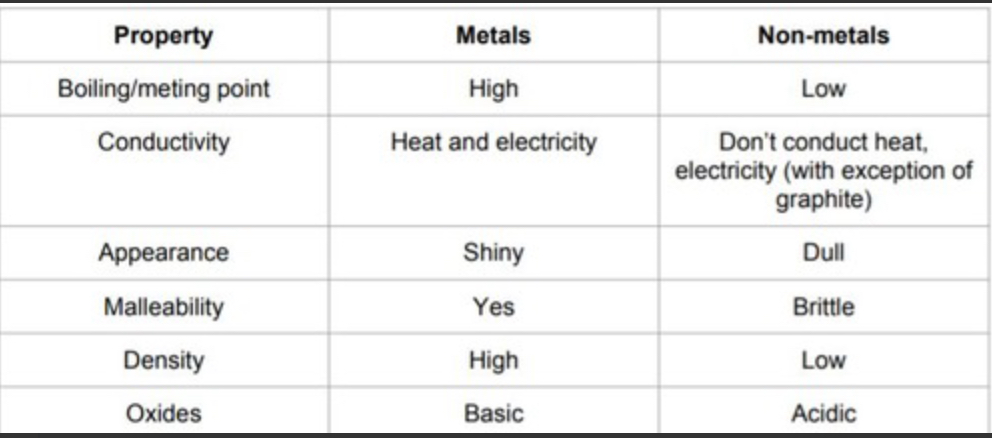
Compare the properties of non-metals and metals.
knowt flashcard image
27
New cards
What is formed when a metal reacts with a non-metal?
An ionic compound (made of positive and negative ions)
28
New cards
What is formed when a non-metal reacts with a non-metal?
A molecular compound containing covalently bounded atoms.
29
New cards
Explain the following: solute, solvent, solution, miscible, immiscible, soluble and insoluble.

A solute is a substance that is dissolved into a solvent. Together they form a solution.

Miscible refers to the substances (particularly liquids) that mix together, e.g. water and alcohol. Water and oil are immiscible, i.e. they do not mix.

Soluble refers to the substance that can be dissolved in the solvent, e.g. salt in water. Insoluble substances wont dissolve in a particular solvent.

30
New cards
The elements of group 0 are commonly known as...?
The noble gases.
31
New cards
Early periodic tables were incomplete and elements were placed in inappropriate groups if what was to be followed?
The strict order of atomic weights.
32
New cards
Mendeelev overcame some problems with the periodic table by doing what? He also changed the order of some elements based on what?
Leaving gaps; atomic weights
33
New cards
Elements that react to form positive ions are..?
Metals
34
New cards
Elements that do not form positive ions are...?
Non-metals
35
New cards
Elements in group one are known as?
alkali metals
36
New cards
State three characteristics of alkali metals
All have one electron in their outer shell; have low density; are stored under oil (to prevent reactions with oxygen or water); are soft (can be cut with knife).
37
New cards
How do group 1 elements react with non-metals? Why are these reactions similar for the different group 1 elements?
They form ionic compounds which are soluble white solids which form colourless solutions - they all have one electron in their outer shell.
38
New cards
How does group 1 react with water?
-They react vigorously to form a metal hydroxide and hydrogen
39
New cards
How does the reactivity change moving down Group 1? Why?
Reactivity increases as the atoms get larger and the distance between the nucleus and the outer electrons increases and thus attraction from the nucleus decreases, allowing them to easily lose electrons
40
New cards
State five characteristics of Group 7

- 7 electrons in outer shell

- Coloured vapours

- Diatomic molecules

- Form ionic salts with metals

- Form molecular compounds with non-metals

41
New cards
State five State Group 7 elements and states of matter of molecules they form

- Fluorine, F. F₂ is a pale yellow gas

- Chlorine, Cl. Cl₂ is a pale green gas

- Bromine, Br. Br₂ is a dark brown liquid

- Iodine, I. I₂ is a grey solid

42
New cards
State three changes that occur in Group 7 as one moves down the group

- Higher relative molecular mass

- Higher melting and boiling point

- Less reactive - less easily gain electrons

43
New cards
Describe the properties of noble gases.
non-metals, gases, low boiling points, unreactive



