Auditory and Vestibular Systems
 Call Kai
 Learn
 Practice Test
 Spaced Repetition
 Match
 Flashcards
 Knowt Play
1/66

There's no tags or description
Looks like no tags are added yet.
67 Terms
What are sound components?
Sequence of air pressure pulses created by vibration
What is frequency?
How often a repeating event or wave happens within a specific period (Hz)
What is amplitude?
Maximum height, distance, or extent of a wave, vibration, or oscillation measured from its resting position (Decibels, dB)
What is the function of the outer ear?
Tuning and directing
What is the purpose of the tympanic membrane?
Vibrates in response to sound waves and transfers to the bones of the ear

What is this structure?
Tympanic membrane
What are the three bones of the middle ear?
Malleus, Incus, Stapes
What are the two muscles of the middle ear?
Stapedius and Tensor tympani
What is the function of the Stapedius and Tensor tympani muscles?
Dampen amplification to help protect ear and help modulate how the middle ear moves
What happens if we have damage to the middle ear (from tympanic membrane to oval window)?
Conductive hearing loss
What is the oval window?
Opening that transfers vibrations from the middle ear into the inner ear
What is the order of the middle ear that transfers vibrations?
Tympanic membrane → Malleus bone → Incus bone → Stapes bone → Oval window → Cochlea
What is the cochlea?
The hearing organ of the inner ear. It’s a small, spiral-shaped, fluid-filled structure
What is the purpose of the cochlea?
Converts mechanical vibrations into electrical nerve signals that the brain interprets as sound
What are Semicircular canals?
Part of the vestibular system of the inner ear. Their main job is to detect head rotation (angular/rotational acceleration) and help maintain balance and gaze stability.
What is the function of the Scala vestibuli?
Carries pressure waves through the cochlea after the stapes pushes on the oval window.
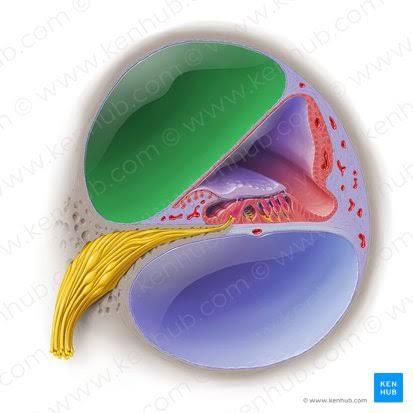
What is this structure?
Scala vestibuli
What is the function of the Scala tympani?
Carries the pressure wave toward the round window

What is this structure?
Scala tympani
What is the function of the Scala media (cochlear duct)?
Contains the organ of Corti/hair cells

What is this structure?
Scala media (Cochlear duct)
What is the Organ of Corti?
Sensory organ for hearing located inside the scala media (cochlear duct)
What is the function of the Organ of Corti?
It converts mechanical vibrations from sound into electrical nerve signals that can be sent to the brain
What is the function of Inner hair cells?
When the basilar membrane moves, the stereocilia of the inner hair cells bend. This causes neurotransmitter release onto neurons of the cochlear nerve. Afferent
What is the function of Outer hair cells?
They can rapidly change length in response to electrical signals, which amplifies movement of the basilar membrane. If something is too loud, the membrane will alter the stiffness to help protect it from damage, if something isn’t loud enough, it will alter the stiffness to help you hear better. Efferent
What are the short projections of hair cells called?
Stereocilia
What are the long projections of hair cells called?
Kinocilium
What happens if the stereocilia is pushed toward the kinocilium?
Depolarization: opening of mechanically-gated potassium (K+) channels, which if enough are opened (graded potential), it can lead to an action potential. This causes glutamate (excitatory neurotransmitter) to be released and propagate down Vestibulocochlear nerve (specifically the cochlear part)
What happens if the stereocilia is pushed away from the kinocilium?
Do not get opening of mechanical-gates. Hyperpolarizes the cell and no action potential occurs
What are some causes of inner hair cell loss (Sensory neural hearing loss)?
Aging, repeated loud noises, issue to CN VIII
How far do high-frequency sounds travel to displace the basilar membrane?
15 mm
How far do medium-frequency sounds travel to displace the basilar membrane?
20-30 mm
How far do low-frequency sounds travel to displace the basilar membrane?
30+ mm
What is an Acoustic Neuroma?
A usually benign tumor of Schwann cells associated with the vestibulocochlear nerve at the Internal Auditory Meatus
What are symptoms of an acoustic neuroma?
Hearing loss — usually unilateral
🔔 Tinnitus — ringing in one ear
⚖ Balance problems/dizziness
Can impact the facial nerve - causing facial weakness
What are the three central pathways of the auditory system?
Localization of sound, onset and duration of sound, and pattern recognition of sound
What are the steps of the localization of sound pathway?
Bilaterally: Superior Olivary Nucleus → Inferior Colliculus → Medial Geniculate Nucleus → Cortex
What are the steps of the onset and duration of sound pathway?
Bilaterally: Superior Olivary Nucleus → Lateral Lemniscus → cross to opposite Inferior Colliculus → Medial Geniculate Nucleus → Cortex
What are the steps of the pattern recognition of sound pathway?
Contralaterally: Inferior Colliculus → Medial Geniculate Nucleus → Cortex
What can happen if there is damage from the cochlear nuclei to the cerebrum (Central hearing loss)?
Lead to bilateral hearing loss to some degree; hearing aids are virtually ineffective
What is the purpose of the vestibular system?
Provides information regarding orientation and acceleration through space, a sense of balance and equilibrium, and coordination of body, head, and eye movements
What is the vestibular labyrinth?
The part of the inner ear responsible for balance and detecting head movement/position.
What is the function of the Semicircular canals?
Detect rotational/angular acceleration
What are the semicircular canals?
Anterior, Horizontal, Posterior
What is the ampulla?
A swollen enlargement at the base of each semicircular canal in the inner ear.
What is the Ganglia of Scarpa?
A collection of sensory neuron cell bodies associated with the vestibular portion of CN VIII, carrying balance information from the inner ear to the brain.
What is the Utricle?
Detects horizontal linear acceleration and head tilt/position relative to gravity.
What is the Saccule?
Detects vertical linear acceleration and head position relative to gravity (vertical orientation)
What are endolymph?
Specialized fluid found inside the membranous labyrinth of the inner ear
What angle is the Anterior semicircular canal at?
45-degree angle from sagittal plane
What angle is the Horizontal semicircular canal at?
30-degree above the transverse plane
What angle is the Posterior semicircular canal at?
45-degree angle from sagittal plane
What does the Anterior semicircular canal depolarize?
Neck flexion
What does the Horizontal semicircular canal depolarize?
Horizontal rotation
What does the Posterior semicircular canal depolarize?
Backwards rotation
How does neural transduction move in the semicircular canals?
Neural signal starts in ampulla, turns mechanical input into signal. Hair cells lay within cupula, inside the ampulla. Movement of the endolymph causes deflection of stereocilia into the kinocilium, causes depolarization. Movement of the endolymph causes deflection of the stereocilia away from the kinocilium, still causes hyperpolarization.
What are the semicircular canal pairings?
Right horizontal - Left horizontal
Right anterior - Left posterior
Right posterior - Left anterior
What happens during angular movement to one side?
We will get depolarization to the canal that is ipsilateral to that same side of movement (i.e. depolarize left anterior, hyperpolarize right anterior when turning head to left)
What is the macula?
Sensory receptor in the utricle and saccule that detects linear acceleration and head position relative to gravity
What is the otolithic membrane?
Gelatinous membrane that sits on top of the hair cells.
What are otoliths?
Tiny crystals that sit inside the gelatinous membrane, weighing the membrane down. So when you shift, the weight of the membrane is bending the hair cells.
What is the Vestibulo-thalamo-cortical Tract?
Starts in vestibular system, goes through thalamus, ends in cortex (conscious awareness of our balance and head orientation) (DMG: true vertigo)
What is the Vestibule-cerebellar Tract?
Starts in vestibular system, goes to the cerebellum; Continuously working (unconsciousness) (DMG: really pooradaptation to environment)
What is the Medial Vestibulospinal Tract?
Starts in vestibular system, ends in the anterior horn in cervical and thoracic spinal cord (Descending pathway); bilateral system; keeps us upright
What is the Lateral Vestibulospinal Tract?
Starts in vestibular system, spans the entire length of spinal cord (entire axial muscles and LE) ends in the anterior horn of lumbar and sacral spinal cord; only ipsilateral system
What is the Vestibular-ocular reflex (VOR)?
Allows you to keep your eyes fixed on an object when your head turns. Planes of the SCC are matched to the eye muscles:
Right head movement -> Right horizontal SCC depolarizes -> information sent to CN III -> Right Medial rectus muscle activates
Right head movement -> Left horizontal SCC hyperpolarizes -> information sent to CN VI -> Left Lateral rectus muscle activates
What is Decerebrate Rigidity?
Damage to vestibular nuclei: lateral vestibulospinal tract is constantly active