gene regulation
 Call Kai
 Learn
 Practice Test
 Spaced Repetition
 Match
 Flashcards
 Knowt Play
1/20

There's no tags or description
Looks like no tags are added yet.
21 Terms
Big theme: Gene expression is regulated
not all geens are expressed at the same time
constitutive genes are always expressed- always on
But many important genes are not always expressed —> related to energetics
prokaryotic gene regulation
Regulation can happen during transcription initiation
Lac operon model
found in ecoli- gut bacteria→ human intestine
adjusts gene expression based on diet
Human drinks milk→ E.coli digests lactose
Induction
turning on gene expression
inducer
compund that stimulates gene expression
inducible gene
gene activated by inducer- default state is off
turned on when needed
contrasts with constitutive genes
operon
complex of dna consisting of
multiple elements
groups of genes with associated/ related functions
associated regulatory dna sequences
only found in prokaryotes (w/ very few exceptions)
An operon is a group of functionally related genes, along with regulatory DNA sequences, that are controlled together and are commonly found in prokaryotes.
Exp: Lac operon
Contains:
promoter- rna polymerase binding site, not transcribed
operator- on/ off switch sequence for gene expression
3 genes: lacz, lacy, laca → dont need to know these

negative regulation of lec operon
governed by the presence of absence of → inducible
no lactose→ negative regulation is ACTIVE, operon is off, no gene expression
lactose is present→ operon is induced, negative regulation is INACTIVE
when off genes are on
involves repressor
repressor
repressor gene codes for repressor protein- down regulates gene expression when active
constitutive expression
not apart of operon
easier explanation: when bound to the operator, it prevents or reduces transcription of the structural genes-> not part of operon but regulates.
it isconstitutively expressed, meaning it continuously produces repressor proteins that regulate gene expression.
Lac repressor activity No lactose scenario
repressor binds operator
The RNA polymerase can bind to the promotor, but can not transcribe genes bc repressor is preventing operator
This prevents the cell from wasting energy making proteins it doesn't currently need.

Lac repressor activity lactose available scenario
Lactose enters the cell and is converted to allolactose (lactose isomer)
allolactose is the inducer (cmpd stim gene expression)
allolactose induces the lac operon by inactivating pressor protein→ changes shape of repressor
Binds 2nd site on repressor protein- inactivates repressor→ can no longer bind operator
Result:
LOW levels of lac expression
1 long mrna w/ all 3 genes, each with their own start and stop codons are being transcribed → eventually translated as 3 sep polypeptides
Prokaryotes have no nucleus and transcription typically occurs in the nucleus then the cytoplasm so the process becomes simultaneous. even though all three genes are on ONE mRNA, they each have their own translation initiation and termination signals. Therefore, the ribosome can translate the three coding regions into three separate proteins.

Positive regulation of lac operon
Regulation by activator that binds DNA to stimulate transcription
HIGH expression when active
responds to the presence or absence of glucose
Ecoli prefers glucose over lactose so when both are present, ecoli will use the glucose first but in the scenario glucose isnt present, it settles for lactose
Lac promoter (binding site) is inefficient
It has a low affinity for RNApolymerase
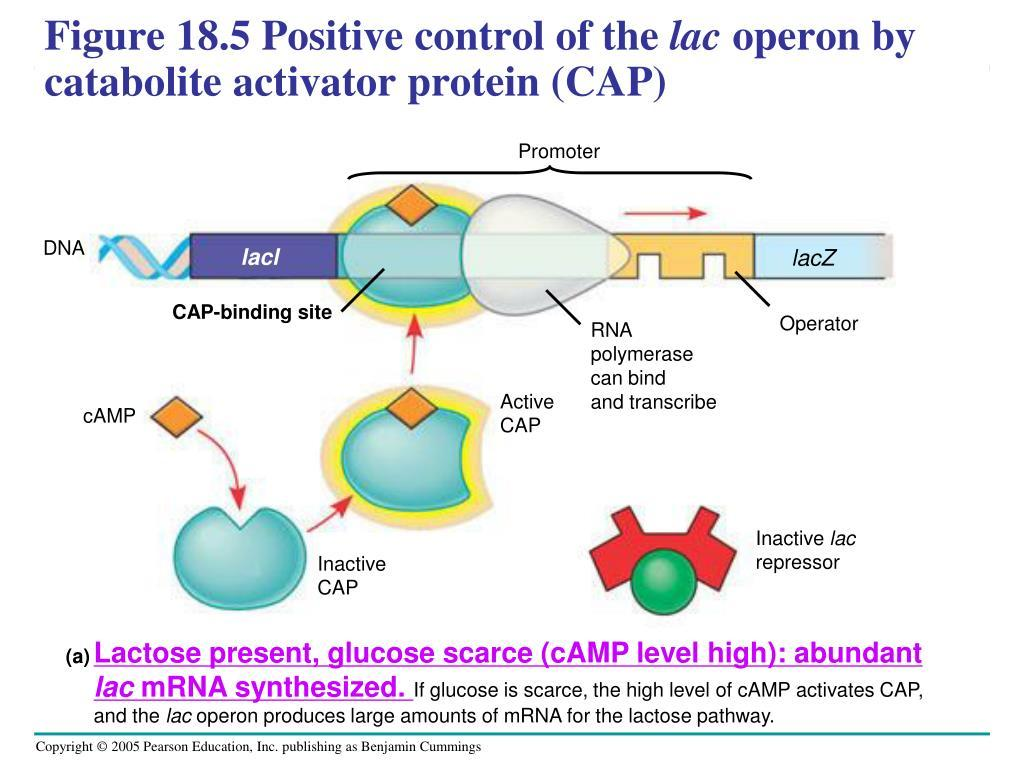
Solution? Catabolite activator protein (CAP)
CAP increases affinity of promoter for RNA polymerase
CAP is inactive alone→ active when bound to cyclic acid (CAMP)
CAMP- indicates if we are out of glucose or not
cAMP levels are inversely related to glucose availability.
In general, cAMP should be low
Glucose availability | cAMP levels |
|---|---|
High glucose | Low cAMP |
Low glucose | High cAMP |

How CAP cAMP works
Low glucose-cAMP increases
cAMP binds to CAP
CAP-cAMP binds CAP binding site in lac promoter (next to rna poly bonding site)
Bends double helix and increases RNA polymerase binding
summary
1. Negative control = repressor
Negative control means a protein (the repressor) blocks transcription.
Absence of lactose: Repressor is active and binds the operator → transcription is blocked → operon OFF.
Presence of lactose: Allolactose binds the repressor, making it inactive → transcription can occur.
So: Negative control represses gene expression when lactose is absent.
2. Positive control = CAP-cAMP
Positive control means a protein helps increase transcription.
Presence of glucose: cAMP is low → CAP is inactive → little activation of transcription.
Absence of glucose: cAMP is high → binds CAP → CAP-cAMP helps RNA polymerase bind → increased transcription.
So: Positive control upregulates gene expression when glucose is absent.
Lactose | Glucose | lac operon expression |
|---|---|---|
Absent | Present | OFF |
Absent | Absent | OFF |
Present | Present | LOW |
Present | Absent | HIGH |
eukaryotic gene regulation
Every level is regulated (unlike prokaryotes)
Regulation of chromatin structure
If dna is loosely packed, genes can be active → euchromatin
if densely packed, no gene expression→ heterochromatin
Modified via DNA methylaton → condenses→ causes gene expression to decrease
regulation of transcription initiation
Generally more complex than prokaryotes
involves DNA sequences and transcription factors→ proteins that bind dna
promote or inhibit transcription initiation
Post transcriptional regulation
length of poly a tail affects level of translation
alternative splicing: diff polypeptides from same gene via inclusion/exclusion of exons
post transitional regulation
polypeptides processed and modified→ final protein
must be folded correctly
chemical modifications affect level of activity
Sometimes a protein is made, but it isn't functional yet. The cell needs to modify it to activate it or change how it works→ “batteries not included”