Marine Organisms Exam 2
 Call Kai
 Learn
 Practice Test
 Spaced Repetition
 Match
 Flashcards
 Knowt Play
1/94

There's no tags or description
Looks like no tags are added yet.
95 Terms
Porifera = (Lating porus = pore, ferre = to bear)
Sponges
~9,000 described species
Marine and freshwater
Different from many other animals:
No gut
No muscles
No nerves
No organs
No symmetry (but do have apical-basal polarity)
But do possess:
Multicellularity
Embryonic layering
Actin-myosin contractile elements
Collagen
Sessile, suspension feeders.
Up to 2 m in size.
Use flagellated cells (choanocytes) to circulate water through water canals.
Internal skeleoon of carbonate or silicon dioxide spicules.
Many totipotent cells, even in adults\
Choanocyte
collar cell, flagellated, moves water
Porocyte
pinacocyte that forms the ostia, miniature sphincter valves
Spicule
structural element
Amoebocyte
progenitor cells, totipotent, phagocytic
Sponge body wall
• Pinacoderm
– Exopinacoderm: covers outer surface
– Endopinacoderm: lines incurrent and excurrent canals
• Choanoderm: forms atrial lining and lining of chonaocyte chambers
• Mesohyl: connective tissue between pinacoderm and chonaoderm
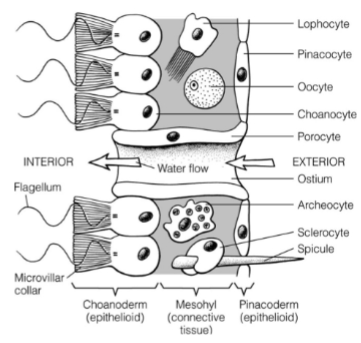
Asconoid sponges
• Water flows in through many ostia (singular = ostium), and out through the osculum
• Water flow created by flagellated choanoderm (“collar skin”)
• < 1 mm in diameter
• Cylindrical bodies

Syconoid sponges
• Overcomes size limitation by increasing surface area and reducing atrial volume
• Essentially like asconoid sponges with body wall folded in on itself
• 1–10 cm

Leuconoid sponges
• Complex network of water vessels in solid, spongy body
• Spherical choanocyte chambers at intersection of incurrent and excurrent canals
• Can have multiple oscula, some have no atrium
• >10 cm

The exception (sponge types)
• Glass sponges
• Body wall = syncytium
– Multi-nucleated cytoplasm, enclosed by external membrane but not divided into cells by internal membranes
• Lack pinacoderm, instead have cobweb-like strands called trabecular syncytium
• Lack choanoderm, instead have choanosyncytium
Sponge Skeleton
• Endoskeleton
• Spicules: siliceous (SiO2- demospongiae) or calcareous (CaCO3- calcarea)
– Many shapes, used for classification
– Secreted by sclerocytes
• Spongin: organic material, compressible, “spongy” (demospongiae)
• Many sponges have both spicules and spongin
Sponge Feeding
• Filter feeders
• Pump body volume once every 5 s
• Water velocity fastest through osculum, slowest in choanocyte chambers
• Food intake occurs through phagocytosis:
– In choanocyte chambers (particles < 5 μm)
– In incurrent canals (5–50 μm)
– At exopinacoderm (> 50 μm)
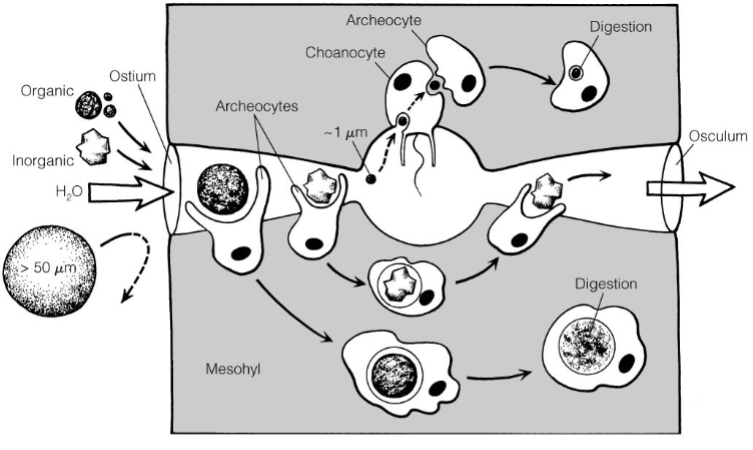
Sponge Internal transport and gas exchange
• Ventillation of all body regions to within 1 mm of all cells
• Simple diffusion of gasses, waste, and food.
Sponge Nervous system
• No nerve cells, no nervous tissue
• Some capable of limited impulse conduction
Clonal reproduction
• Fragmentation
• Budding
• Formation of gemmules and reduction bodies (overwintering propagules, containing archaeocytes, produced by dying sponge)
Sponge Sexual reproduction
• Most sponges are hermaphrodites, but do not self-fertilize.
• Sperm arise from choanocytes, eggs from choanocytes or archaeocytes
• Sperm lack acrosome, not needed because sperm nucleus enters egg by phagocytosis
• In oviparous species, sperm (and sometimes eggs) released into environment. Broadcast spawning.
• In viviparous species, only sperm released. Internal fertilization and retention of zygotes.
• Sperm lack acrosome. Not needed because sperm enter egg through phagocytosis
Embryogensis, larvae
• Broad array of embryonic development processes and larval types.
• Embryogenic pathways and patterns not seen in other animals.
Ctenophora (ctene- = “comb”)
• Comb jellies
• Primarily planktonic, marine
• Voracious predators of zooplankton (crustaceans, jellyfish, fish larvae, fish eggs, etc.)
• Radial symmetry, main body axis: oral-aboral axis
• Few mm to >30 cm
• Largest animal to use cilia for locomotion
• NOT JELLYFISH!
– Swim with mouth forward
– No nematocysts (stinging cells)
– Ciliary locomotion

Ctenophore Sensory Capabilities
• Aboral organ
– Statocyst: gravity, direction
– Photoreceptors
• Aboral organ
– Statocyst: gravity, direction
– Photoreceptors
• Nervous system: nerve net
Ctenophore feeding and digestion
• Predatory
• Capture prey using tentacles and tentilla
• Very rudimentary anal pores
Ctenophore Respiration
• No respiratory organs
• Diffusion
– Epidermis: cell layer on outer surface of body
– Gastrodermis: cell layer on inner surface of body
– Both very thin, few cells thick
– Between the two: watery gel, very few cells.
Ctenophore reproduction and development
• Clonal (asexual) reproduction is uncommon
• Most hermaphrodites, two species gonochoric
• Broadcast spawning, external fertilization
• Cross- or self-fertilization
• Direct development, embryojuvenile
Mnemiopsis leidyi
• Sea walnut
• Common in Atlantic and Gulf of Mexico
• Invasive species in Black Sea, Caspian Sea, North Sea, Baltic Sea.
– Potential for consumption of large numbers of fish larvae and other zooplankton
– Potential negative effects on fisheries.
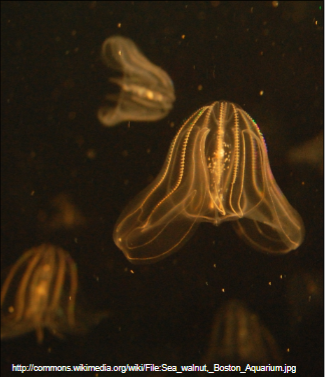
Phylum Cnidaria
Cnidaria (cnida- = “stinging nettle”)
• Corals, anemones, jellyfish, hydroids
• Radial symmetry
• Gut-like cavity (coelenteron) surrounded by body wall, opening of coelenteron ringed by tentacles
Two primary body forms:
Polyp
Medusae
Polyps
• Examples = hydroids, corals, anemones
• Resembles a flower with stalk
• Stalk = column
• Base = pedal disk
• Other end = oral disk and manubrium
Medusae
• Examples = jellyfish
• Resembles an umbrella or bell
• Mouth is at tip of manubrium
• Tentacles around margin of bell and around mouth
• Typically swim by bell pulsation
Cnidaria Body Wall
3 tissue layers
Epidermis
Outer epithelium (skin)
Mesoglea
Gelatinous extracellular matrix
The jelly in a jellyfish
Gastrodermis
Inner epithelium
Lines coelenteron and joins epidermis at mouth
Epidermis and gastrodermis very thin- respiration occurs through diffusion
Colonialism
Individuals within a colony = zooids
Cnidaria Movement
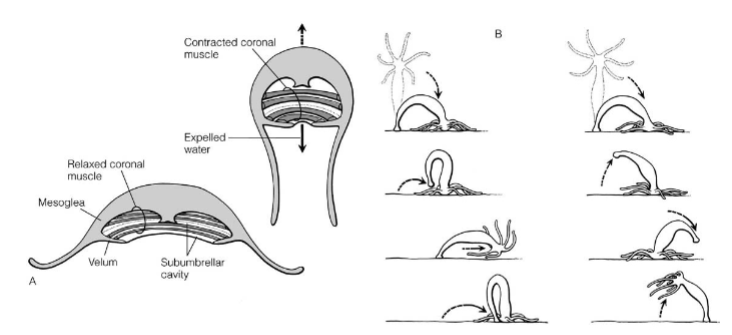
Cnidaria Nervous System
Radial nervous system
Paired nerve nets
One in base of epidermis
One in base of gastrodermis
Linked by nerves that bridge mesoglea
Impulses travel like ripples on a pond (diffuse conduction)
Medusae:
Also have rings of nerves and ganglion (clusters of nerves) around bell
Sensory organs (statocysts, ocelli, etc.)
Nematocysts
• Occur in all groups of cnidarians
• Spines or barbs on surface of everted tubule
• Hinged lid (operculum, Scypohozoans and hydrozoans) or apical flaps (anthozoans) cover opening
• Sensory cilium is mechanoreceptive
Cnidaria Asexual Reproduction

Cnidaria Sexual Reproduction - Corals, anemones

Cnidaria Sexual Reproduction - jellyfish

Classes within Phylum Cnidaria
Subphylum Anthozoa- no medusa stage
Class Anthozoa: anemones, corals, sea fans, sea pens, sea pansies
Subphylum Medusozoa- both polyp and medusa stages
Class Scyphozoa: jellyfish
Class Cubozoa: box jellyfish, sea wasps
Class Hydrozoa: Portuguese man-of-war, fire coral, Hydra
Class Anthozoa
• “Flower animals”
• Exclusively polyps, no medusa stage
• Anemones, sea pens, corals
• Clonal reproduction is common
Class Anthozoa Subclass Hexacorrallia- hexamerous symmetry
Order Actinaria: sea anemones
Large, solitary polyps
Highly inflatable
6 or >8 tapered tenticles
Order Scleractinia: stony corals
Produce calcium carbonate exoskeleton
Polyp can retract into a skeletal cup or corralite for protection
Polyps arise from coenosarc, extension of the coelenteron
Colonies grow, but each polyp has a maximum size
Class Anthozoa Subclass Octocorrallia- octamerous symmetry
Order Alcyonacea: soft corals
Do not produce calcium carbonate exoskeletons
Instead, rely on sclerites, small spiny skeletal elements
Order Holoxonia: sea whips, sea fans (gorgonians)
Highly branching, upright
Order Pennatulacea: Sea pens, sea pansies
Often have bilateral symmetry
Soft sand or mud
Many resemble a feather
Feed entirely on plankton
Classes within Phylum Cnidaria
Subphylum Anthozoa- no medusa stage
Class Anthozoa: anemones, corals, sea fans, sea pens, sea pansies
Subphylum Medusozoa- both polyp and medusa stages
Class Scyphozoa: jellyfish
Class Cubozoa: box jellyfish, sea wasps
Class Hydrozoa: Portuguese man-of-war, fire coral, Hydra
Class Scyphozoa
• “drinking cup animals”
• Medusa stages
• Tetramerous symmetry
Scyphozoan Body Form
• Small, funnel-shaped polyps (scyphystomae)
• Large medusae (scyphomedusae)
Sense organs- rhopalia
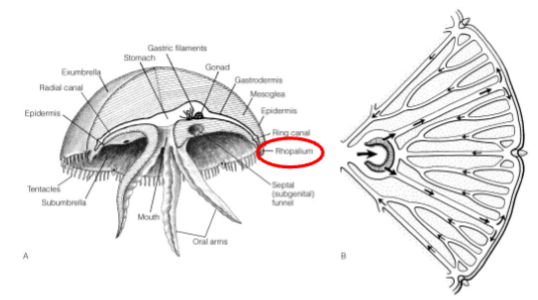
Class Scyphozoa Order Semaeostomae: flag-mouth jellies
Large medusae
Elongate manubrium divided into 4 oral arms, mouth leads into 4 gastric pouches
Moon jellyfish Aurelia aurita, sea nettle Chrysaora spp., lion’s mane jelly Cyanea capillata, etc.
Class Scyphozoa Order Rhizostomeae: root-mouth jellies
– Root-like manubrium develops from branched or fused oral arms, additional manubrial outgrowths to increase surface area
– No marginal tentacles
– Upside-down jellyfish Cassiopeia xamachana, canonball jelly Stomolophus meleagris, etc.
Class Cubozoa
• Box jellies
– Cubic bell
– Highly venomous nematocysts
– Sea wasp Chironex fleckeri- one of world’s most venomous animals (Australia)
– Chiropsalmus quadrumanus- American species
Class Hydrozoa
• “hydra animals”
• Generally have both polyp and medusa stages, but one usually reduced
• Polyps tiny, < 1 mm
• Most (but not all) are colonial
Colonial hydrozoans
Individuals within a colony: zooid
Monomorphic
only a single type of zooid: gastrozooids (feeding)
Release medusae from medusa buds
Polymorphic
Gastrozooids plus at least one other type of zooid: gonozooid (reproductive), dactylozooid (protective or food-catching), etc.
Class Hydrozoa Order Athecata
– Always have a polyp stage
– Highly diverse
– Fire coral Millepora alcicornis
– By-the-wind sailor Velella velella
– Blue button Porpita porpita
– Hydractinia
Class Hydrozoa Order Siphonophora
– Always colonial, always polymorphic
– Colonies are highly specialized and integrated, function as single unit
– Lack sensory organs
– Arise from a single axial polyp
– Gas-filled pneumatophore
– May have nectophores for propulsion
Bilateral symmetry
Only a single plane of bisection (midsagittal plane) produces mirror-image halves
Left and right
Much more diverse than non-bilateral groups (Porifera, Ctenophora, Cnidaria)
99% of all animals
Tremendous size range, < 100 μm to 25 m (inverts) or up to 30 m (verts)
Anterior-posterior: head-tail
Dorsal-ventral: back-belly
Proximal-distal: extends away from midsagittal plane
Cephalization in motile Bilateria
Motile bilaterians actively purse food, mates, and shelter using sense organs
concentrated at anterior end of body
Anterior concentration of sense organs = cephalization
Generally associated with central nervous system
Phylum Platyhelminthes
Platy” = flat, “helminth” = worm (Greek)
3 classes:
Class Turbellaria: free-living flatworms
Class Trematoda: parasitic flukes
Class Cestoda: tapeworms
Lack a circulatory system, so generally small (rely on simple diffusion for circulation)
Simple anatomy, but >20,000 species
Considered to be one of the most primitive Bilaterians
Free-living flatworms
• Marine and freshwater
• Body covered by ciliated epidermis
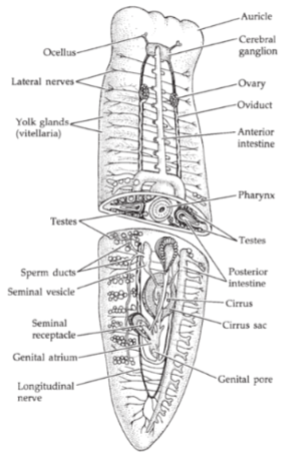
Flatworm movement
Complex musculature
Grid-like arrangement of outer and inner longitudinal fibers
Two layers of diagonal muscles
Surface gliding using cilia, muscular creeping, muscular swimming
Twisting, extension, retraction, somersaulting
Benthic flatworms may secrete mucus to aid movement.
Flatworm nervous system
Sub-epidermal, ringlike brain/cerebral ganglion
Multiple nerve cords
Nerve net located internally to musculature
Still mostly a radial nervous system, but somewhat centralized
Flatworm Sense Organs
Pigment-cup ocelli (simple eyes for orienting to light)
Statocysts
Ciliary receptors (mechanoreceptors or chemoreceptors)
Sensory pits (chemoreceptors)
Feeding and digestion
• Typically predators or scavengers, small species eat bacteria or fungi in biofilms. Some herbivorous at young ages.
• Digestive system mostly a blind sac, mouth used for both ingestion and egestion.
• Anus usually not present.
Flatworm Regeneration
Extraordinary regenerative ability
Able to regenerate body from small piece
Flatworm Clonal reproduction
Transverse fission and budding
3 types:
Paratomy: parent’s body differentiated into chain of zooids, similar to strobilation
Architomy: differentiation occurs after fission
Budding: bud offspring from lobe of posterior end, primarily in small and simple platyhelminths
Flatworm Sexual reproduction
• Hermaphrodites
• Reproduce through copulation and internal fertilization. Mutual cross-fertilization.
Flatworm Development
• Usually direct.
• Some polyclads undergo indirect development. Muller’s larvae.
Trematodes (flukes)
Superorder Digenea:
Parasitic flukes
2 or more hosts, at least 2 infective stages
1st intermediate host is typically snail
2nd intermediate host typically arthropod or fish
Definitive host: vertebrate
Superorder Aspidogastrea
Parasitic flatworms, but with large adhesive organ
Primarily endoparasites in fish and turtle guts
Phylum Nemertea
• Ribbon worms
• Rounder, more elongate than flatworms
• No segmentation
• Typically ambush predators. Harpoon or lasso prey with proboscis
• Most < 20 cm, but longest nemertean: Bootlace worm Lineus longissimus (25 m)
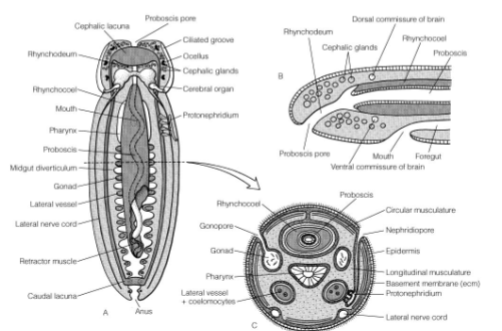
Anatomy of a nemertean
• Body wall= ciliated epidermis, connective tissue, musculature
• Cephalic glands secret slime, used to facilitate locomotion
Proboscis
• Extensible muscular tube, lies in rhynchocoel (coelom)
• Used to capture prey, sometimes to burrow
• Everts to extend
• May contain a barb (stylet)- armed nemerteans
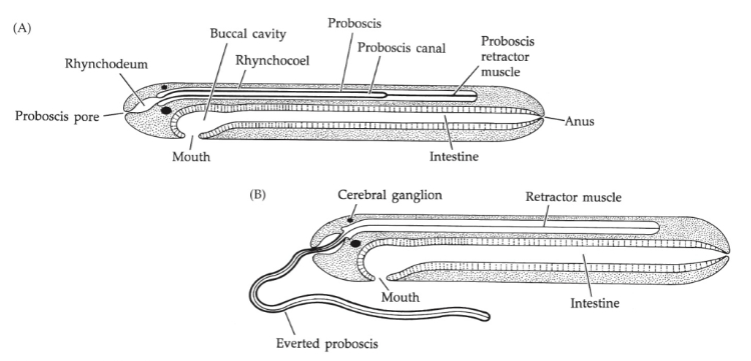
Armed v. unarmed Nemerteans
• Unarmed nemerteans: no stylet
• Armed nemerteans: stylet

Nemertea Digestive system
Predatory
Digestive system = mouth, foregut, stomach, intestine, anus
In armed nemerteans, mouth and proboscis share same hole. In unarmed nemerteans, digestive system is completely separate
Gas exchange, internal transport
No gills, has exchange occurs across body surface by diffusion
Circulatory system consists of rhyncocoel and peripheral vessels
One peripheral vessel on either side of the gut, joined at each end of animal
May also have additional longitudinal and transverse vessels
Fluid flow depends on contraction of vessels and body wall musculature
No hemoglobin to transport large quantities of oxygen, so restricted to short bursts of movement
Nemertea Nervous system and sense organs
Brain + pair of longitudinal nerve cords
Brain = ring of ganglia around anterior rhyncocoel
Nervous system may be pink because of noncirculating hemoglobin (neuroglobin), which stores oxygen and enables functioning under anoxic conditions (e.g., burrowing in sediment)
Sense organs:
Chemoreceptors: cephalic slits and grooves, cerebral organs, frontal organs
Pigment cup ocelli
Statocysts in only a few small interstitial species
Nemertea Clonal reproduction
Many species able to reproduce by fragmentation
Nemertea Sexual reproduction
• Gametes develop from stem cells, aggregate into gonads which lie between intestinal diverticula (pouches branching off from the intestine)
• When gametes are mature, gonoduct grows between gonad and outside, gametes escape.
• Does not require contact between worms, but may include contact
• External fertilization in most nemerteans
Direct Nemertea Development
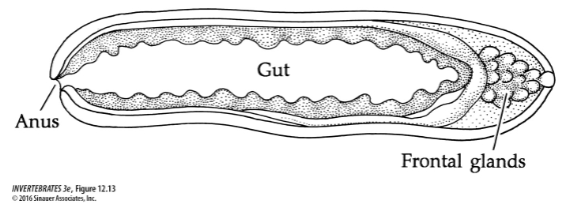
Indirect Nemertea Development

Phylum Annelida
“Annelida” = ringed
3 classes:
Class Polychaeta: bristleworms, highly diverse marine worms
Class Oligochaeta: earthworms, small freshwater and marine worms
Class Hirudinomorpha: leeches
Segmented
Prostomium- brain, sense organs
Trunk- contains segments
Pygidium- contains anus
Segmentation
Teloblastic growth: grow by adding segments in teloblastic growth zone.
Segmented internal structures present in each segment
Appendages
Coelomic cavities
Nephridia (kidney-like organs)
Gonads
Some structures span segments
Nervous system
Hemal system
Musculature
Digestive system
Chaetae
• Chaetae (KEE-tee): chitinous bristles, project outward from epidermis. Used primarily for traction.
• Tough and flexible, but may be hardened with sclerotized protein and calcium carbonate
Annelid Nervous System
Anterior, dorsal brain in prostomium
Ventral longitudinal nerve cords
Paired ganglia in each segment, linked by a transverse nerve
Ladder-like nervous system
Longitudinal nerve cords contain giant axons, allow rapid conduction and quick response times.
Functions only in escape response, not in normal locomotion.
Sense organs mostly unicellular receptors, concentrated anteriorly. Also have ocelli, eyes, statocycts, and chemosensory nuchal organs.
Class Polychaeta
• Bristleworms
• Marine annelids
• 8000 species
• Gonochoric- separate sexes
LEGS
• Parapodia = polychaete legs
• Fleshy outgrowths of body wall, complexity depends on species
• 1 pair per segment
• Tentacle-like cirri project from base of parapodia. Sensory function.
Tube-dwelling polychaetes
Many species secrete and occupy a tube, may be open at 1 or both ends, may be permanent or temporary
Tube material is fibrous protein, often incorporates foreign material
Mud, sand, shells, plant debris, algae
May be calcified
Protective, but also function for filter feeding, prey capture, attachment method
Annelid Locomotion
Diverse locomotory adaptations
Peristaltic burrowing (reduced parapodia)
Active burrowing using eversible pharynx which everts, anchors in sediment, and pulls body forward
“Shimmy worms” swim through loosely consolidate dsand
Crawling or swimming using parapodia
Slow crawling: parapodia move like legs
Fast crawling: also involved body undulations
Annelid Feeding modes
Direct deposit feeders: ingest sediment
Indirect deposit feeders: collect material first with specialized appendages
Carnivores
Herbivores
Scavengers
Suspension Feeders
Annelid Reproduction
Sexual or asexual
Sexual
External fertilization
Spiral cleavage
Trochophore larvae
Asexual
All forms
Lophophorata
3 phyla:
Phoronida
Bryozoa
Brachiopoda
Lophophore: unique feeding structure
All benthic, all suspension feeders (with lophophore)
U-shaped gut
Adapted for living in tubes, compartments, or shells
Phylum Bryozoa: The moss animals
Sessile, colonial
Most colonied bud from single, sexually produced individual (ancestrula)
Marine and freshwater
Often confused with plants
Bryozoan body plan
Two primary parts:
Cystid: outer body wall, skeletal housing of each zooid
Can be gelatinous, chitinous, or calcified.
Polypide: includes tentacle crown (lophophore) and internal organs. Can be extended and retracted from the cystid.
Colonies can be polymophic
Autozooids: feeding zooids
Heterozooids: non-feeding zooids
Kenozooids: modified for attachment to substrate
Avicularia: defense and debris removal
Vibraculum: sediment removal?
Coelom
Fluid-filled space, primarily used for hydraulic extension of the lophophore.
Bryozoan Feeding and Digestion
Suspension feeders
Lophophore (tentacle crown) is horseshoe shaped or circular
Tentacles are ciliated
Cilia create a current that passes food through the tentacular crown.
Bryozoan Nervous System
• Reduced nervous system
• Cerebral ganglion, circumoral nerve ring, nerves extending to viscera and tentacles.
• Only receptors are tactile cells on the tentacles
Bryozoan Reproduction and development
Hermaphoditic colonies
Some have hermaphroditic zooids.
Internal fertilization
Brooding of embryos
Short larval period before metamorphosis
Also reproduce asexually, for colony growth
Budding
Asexual production of statoblasts, resistant to drying and freezing.
Phylum Brachiopoda: Lamp Shells
Shape of exoskeleton resembles oil lamp
Solitary, marine, benthic
2-4 cm
Body is envlosed between two dorsoventral valves
Unequal valves, sit with ventral side up
Can attach to substrate using fleshy pedicle
Branchiopod Feeding and Digestion
Suspension feeders
Lophophore: pair of tentacle-baring arms extending into mantle cavity
Simple circular or u-shaped, or coiled arms
Lophophore always contained within valves, essentially immovable
Valves open slightly, cilia generate current over lophophore.
Some have complete gut, some lack anus.
Branchiopod Circulation and Gas Exchange
Open circulatory system
Heart pumps blood through channels in connective tissue
Blood separate from coelomic fluid
Primarily for nutrient distribution
Gas exchange occurs across body surface, especially lophophore.
No respiratory organs
Nervous system
Reduced
Dorsal ganglion, ventral ganglion, circumenteric nerve ring, nerves extending to muscles and lophophore
Tactile receptors, maybe chemoreceptors, maybe statocysts
Reproduction
NO asexual reproduction. Only sexual.
Most species gonochoric, gametes develop from transient gonadal tissue (coelomic epithelium)
Primarily broadcast spawning, external fertilization.
Some do have internal fertilization in a brood area and brooding of embryos.
Free-swimming larvae, similar to trochophore.