55040 Electronic Circuit Assembly & Repair
 Call Kai
 Learn
 Practice Test
 Spaced Repetition
 Match
 Flashcards
 Knowt Play
1/23

There's no tags or description
Looks like no tags are added yet.
24 Terms
What is electrostatic discharge (ESD)?
A transfer of electrons between objects caused by a difference in electrical potential.
How much voltage can static electricity build up on your body?
Typically 5,000 to 35,000 volts.
What causes static electricity?
Electrons transfer between materials through friction, called the triboelectric effect.
Which electronic components are most susceptible to ESD?
MOSFET transistors, integrated circuit chips, thin-film capacitors, and metal-film resistors.
What is the difference between hard and soft grounding
Hard grounding directly connects to ground; soft grounding uses impedance to limit current to a safe level.
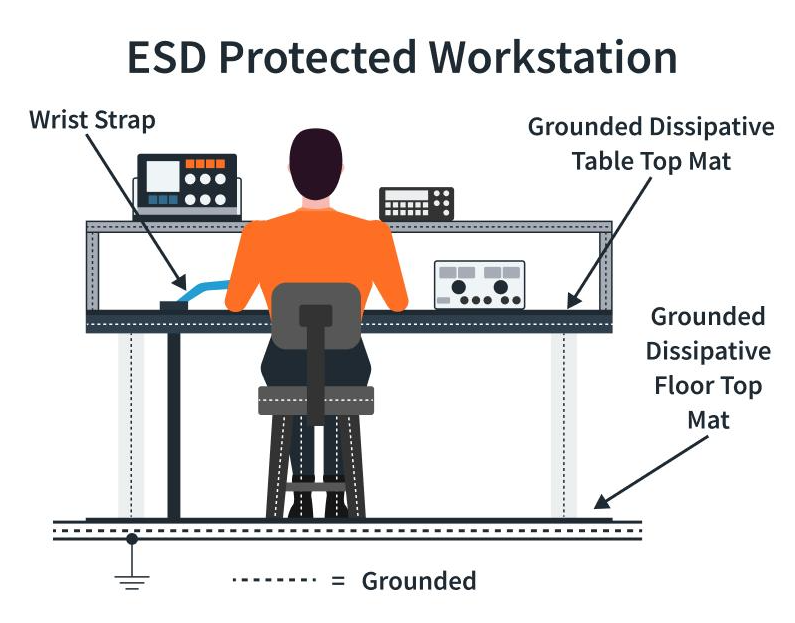
What is the purpose of an ESD wrist strap?
Grounds the worker to help prevent static discharge from damaging sensitive components.
What environmental condition helps reduce static buildup?
Higher humidity helps control static electricity.

What is breadboarding used for?
Prototyping and testing circuits before building a permanent assembly.
What is point-to-point wiring?
Connecting components and wires directly to device terminals and leads.

What is a perfboard?.
A perforated board with holes for mounting components and adding connecting wires

What are PCB traces and pads?
Traces are conductive paths connecting components; pads are copper areas around connection holes.
What is conformal coating on a PCB?
A protective layer that shields traces from corrosion, dirt, and chemicals.
What are the four component mounting methods?.
Stud, clinched, swagged, and surface mounted
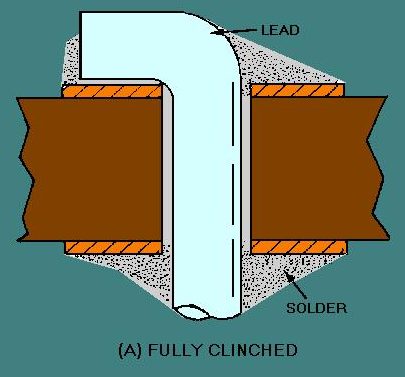
What is clinched mounting?
Bending component leads outward or inward to grip the PCB and hold components in place.
What is stress relief in component mounting?
A mounting method that prevents concentrated force from damaging leads or solder joints.
What are surface-mounted devices (SMDs)?
Small components soldered directly onto PCB pads without traditional through-hole leads.
What is the maximum typical SMD lead alignment offset?
Less than 25% of the pad width.
What are the four main terminal types?
Eyelet, turret, cup, and bifurcated terminals.
What are the color codes for crimp connector wire sizes?
Red: 22–16 AWG;
Blue: 16–14 AWG;
Yellow: 12–10 AWG.
When crimping a connector, which side should the seam face?
The indented side of the crimper, not the bump side.
What is an eyelet terminal?
A terminal with a small hole or loop for attaching a wire.
What is a turret terminal
A post-shaped terminal around which a wire is wrapped before soldering.
What is a cup terminal
A hollow, cup-shaped terminal where the wire is inserted and soldered.
What is a bifurcated terminal?
A split post with two prongs that hold a wire in place for soldering.