Biology topic 1 - biological molecules
 Call Kai
 Learn
 Practice Test
 Spaced Repetition
 Match
 Flashcards
 Knowt Play
1/83

There's no tags or description
Looks like no tags are added yet.
84 Terms
What is the definition of a monomer?
Monomers are the smaller units from which larger molecules are made.
What is the definition of a polymer?
Polymers are the molecules made from a large number of monomers joined together.
Give examples of monomers and polymers.
Monomers: Polymers:
Monosaccharides Starch, cellulose, glycogen.
Amino acids Protein
Nucleotide DNA and RNA
What happens during a condensation reaction?
Joins two molecules together.
With the formation of a chemical bond.
Involves the elimination of a molecule of water.
What happens during a hydrolysis reaction?
A chemical bond is broken.
Between two molecules.
Involves the use of a water molecule.
What elements do all carbohydrates contain?
Carbon, hydrogen and oxygen.
Name some monosaccharides, disaccharides and polysaccharides.
Monosaccharides: Disaccharides: Polysaccharides:
Glucose Maltose Starch
Fructose Sucrose Cellulose
Galactose Lactose Glycogen
What is the definition of a monosaccharide?
The monomers from which larger carbohydrates are made.
What bond is formed during a condensation reaction between two monosaccharides?
A glycosidic bond.
What is the definition of an isomer?
Two molecules which have the same molecular formula but different structure.
What are the structures of alpha and beta glucose molecules?

How is a disaccharide formed?
A disaccharide is formed by the condensation of two monosaccharides. A glycosidic bond is formed between the monosaccharides to make the disaccharide.
Name some monosaccharides and the disaccharides that are formed after the condensation reaction?
Glucose + glucose = maltose + water
Glucose + galactose = lactose + water
Glucose + fructose = sucrose + water
During a condensation reaction between two monosaccharides, where is the water eliminated from? And what is this bond called?
Either a H on carbon 1 or carbon 4, and an OH on either carbon 1 or carbon 4, from the two hydroxyl groups on each carbon, meaning that an oxygen atom remains.
The bond is a 1-4 glycosidic bond.
How are polysaccharides formed? And give examples of polysaccharides.
Via the condensation reactions between many glucose monomers.
Starch, cellulose, glycogen.
Where are these polysaccharides found and what is the overall function of them?
Starch - found in plants and is a store of glucose.
Cellulose - found in plants and for structural strength.
Glycogen - found in animals, store of glucose.
State the monomers, the bond between the monomers, function, location, and structure of starch.
Monomers - alpha glucose
Bond between monomers - 1-4 glycosidic bonds in amylose, 1-6 glycosidic in amylopectin.
Function - store of glucose.
Location - plant cells
Structure:
Amylose - an unbranched helix
Amylopectin - a branched molecule
Explain how the structure of starch leads to its function,
The helix shape is compact to fit a lot of glucose in a small space.
The branched structure of amylopectin increases surface area for rapid hydrolysis of starch back to glucose (enzymes work on ends) for respiration.
Insoluble - doesn’t affect water potential.
State the monomers, bond between the monomers, function, location and structure of cellulose.
Monomers - beta glucose
Bond between monomers - 1-4 glycosidic bonds.
Functions - structure strength for cell wall.
Location - plants - cell wall.
Structure - long straight chains, hydrogen bonds between adjacent cellulose chains to form microfibrils which strengthen plant cell walls.
Explain how the structure of cellulose leads to its function.
The many hydrogen bonds form between adjacent chains, providing collective strength and forming microfibrils, this gives the cell wall high tensile strength which prevents the cell from bursting when water enters by osmosis, so it won’t affect the cells water potential.
State the monomers, the bond between monomers, function, location and the structure of glycogen.
Monomers - alpha glucose.
Bond between monomers - 1-4 and 1-6 glycosidic bonds.
Functions- store of glucose
Location - animal cells.
Structure - a highly branched molecule.
Explain how the structure of glycogen leads to its function.
It is a branched structure which increases its surface area for rapid hydrolysis back to glucose for respiration.
Insoluble - won’t affect water potential.
Compact molecule - a large amount can be stored in a small space.
How do we test for starch?
1) add iodine solution
2) a positive test observation = solution turns from orange to blue/black.
What is the test for reducing sugars?
1) add Benedict’s reagent AND heat.
2) a positive test observation = solution turns from blue to green, yellow orange or brick red (the more red, the higher the concentration of reducing sugar).
What is the test for non-reducing sugars?
1) following a negative Benedict’s test where the reagent remains blue.
2) add HCl and boil (this is acid hydrolysis).
3) cool the solution then add an alkali to neutralise.
4) add Benedict’s reagent and heat.
5) a positive test observation = solution turns from blue to orange or brick red.
Name two types of lipids.
Triglycerides and phospholipids.
How are triglycerides formed?
They are formed by the condensation of one molecule of glycerol and three fatty acid molecules.
How is a phospholipid formed?
Formed by the condensation of one glycerol molecule, two fatty acid molecules, one of the fatty acid molecules of a triglyceride is swapped for a phosphate group.
What bond forms during the condensation reaction between glycerol and fatty acid?
An ester bond.
Where is the water removed from during the condensation reaction between glycerol and fatty acid molecules?

What is the R group in terms of lipids?
The fatty acid chain.
What is the difference between saturated and unsaturated fatty acids?
Saturated = the hydrocarbon chain has only single bonds between the carbons, the maximum amount of hydrogen atoms are bonded.
Unsaturated = the hydrocarbon chain consists of at least one double bond between carbons.
Explain the properties of triglycerides.
Due to the high ratio of hydrogen to oxygen atoms they act as a metabolic water source. Triglycerides can release water if they are oxidised, this is essential for animals in the desert.
Triglycerides do not affect water potential and osmosis, this is because they are large and hydrophobic, making them insoluble in water.
Energy storage - due to the large ratio of energy - storage carbon - hydrogen bonds compared to the number of carbon atoms, a lot of energy is stored in the molecule.
Lipids have a relatively low mass, therefore a lot can be stored without increasing the mass and preventing movement.
What are the properties of phospholipids?
The hydrophilic head (glycerol and phosphate) of a phospholipid can interact with water as it is charged.
Due to the phosphate being charged (polar), it repels other fats.
The fatty acid chain is non-polar (hydrophobic) and it repels water, but will interact with fats.
In an aqueous environment environment, phospholipids arrange themselves into a bilayer where:
The hydrophilic heads face outward, towards the water.
The hydrophobic tails face inward, away from the water, forming a protective layer.
This structure forms the phospholipid bilayer, which is the basic structure of the plasma membrane surrounding all cells.
What is the test for lipids?
1) mix/shake the sample in ethanol.
2) then, add distilled water.
3) a positive test observation = a white emulsion forms.
What are the monomers from which proteins are made?
Amino acids.
What determines the function of proteins?
Their 3D shape.
What is the general structure of an amino acid?

How can amino acids differ?
They can differ in their side group ‘R’ group, which could vary between 20 different amino acids.
What bond is formed via a condensation reaction between two amino acids? And what molecule is formed via this reaction?
A peptide bond.
A dipeptide.
Where is the H2O eliminated from during the condensation reaction?
A hydroxyl group (OH) of the carboxylic group of one amino acid, and a hydrogen of the amine group of another amino acid.
What are the four levels of structure of a protein molecule?
Primary
Secondary
Tertiary
Quaternary
Explain the primary structure of proteins.
the order / sequence of the amino acids in a polypeptide chain.
Held via peptide bonds.
Explain the secondary structure of proteins.
1) the sequence of amino acids causes parts of a protein molecule to bend into alpha helix shapes or fold into beta pleated sheets.
2) hydrogen bonds hold the secondary structure.
3) the hydrogen bonds form between the C=O groups of the carboxyl group in one amino acid and a H in the amine group of another.
Explain the tertiary structure of proteins.
1) the further folding of the secondary structure.
2) to form a unique 3D shape.
3) held in place by ionic, hydrogen and disulphide bonds.
the ionic and disulphide bonds form between the R groups of different amino acids.
How can disulphide bonds form?
Disulphide bonds only sometimes occur, as there must be a sulphur atom in the R groups for this bond to occur.
Explain the quaternary structure of proteins.
A protein made up of more than one polypeptide chain, to form a functional protein.
The subunits are held together by hydrogen bonds, ionic bonds, disulphide bridges and hydrophobic interactions.
What is the importance of the primary structure of proteins?
if even one amino acid in the sequence is different it will cause the ionic/hydrogen/disulphide bonds to form in a different location.
This results in a different 3D shape.
Impact:
Enzymes will have a different shape active site (will be non-functioning)
Carrier proteins will have a different shaped binding site (molecules will no longer be complementary and cannot be transported across the membrane).
What could cause a change to the amino acid sequence?
A mutation.
What is the test for proteins?
1) add biuret solution
2) a positive test observation = solution turns from blue to purple.
What is the function of enzymes?
Enzymes are tertiary structure proteins which catalyse reactions by providing an alternative pathway for the reaction with a lower activation energy.
Why is it important that the active site is specific and unique in shape?
So that they can only attach to substrates that are complementary in shape.
What are the two models of enzyme action?
1) the lock and key theory.
2) the induced fit model.
What is the energy called that all reactions require before they occur?
The activation energy.
Explain the lock and key theory.
It suggests that the enzyme is like a lock and the substrate is like a key that fits into it perfectly due to their complementary shape.
The enzymes active site is a fixed shape and that due to random collisions the substrate can collide and attach to the enzyme.
This forms an enzyme - substrate complex.
Once the enzyme-substrate complex has formed, the charged groups within the active site are thought to distort the substrate and therefore lower the activation energy.
The products are then released and the enzyme active site is empty and ready to be reused.
Explain the induced fit model of enzyme action.
This model suggests that the enzyme is like a glove and the substrate is like a hand, the active site is not exactly complementary in shape to the substrate, but when the substrate enters in enables the enzyme to mould around the substrate to become completely complementary.
The enzymes active site is induced or slightly changes shape to mould around the substrate (the enzymes 3D tertiary structure is altered). When the enzyme-substrate complex occurs due to the enzyme moulding around the substrate it puts strain on the bonds and therefore lowers the activation energy. The products are then removed and the enzyme active site returns to its original shape.
How does temperature affect enzyme action?
Temperature affects the rate of enzyme-controlled reactions by changing the kinetic energy of enzyme and substrate molecules. At low temperatures, molecules have less kinetic energy, so there are fewer successful collisions between enzyme and substrate. As a result, fewer enzyme–substrate complexes form and the reaction rate is low.
As temperature increases, enzyme and substrate molecules gain kinetic energy and move faster. This increases the frequency of successful collisions, so more enzyme–substrate complexes are formed and the reaction rate increases until the optimum temperature is reached.
Above the optimum temperature, heat causes bonds, such as hydrogen and ionic bonds, that maintain the enzyme’s 3D tertiary structure to break. This changes the enzyme’s 3D tertiary structure, altering the shape of the active site.
The substrate is no longer complementary to the active site, so fewer or no enzyme–substrate complexes can form. The enzyme becomes denatured, and the reaction rate rapidly decreases, eventually reaching zero if all enzymes are denatured.
How does pH affect enzyme action?
pH affects the rate of enzyme-controlled reactions by changing the concentration of hydrogen ions (H⁺). Each enzyme has an optimum pH at which it works at its maximum rate.
At the optimum pH, the active site has a shape that is complementary to the substrate, so enzyme–substrate complexes form readily and the reaction rate is at its highest.
If the pH moves above or below the optimum, hydrogen ions interfere with the ionic and hydrogen bonds that maintain the enzyme’s 3D tertiary structure.
This changes the enzyme’s 3D tertiary structure, altering the shape of the active site.
The substrate is no longer complementary to the active site, so fewer enzyme–substrate complexes form and the rate of reaction decreases.
At extreme pH values, enough bonds are disrupted that the enzyme becomes denatured. The active site is permanently altered, the substrate can no longer bind, and the reaction stops.
How does substrate concentration affect the rate of reaction?
At low substrate concentration, there are relatively few substrate molecules, so there are fewer successful collisions between enzyme and substrate. As a result, fewer enzyme–substrate complexes form and the rate of reaction is low.
As substrate concentration increases, there are more substrate molecules available to collide with enzyme active sites. This increases the frequency of successful collisions, so more enzyme–substrate complexes are formed and the rate of reaction increases.
Eventually, the rate reaches a maximum. At this point, all of the enzyme active sites are occupied because the enzymes are saturated with substrate.
The enzyme concentration becomes the limiting factor. Increasing substrate concentration further does not increase the rate of reaction because no more enzyme–substrate complexes can form until products are released and active sites become available again.
Explain how enzyme concentration can affect the rate of reaction.
At low enzyme concentration, there are relatively few enzyme molecules, so there are fewer active sites available. As a result, fewer enzyme–substrate complexes form and the rate of reaction is low.
As enzyme concentration increases, there are more enzyme molecules and therefore more active sites available. This increases the frequency of successful collisions between enzyme and substrate, so more enzyme–substrate complexes are formed and the rate of reaction increases.
Eventually, the rate reaches a maximum. At this point, substrate concentration becomes the limiting factor because there are not enough substrate molecules to occupy all of the available active sites.
Increasing enzyme concentration further does not increase the rate of reaction because there is insufficient substrate to form additional enzyme–substrate complexes.
How does a competitive inhibitor affect enzyme action and rate of reaction?
A competitive inhibitor has a similar shape to the substrate and binds to the enzyme’s active site.
The inhibitor competes with the substrate for the active site, preventing the substrate from binding.
This reduces the number of enzyme–substrate complexes that are formed, so the rate of reaction decreases.
The inhibitor does not permanently bind to the enzyme and can leave the active site.
If the substrate concentration is increased, substrate molecules are more likely to collide with and bind to the active site than inhibitor molecules.
This means the effect of the competitive inhibitor can be reduced or overcome by increasing substrate concentration, so the rate of reaction increases.
How does a non competitive inhibitor affect enzyme action and the rate of reaction?
A non-competitive inhibitor binds to a site on the enzyme that is not the active site. This causes a change in the enzyme’s 3D tertiary structure, which alters the shape of the active site.
The substrate is no longer complementary to the active site, so fewer enzyme–substrate complexes can form. This reduces the rate of reaction.
The inhibitor does not compete with the substrate for the active site, so increasing substrate concentration does not overcome the effect of the inhibitor.
The enzyme may become unable to catalyse the reaction because the active site has been changed. As a result, the maximum rate of reaction is reduced.
What are the main functions of DNA and RNA?
DNA (deoxyribonucleic acid)
Main functions:
Stores genetic information in the form of a sequence of bases (A, T, C and G).
Contains genes, which are sections of DNA that code for the production of proteins.
Acts as a template for mRNA production during transcription.
Allows genetic information to be passed on to daughter cells during cell division through DNA replication.
Controls cell activities by determining which proteins are made.
RNA (ribonucleic acid)
Main functions:
mRNA (messenger RNA) carries the genetic information copied from DNA to the ribosome for protein synthesis.
tRNA (transfer RNA) carries specific amino acids to the ribosome and has an anticodon that pairs with an mRNA codon.
rRNA (ribosomal RNA) forms part of the ribosome, where proteins are assembled.
Helps convert the genetic information stored in DNA into a sequence of amino acids to make proteins.
What is the monomer of the polymers DNA and RNA?
Nucleotides
What do ribosomes consist of?
rRNA and proteins.
What do DNA nucleotides consist of?
a pentose sugar (deoxyribose)
a nitrogen-containing organic base (adenine, thymine, cytosine and guanine)
a phosphate group

What does an RNA nucleotide consist of?
a pentose sugar (ribose)
a nitrogen-containing organic base (adenine, guanine, cytosine and uracil)
a phosphate group
What is the polymer of nucleotides called?
A polynucleotide.
How is a polynucleotide formed?
It is created via condensation reactions between the deoxyribose sugar and the phosphate group of different nucleotides, creating the phosphodiester bond.
Phosphodiester bonds are strong covalent bonds, and therefore help to ensure that the genetic code is not broken down.
What are the structural differences between DNA and RNA?
DNA is a double-stranded molecule made of two polynucleotide chains twisted into a double helix. It contains the sugar deoxyribose and the bases adenine, thymine, cytosine and guanine. Complementary base pairing occurs between adenine and thymine and between cytosine and guanine.
RNA is usually a single-stranded molecule made of one polynucleotide chain. It contains ribose sugar and the bases adenine, uracil, cytosine and guanine. RNA is shorter and less stable than DNA because it is single-stranded and contains ribose instead of deoxyribose.
Why is complementary base pairing important?
DNA replication: The two DNA strands separate, and each original strand acts as a template. Complementary base pairing means the correct nucleotides are added (A pairs with T, and C pairs with G), producing two identical DNA molecules.
Transcription: Complementary base pairing allows an mRNA strand to be made from a DNA template strand (A pairs with U, C pairs with G).
Protein synthesis: Complementary base pairing between mRNA codons and tRNA anticodons ensures the correct amino acids are brought to the ribosome in the correct order to make a protein.
It helps maintain the accuracy of genetic information passed between cells and generations.
How does the structure of DNA relate to its function?
DNA structure | How this relates to its function |
Double-stranded molecule forming a double helix | The two strands provide a template for DNA replication, allowing an identical copy of DNA to be produced. |
Complementary base pairing (A–T and C–G) | Allows DNA to be copied accurately because each strand acts as a template. It also allows accurate transcription of mRNA. |
Hydrogen bonds between bases | Hydrogen bonds are weak, allowing the two DNA strands to separate during replication and transcription. |
Strong covalent bonds in the sugar-phosphate backbone | Makes DNA stable and protects the genetic information stored in the base sequence. |
Sequence of bases (A, T, C and G) | The order of bases forms the genetic code, which determines the sequence of amino acids in proteins. |
Long molecule containing many genes | Allows DNA to store large amounts of genetic information and code for many different proteins. |
Coiled double helix structure | Makes DNA compact, allowing it to fit inside the nucleus. |
Why must DNA replication occur?
Before cells divide (by mitosis or meiosis) all the DNA must replicate to provide a copy for the new cell.
What is the name of the process of DNA replication?
Semi-conservative replication (In the daughter DNA, one strand is from the parental DNA and one strand is newly synthesised).
What enzymes are involved in the semi-conservative replication of DNA?
1) DNA helicase
2) DNA polymerase
Explain the process of the semi-conservative replication of DNA.
DNA replication occurs before cell division so that each daughter cell receives a complete and identical copy of the genetic information.
The DNA double helix unwinds and the enzyme DNA helicase breaks the hydrogen bonds between complementary base pairs, causing the two DNA strands to separate.
Each original strand acts as a template for the formation of a new strand. Free DNA nucleotides align with the exposed bases by complementary base pairing (adenine pairs with thymine and cytosine pairs with guanine).
The enzyme DNA polymerase joins adjacent nucleotides together by forming phosphodiester bonds between the sugar and phosphate groups, creating new DNA strands.
Two identical DNA molecules are produced. Each DNA molecule contains one original parental strand and one newly synthesised strand, which is why DNA replication is described as semi-conservative.
Who conducted an experiment which proved DNA replication must be semi-conservative?
Meselson and stahl
ATP is a nucleotide derivative, what does it consist of?
a pentose sugar (ribose)
Adenine
3 phosphate groups
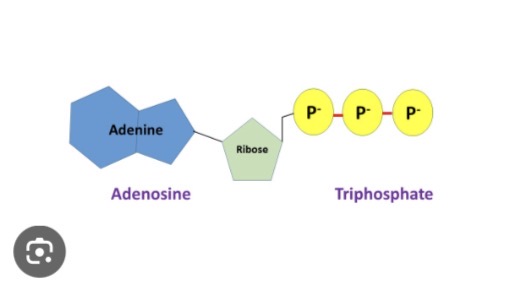
What is ATP?
ATP (adenosine triphosphate) is a small, soluble molecule that acts as an immediate source of energy for cells.
ATP provides energy for many cellular processes, including:
Active transport: energy is used to move substances against their concentration gradient across membranes.
Muscle contraction: ATP provides energy for myosin heads to move and cause muscle contraction.
Protein synthesis: ATP provides energy for joining amino acids together to form proteins.
DNA replication: ATP provides energy for processes involved in copying DNA.
Movement of organelles: ATP provides energy for motor proteins moving substances within cells.
Explain ATP hydrolysis.
ATP is hydrolysed by the enzyme ATP hydrolase. Water is added to ATP, causing the bond between the last two phosphate groups to break. This produces ADP (adenosine diphosphate) and inorganic phosphate (Pi), releasing energy.
The released energy is used for cellular processes such as active transport, muscle contraction, and protein synthesis.
Equation:
ATP + H₂O → ADP + Pi + energy
After ATP hydrolysis, what can the inorganic phosphate (pi) be used for?
The inorganic phosphate (Pi) released during ATP hydrolysis can be used in several ways:
ATP resynthesis: Pi combines with ADP during ATP synthesis to reform ATP:
ADP + Pi → ATPPhosphorylation: Pi can be added to other molecules, which can make them more reactive. For example, in respiration, phosphorylation of glucose helps it take part in further reactions.
Activation of molecules: Adding a phosphate group can change the shape or properties of molecules, allowing them to participate in cellular processes.
Explain how ATP is resynthesised?
ATP is resynthesised when ADP combines with inorganic phosphate (Pi) in a condensation reaction. Energy is required to form the phosphodiester bond between ADP and Pi, producing ATP.
The energy for ATP resynthesis comes from processes such as respiration and photosynthesis. In aerobic respiration, energy released from the breakdown of glucose is used to join ADP and Pi together. In chloroplasts, light energy is used during photosynthesis to produce ATP.
The enzyme ATP synthase catalyses the formation of ATP by joining ADP and Pi.
Equation:
ADP + Pi + energy → ATP + H₂O
How is water a polar molecule?
Water is a polar molecule because the electrons are unevenly distributed between the oxygen and hydrogen atoms, oxygen has a slight negative charge and the two hydrogen atoms have a slight positive charge.
What are the key properties of water?
1.
Solvent properties
Water is a good solvent because its polar molecules attract and separate ions and other polar molecules.
This allows substances such as glucose, amino acids and mineral ions to dissolve and be transported.
Example: Blood plasma transports dissolved substances around the body.
2.
High specific heat capacity
Water requires a lot of energy to increase its temperature because energy is needed to break hydrogen bonds.
This means water heats up and cools down slowly.
This helps maintain stable temperatures in organisms and aquatic environments.
3.
High latent heat of vaporisation
A lot of energy is needed to evaporate water because hydrogen bonds must be broken.
This allows evaporative cooling, such as sweating in mammals and transpiration in plants.
4.
Cohesion
Hydrogen bonds cause water molecules to stick together.
This allows water to move as a continuous column through the xylem in plants during transpiration.
It also creates surface tension.
5.
Ice is less dense than liquid water
When water freezes, hydrogen bonds hold molecules further apart in a fixed structure.
Ice is less dense, so it floats.
This insulates water below, allowing aquatic organisms to survive in cold conditions.
6.
Metabolic role
Water is a reactant in important biological reactions:
Hydrolysis breaks bonds in molecules such as ATP, proteins and carbohydrates.
Water is produced during condensation reactions.