BIO2 Readings 11-16
 Call Kai
 Learn
 Practice Test
 Spaced Repetition
 Match
 Flashcards
 Knowt Play
1/28

There's no tags or description
Looks like no tags are added yet.
29 Terms
Adenosine Triphosphate (ATP)
Short-term energy transfer device for the cell; phosphate groups are removed via exergonic hydrolysis reactions (phosphorylation is thus endergonic)

Substrate-Level Phosphorylation
The formation of ATP by directly transferring a phosphate group to ADP from an intermediate substrate

What are the components of central metabolism? (+ an extension)
Glycolysis
TCA Cycle
Pentose-Phosphate Pathway
+ Fermentation (Extension)

Glycolysis
Anaerobic breakdown of glucose by enzymes, releasing energy and pyruvate; occurs in the cytosol

What are the two phases of glycolysis?
Energy investment phase (2 ATP in) and energy payoff phase (repeats twice per investment phase; total 4 ATP out)

Reactants and Products of Glycolysis
1 Glucose + 2 NAD+ + 2 ATP + 2ADP + 2 Pi -> 2 Pyruvate + 2 NADH + 4 ATP

What precursors does glycolysis produce? (6)
Glucose 6-Phosphate
Glyceraldehyde 3-Phosphate
Phosphopyruvate
Fructose 6-Phosphate
3-Phosphoglycerate
Pyruvate
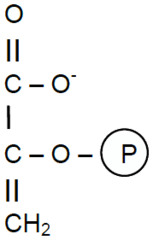
What can pyruvate be used for after glycolysis? (4)
Act as a terminal electron acceptor in fermentation
Be secreted as a waste product
Be further oxidized through the TCA cycle
Serve as an intermediate compound in other metabolic pathways

What occurs between glycolysis and the TCA cycle?
Pyruvate is converted to acetyl-CoA through decarboxylation and the addition of coenzyme-A through a thioester linkage

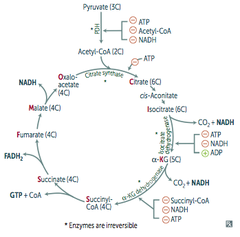
TCA Cycle
Further oxidizes pyruvate to extract more energy; occurs in the cytosol in prokaryotes and in the mitochondria in eukaryotes

Reactants and Products of the TCA Cycle
1 Acetyl-CoA + 3 NAD+ + 1 FAD + 1 GDP/ADP + 1 Pi + 2 H2O -> 2 CO2 + 3 NADH + 3 H+ + 1 FADH2 + 1 GTP/ATP + 1 Free Coenzyme A + 1 Oxaloacetate

What precursors does the TCA cycle produce? (4)
Acetyl-CoA
α-ketoglutarate
Oxaloacetate
Succinyl-CoA

Do all organisms have a full TCA cycle?
No, but all organisms can produce the four essential precursors produced in the TCA cycle; can go through reactions in reverse utilizing energy
Fermentation
Anaerobic reduction of downstream product(s) (commonly pyruvate) to restore pools of oxidizing agents (such as NAD+)

Pentose-Phosphate Pathway
Alternative to glycolysis (less energy efficient) that produces precursors and NADPH and does not require or produce ATP; occurs in the cytosol

What precursors does the pentose-phosphate pathway cycle produce? (4)
Glucose 6-Phosphate
Fructose 6-Phosphate
Ribose-5-Phosphate
Erythrose-4-Phosphate

What does the pentose phosphate pathway produce in addition to NADPH and precursors?
Pentose and four-carbon sugars; the cell would otherwise need to obtain these from the environment

Electron Transport Chain
A sequence of electron carriers and enzymes that shuttle electrons during the redox reactions that release energy used to make ATP

Where do electrons in the electron transport chain come from?
Reduced compounds, such as NADH and FADH2

Proton Motive Force
The potential energy stored in the form of an electrochemical gradient, generated by the pumping of hydrogen ions across biological membranes during chemiosmosis

Terminal Electron Acceptor
Compound onto which electrons are placed (reduced) at the end of the electron transport chain

What are protein complexes in electron transport chains called?
Reductases; the terminal complex is called an oxidase (redox reactions in the protein complexes are carried out by prosthetic groups)

What compounds in the electron transport chain can carry both protons and electrons? (3)
Flavoproteins
Quinones
NADH/NADPH

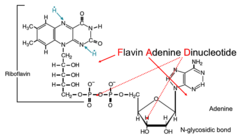
Flavoproteins
Contain a flavin prosthetic group (such as FADH2)
Quinones
Family of lipids; soluble with the nonpolar interior of the membrane

What compounds in the electron transport chain can carry just electrons? (2)
Cytochromes
Iron-Sulfur Proteins
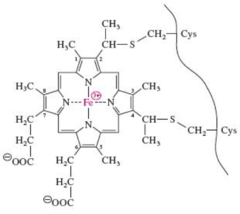
Cytochromes
Proteins containing a heme prosthetic group, which can carry an electron

Iron-Sulfur Proteins
Contain a non-heme iron-sulfur cluster that can carry an electron

What is the difference between aerobic respiration and anaerobic respiration?
Aerobic respiration utilizes oxygen as the terminal electron acceptor while anaerobic respiration utilizes a different terminal electron acceptor
