IAL edexcel Physics PP mistakes (2020-2024)
 Call Kai
 Learn
 Practice Test
 Spaced Repetition
 Match
 Flashcards
 Knowt Play
1/19

There's no tags or description
Looks like no tags are added yet.
20 Terms

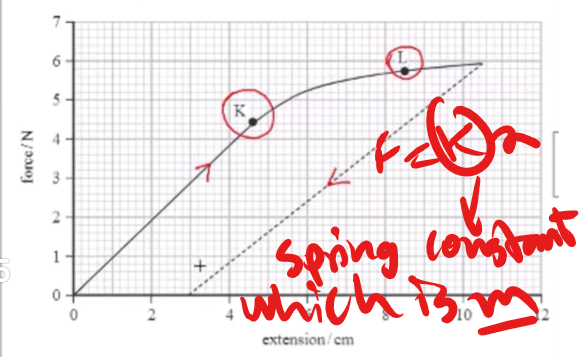
(a) State the significance of point K
(1marks)
(b) Explain the significance of point L (2 marks)
(c ) Suggest why the unloading graph has a different gradient to the loading graph
(1mark)
(a) limit of proportionality
(b) - L is elastic limit, so beyond point L the spring will behave plastically
- spring will no longer return to its original length (once the deforming force is removed)
(c ) the spring constant/stiffness has changed
NOTE:
Spring constant, k from Hooke’s law is a measure of the stiffness of a particular object
It indicates the force required to produce a unit of deformation & depends on the object’s material, size and shape (UNLIKE YOUNG MODULUS which is a stiffness constant of object)
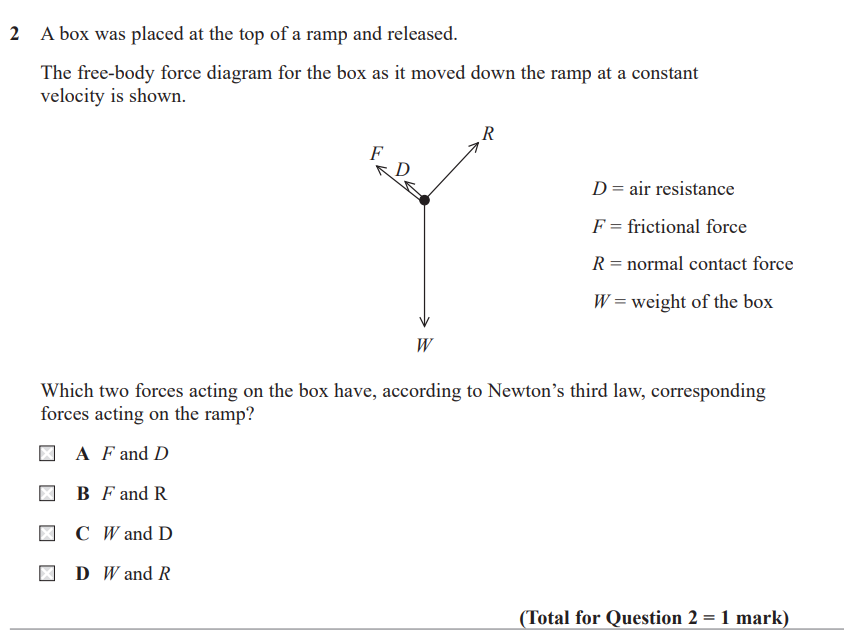


D


since student forgot to substract OG length, at F = 0 what would normally be
extension 0( e = x - xOG) the extension is equal to the unstretched OG length


-in series, the same force acts through both springs
- so both springs have the same extension
- so in this (series) combination, the extension is doubled
thus spring constant k halves
(2x, if there were three springs it would be 3x and so on..)
- because F = k∆x, here k is proportional to 1 / ∆x so k is halved

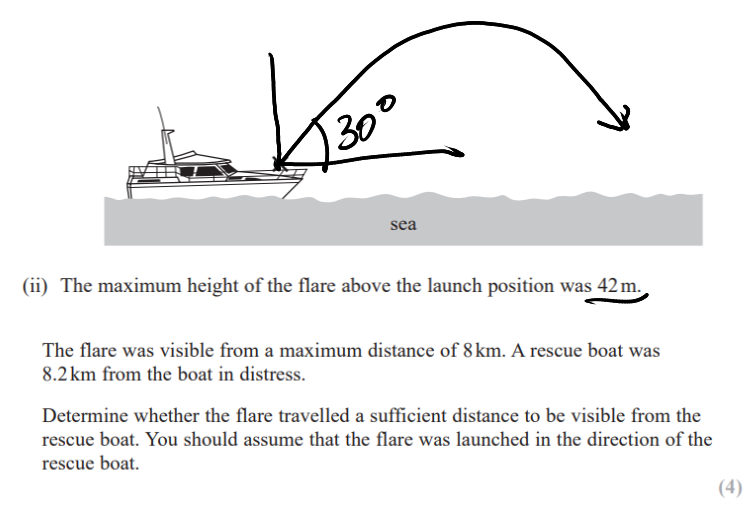
state one assumption you made in this calculation
drag/ air resistance is assumed to be negligible


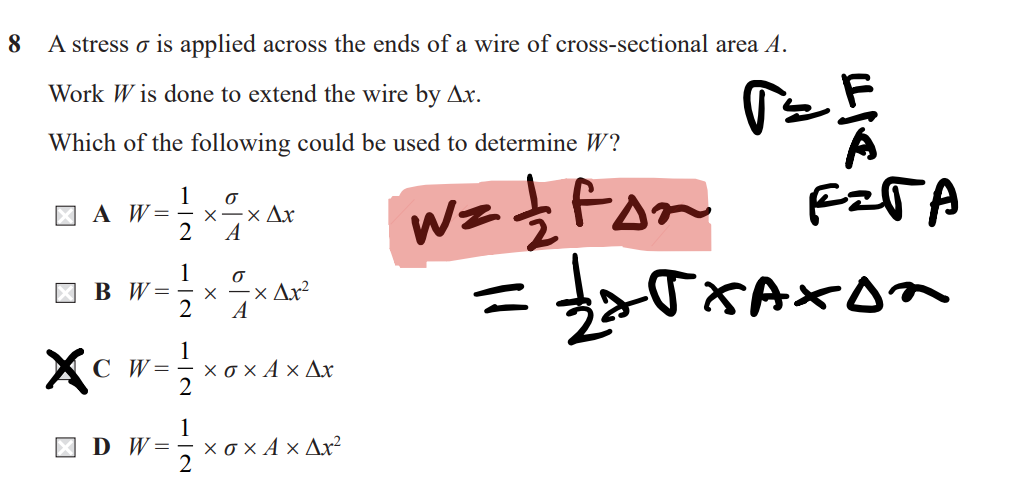
The Young modulus applies only to the proportional section of the graph,



for Q.9 the key point to remember is the area under vt graph gives displacement, the opposite direction gave less area so ball rebounds to a lower position. SO ans is B
Explain how air resistance affects projectile motion [3 marks]
Air resistance (or drag) acts to oppose the motion (of x like ball or bike etc)
so horizental velocity is reduced
therefore horizental distance is reduced
(btw also reduces vertical velocity and height but horizental more significant)


state the principle of conservation of linear momentum [2marks]
Total momentum before collision = total momentum after collision
Provided no unbalanced/resultant force acts

reduces work done by motor
because counterweight contributes to work done
[The counterweight loses gravitational potential energy, which contributes energy to the system. Therefore, the motor does less work]

NOTE: since the wire is made from same material, stress is the same


btw when decelerating Rf is down because f = -ma now, so Rf is -ve so its down
(and then i did algebra to prove why Rf down means R the reaction force is less)


main problem was for stress = F/A, i wasn’t sure to take Fweight or Ftension on rope.
Take Tension as stress is the force transmitted through the rope's cross-sectional area. The tension is the force stretching the rope i.e.
