WILD 346 Exam 3: Temperature
 Call Kai
 Learn
 Practice Test
 Spaced Repetition
 Match
 Flashcards
 Knowt Play
1/59

There's no tags or description
Looks like no tags are added yet.
60 Terms
How prokaryotes and vertebrates differ in their tolerance to environmental temperature?
prokaryotes span almost the entire range of Earth’s temperatures
vertebrates can tolerate only a small portion of the Earth’s temperature range
What does environmental temperature (like the sun) effect?
physiology, morphology, and behavior
performance
Darwinian fitness (natural selection)
temperature sets limits on all of these factors
How does temperature set limits at the cellular level?
increased temperature speeds up biochemical reactions (to a point)
What happens as a molecule has more heat?
it has more kinetic energy, which makes it move more (vibrating and running into each other more)
What is denaturing due to heat (thermal denaturation)?
when a protein or nucleic acid loses its structure (unfolds) due to excess heat or stress, resulting in loss of function


What is this graph communicating?
as temperature initially increases, the rate of the biochemical reaction also increases (speeds up)
however, when it gets too hot, the biochemical structure starts to breakdown due to denaturation
take home: biochemical reactions can only withstand so much heat.
How are temperature limits species-specific between generalists and specialists?
generalists: can withstand a wide range of temperatures at the cost of lower performance
specialists: have higher performance in a narrower range of temperatures


What do the x-intercepts (red and blue dots) represent on this graph?
the upper and lower lethal temperatures (too cold vs. too hot)
What are lethal temperatures in animals?
extreme temperature limits in organisms, either hot or cold, when they cannot perform anymore (resulting in death)
What is heat?
the total kinetic energy within a system (measured in Calories or Joules)
What is temperature?
the measure of the total intensity of heat
What is 1 Calorie equal to?
the energy required to raise 1 gram of water by 1 degree Celsius
How many calories would it take to raise 1 gram of water from 25 to 50 degrees Celsius?
25 calories
How many calories would it take to raise 100 grams of water from 25 to 50 degrees Celsius?
2,500 calories
What does body temperature depend on?
how much heat has been stored in the body
Do endotherms or ectotherms have higher body temperatures?
endotherms
What are the 3 rules that dictate how much heat can move?
Heat flows from warmer to colder temperatures
Greater temperature gradient (difference) = greater heat flux (movement)
Physical properties matter
What does the first rule of heat transfer mean?
Heat flows from warmer to colder temperatures.
Heat moves from a higher-temperature object to a lower-temperature one until they reach thermal equilibrium
What does the second rule of heat transfer mean?
Greater temperature gradient (difference) = greater heat flux (movement)
The bigger the gap in temperature between two points, the faster and more intense the transfer of heat will be.
What does the third rule of heat transfer mean?
Physical properties matter.
The speed and ease of heat transfer depend heavily on what the material is made of.
ex: metals like copper conduct heat quickly, while insulators like wood, foam, or air slow it down.
How does heat transfer differ between long-haired and short (or hairless) dogs?
long-haired dogs have more insulation because their fur traps heat
short-haired/hairless dogs have less insulation, so heat moves rapidly out of their bodies
What are the 4 mechanisms of heat transfer?
conduction
conduction and convection
radiation
evaporation
What is conduction?
heat transfer between objects or molecules that are in direct physical contact
How does conduction work?
faster-moving (hotter) molecules bump into slower (cooler) molecules and pass kinetic energy along
What is an example of conduction in wildlife?
iguana touching a sun-warmed rock by standing (conduction via feet only) or laying down (conduction via entire underside)
What is convection?
heat transfer between an animal's body and a moving fluid, such as air or water
What does convection do?
accelerates heat transfer between a solid and a fluid (liquid or gas)
What is a boundary layer?
a thin zone of relatively still fluid (either air or water) that adheres directly to the surface of an animal's body
What is the size of a boundary layer influenced by?
size and shape of animal
surface roughness
fluid speed
What happens if you don’t have a boundary layer?
you will lose much more heat to the air around you
Why are boundary layers important for animals?
they act as a blanket of insulation, keeping heat from being lost to the air via conduction
What is radiation?
heat transfer between objects without contact
True or False: Above absolute zero, all objects emit and receive radiation.
true
Why is surface temperature important for radiation?
the hotter the surface, the shorter the wavelengths (e.g. the sun)
intensity of radiation is proportional to T4
What affects the amount of radiation emitted/received?
the area of radiative surface (large vs. small)
larger size = more radiation
What is an example of radiation in wildlife?
basking in the sun
giving off body heat to the cool air at night
What is evaporation?
The loss of heat that occurs when liquid water on a body surface or respiratory tract turns into water vapor (e.g. sweating)
What is an alternative to sweating for evaporation?
exposure to other moist surfaces (e.g. dogs panting to release heat)
What role does the moisture gradient play in evaporation in dry vs. humid areas?
it’s more difficult to lose heat via sweating when the air already holds a lot of moisture (high humidity)
What is the equation for body temperature?
heat production (metabolism) + heat IN - heat OUT = body temp
What are the gains in temperature for a lizard sitting on a sun-warmed rock?
conduction from touching the rock
infrared thermal radiation from the rock, sun, and the atmosphere
convection by wind (if air is warmer than lizard)
What are the losses of temperature for a lizard sitting on a sun-warmed rock?
conduction to air (giving off body heat)
convection by wind (if air is cooler than the lizard)
emitting thermal radiation from itself
evaporation (if liquid is on the skin)
How do camels cope with extremely hot temperatures?
body heat regulation
storing water
brain function
How does having thick fur help a camel regulate body heat?
it prevents heat gain due to there being less conduction (less radiative heat in contact with their skin)
The normal body temp for mammals is 37°C (98.6°F). What temperature do camels change their body temp to when the air temperature can exceed 50°C (138°F)?
camels increase their body temp to about 41°C (106°F)
How does increasing body temp help a camel regulate their body heat?
there is less heat transfer by convection because their body temp is closer to the temperature of the air (lowers the temperature difference)
Where is a camel’s fat stored? How does it help them regulate their body heat?
fat stored in their hump, not their underside
they need to lose heat through conduction/convection with the cold air at night
How does losing heat at night help a camel regulate their body heat?
since they lose heat at night, they don’t have to lose water through evaporative cooling
saves them 5L of water per day
How long can camels go without a water source?
10 days (can tolerate 24% of dehydration before going into a coma)
How long can camels go without free water?
6-7 months
can drink 200L of water in 3 minutes because the water doesn’t move into their blood all at once
How do camels minimize their water loss?
concentrate their urine → lose less water to get rid of waste
they don’t sweat
their noses are hygroscopic
What do hygroscopic nasal membranes help camels with?
trap water vapor and prevent dehydration in hot and dry environments
every time they exhale, they lose less water than humans would
What is a camel’s nasal turbinate?
bone structures covered in moist mucous membranes that provide over 1,000 square centimeters of surface area inside the nasal cavity (compared to about 160–180 cm² in humans)
Why is a camel’s nose important?
it’s the main place where evaporative cooling occurs
their nostrils open and close to save water from evaporation
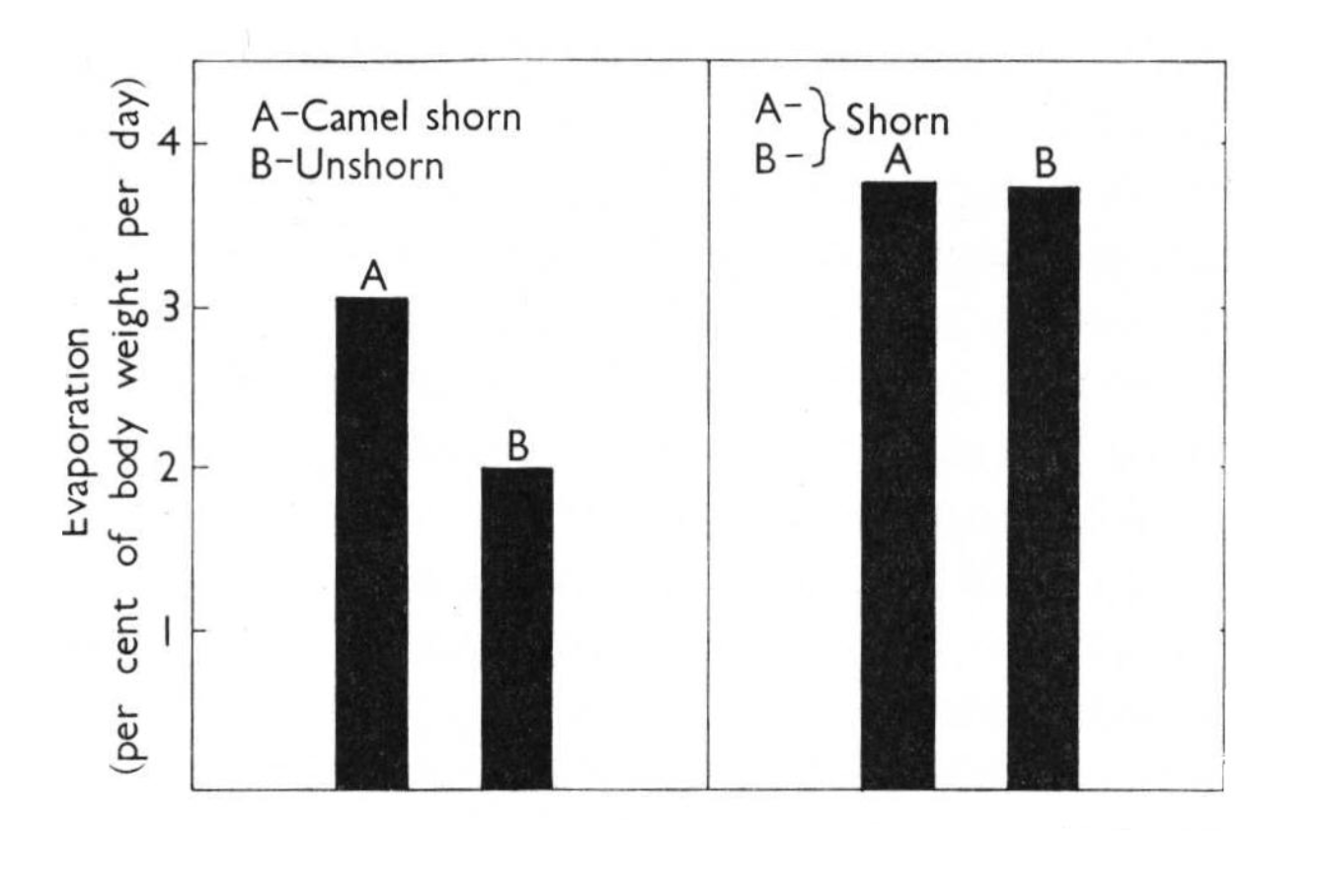
What is this graph asking? What is it communicating?
compared 2 camels: one shorn, one unshorn
what percent of body weight did they lose to water based on their fur length?
the shorn camel lost a higher percent of its body water to evaporation than the camel with fur
when both camels were shorn, they lost a lot of body water
What is unique about a camel’s brain?
their brain cannot function above 41°C (106°F), so they keep their brain cooler than the rest of their body
What is a rete mirabile?
a dense, sponge-like network of branching and reconnecting arteries located inside the cavernous sinus at the base of the brain
What does a rete mirabile allow for?
brain cooling despite very high body temps
by helping regulate brain and body temperatures, it reduces the need to sweat or pant heavily, conserving vital body water
How does a rete mirabile work?
acts as a countercurrent heat exchange system that cools arterial blood headed toward the delicate brain tissue
loses heat because it is constantly running into cooler blood

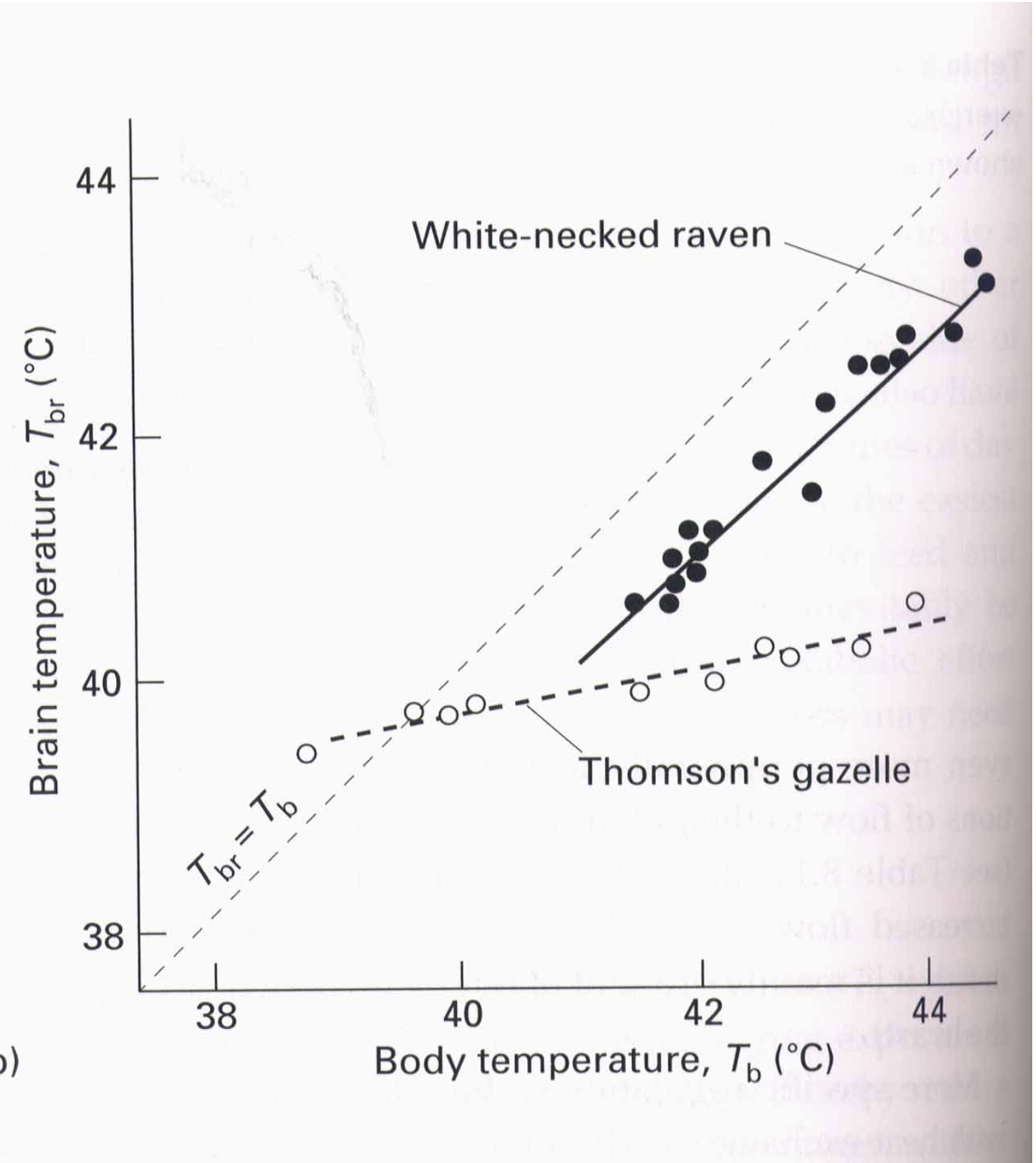
Based on this graph, does the gazelle or raven have a rete mirabile? How can you tell?
gazelle has a rete mirabile
gazelles have a lower brain temperature compared to their body temp
explains why they can run for so long