Chapter 4 - Carbon and the Molecular Diversity of Life
 Call Kai
 Learn
Learn Practice Test
 Spaced Repetition
 Match
Match Flashcards
 Knowt Play
1/13

There's no tags or description
Looks like no tags are added yet.
Name | Mastery | Learn | Test | Matching | Spaced | Call with Kai | Chat |
|---|
No analytics yet
Send a link to your students to track their progress
14 Terms
Carbon Cycle
The process that exchanges carbon between the atmosphere, oceans, soil, and living organisms
Carbon Compounds
Carbohydrates
Lipids
Nucleic Acids
Proteins
Organic Chemistry
Study of compounds that contain carbon
Organic compounds range from small to extremely large
Most organic compounds contain hydrogen
Carbon is very good at forming long, complex bonds due to 4 valence electrons
Vitalism
Life force exists outside physical and chemical laws
Organic compounds can only be created in living organisms
Berzelius
Mechanism
All natural phenomena are governed by physical and chemical laws
Organic compounds can be produced in labs (abiotic synthesis)
Miller
Carbon Skeletons
Length
Branching
Double bond position
Prescence of Rings
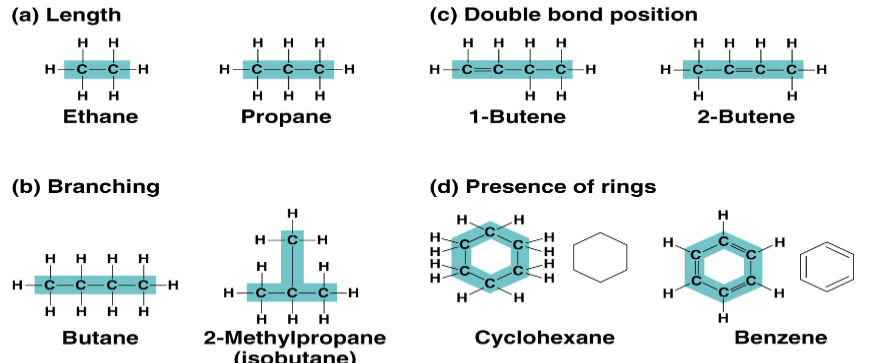
Isomers
Compounds that have the same numbers of atoms of the same elements but arranged in a different structure so they have different properties
Structural isomers
The bonds have large structural differences in the covalent bonds
Cis-trans isomers
Carbons have covalent bonds to the same atoms but the atoms have different arrangements because double bonds are inflexible
Cis isomers - 2 bonds on the same side
Trans isomers - 2 bonds on opposite corners
Enantiomers
Mirror images of each other that differ in shape due to an asymmetric carbon (Left and Right hands)
Hydrocarbons
Organic molecules consisting of only hydrogen and carbon
Nonpolar (hydrophobic
Ability to release large amounts of energy
Fossil fuels and fats
Functional Groups
Components of organic molecules most likely to be involved in a reaction
Number and arrangement of functional groups are what give molecules their properties
Consists of 7 different groups
Hydroxyl Group
Carbonyl Group
Carboxyl Group
Amino Group
Sulfhydryl Group
Phosphate Group
Methyl Group
Hydroxyl Group
Called alcohols, which normally end in ol
Properties
Polar as a result of electrons spending more time near the electronegative oxygen
Can form hydrogen bonds with water, helping dissolve organic compounds like sugars

Carbonyl Group
Called ketones if the Carbonyl Group is inside the carbon skeleton and aldehydes if its outside
Properties
A ketone and an aldehyde may be structural isomers with different properties
Ketone and aldehyde groups are also found in sugars, which lead to two major groups of sugars, ketoses and aldoses

Carboxyl Group
Called carboxylic acids or organic acids
Properties
Acts as an acid; Can donate a H+ because the covalent bond between oxygen and hydrogen is so polar
Found in cells in the ionized form with a charge of 1-, which is called a carboxylate ion

Amino Group
Called amines
Properties
Acts as a base, can pick up an H+ from surrounding solution
Found in cells in the ionized form with a charge of 1+

Sulfhydryl