KN 232 - Week 8 Structure List

0.0(0)
Studied by 0 people
call kaiCall Kai
learnLearn
examPractice Test
spaced repetitionSpaced Repetition
heart puzzleMatch
flashcardsFlashcards
GameKnowt Play
Card Sorting

1/38

encourage image

There's no tags or description

Looks like no tags are added yet.

39 Terms

1
New cards

Neuron

- The structural unit of the nervous system

- Collectively, neurons receive information, conduct electrical signals, and release neurotransmitters

<p>- The structural unit of the nervous system</p><p>- Collectively, neurons receive information, conduct electrical signals, and release neurotransmitters</p>
2
New cards

Cell body (perikaryon or soma)

- The main part of the neuron; its plasma membrane encloses the cytoplasm, and it contains the nucleus

- Receives input from dendrites, initiates some graded potentials, and conducts these potentials toward the axon

<p>- The main part of the neuron; its plasma membrane encloses the cytoplasm, and it contains the nucleus</p><p>- Receives input from dendrites, initiates some graded potentials, and conducts these potentials toward the axon</p>
3
New cards

Nucleus

- An organelle located inside the cell body

- Contains DNA and controls cell activities
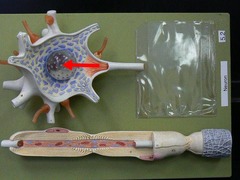
<p>- An organelle located inside the cell body</p><p>- Contains DNA and controls cell activities</p>
4
New cards

Nucleolus

- A dense region inside the nucleus

- Produces components needed to make ribosomes

<p>- A dense region inside the nucleus</p><p>- Produces components needed to make ribosomes</p>
5
New cards

Mitochondria

- Organelles found in the cell body

- Produce ATP to supply energy for cellular activities

<p>- Organelles found in the cell body</p><p>- Produce ATP to supply energy for cellular activities</p>
6
New cards

Chromatophilic substance (Nissl bodies / rough ER)

- Made of free and bound ribosomes in the cell body

- Ribosomes synthesize proteins

<p>- Made of free and bound ribosomes in the cell body</p><p>- Ribosomes synthesize proteins</p>
7
New cards

Dendrites

- Short, unmyelinated processes that branch off the cell body

- Receive input and transfer it to the cell body

<p>- Short, unmyelinated processes that branch off the cell body</p><p>- Receive input and transfer it to the cell body</p>
8
New cards

Axon

- A long process extending from the cell body; it attaches at the axon hillock and ends in terminal branches

- Conducts action potentials and releases neurotransmitters at synaptic knobs
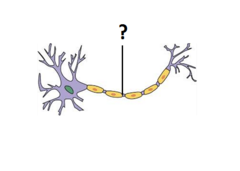
<p>- A long process extending from the cell body; it attaches at the axon hillock and ends in terminal branches</p><p>- Conducts action potentials and releases neurotransmitters at synaptic knobs</p>
9
New cards

Axolemma

- The plasma membrane surrounding the axon

- Conducts action potentials as voltage-gated channels open sequentially along the membrane

<p>- The plasma membrane surrounding the axon</p><p>- Conducts action potentials as voltage-gated channels open sequentially along the membrane</p>
10
New cards

Axon hillock

- The triangular region of the cell body where the axon attaches

- Incoming signals are summed; if threshold is reached at the initial segment, an action potential is generated

<p>- The triangular region of the cell body where the axon attaches</p><p>- Incoming signals are summed; if threshold is reached at the initial segment, an action potential is generated</p>
11
New cards

Myelin

- Several layers of glial-cell membrane wrapped around an axon; its high lipid content gives it a glossy-white appearance

- Insulates the axon and allows faster action-potential propagation

<p>- Several layers of glial-cell membrane wrapped around an axon; its high lipid content gives it a glossy-white appearance</p><p>- Insulates the axon and allows faster action-potential propagation</p>
12
New cards

Schwann cells (neurolemmocyte)

- Elongated, flat glial cells that wrap around axons in the peripheral nervous system

- Form myelin around PNS axons, allowing faster action-potential propagation

<p>- Elongated, flat glial cells that wrap around axons in the peripheral nervous system</p><p>- Form myelin around PNS axons, allowing faster action-potential propagation</p>
13
New cards

Nodes of Ranvier (neurofibril node)

- Gaps between adjacent myelin-wrapped segments of an axon

- Allow action potentials to be regenerated along the axon, supporting faster conduction

<p>- Gaps between adjacent myelin-wrapped segments of an axon</p><p>- Allow action potentials to be regenerated along the axon, supporting faster conduction</p>
14
New cards

Oligodendrocytes

- Glial cells in the central nervous system (CNS) with extensions that wrap around axons

- Form myelin around portions of multiple axons

<p>- Glial cells in the central nervous system (CNS) with extensions that wrap around axons</p><p>- Form myelin around portions of multiple axons</p>
15
New cards

Terminal branches (telodendria)

- Branches at the end of an axon

- Lead to synaptic knobs that release neurotransmitters to communicate with other cells

<p>- Branches at the end of an axon</p><p>- Lead to synaptic knobs that release neurotransmitters to communicate with other cells</p>
16
New cards

Axon terminal (synaptic knob / terminal bouton)

- The enlarged tip at the end of a telodendrion

- Releases neurotransmitters from synaptic vesicles

<p>- The enlarged tip at the end of a telodendrion</p><p>- Releases neurotransmitters from synaptic vesicles</p>
17
New cards

Vesicle (synaptic vesicle)

- A small sac inside a synaptic knob that contains neurotransmitters

- Releases neurotransmitters when an arriving action potential triggers calcium entry into the synaptic knob

<p>- A small sac inside a synaptic knob that contains neurotransmitters</p><p>- Releases neurotransmitters when an arriving action potential triggers calcium entry into the synaptic knob</p>
18
New cards

Neurotransmitter

- A chemical messenger synthesized by neurons and stored in vesicles in synaptic knobs

- Is released, binds to receptors on a target cell, and triggers a physiological response

<p>- A chemical messenger synthesized by neurons and stored in vesicles in synaptic knobs</p><p>- Is released, binds to receptors on a target cell, and triggers a physiological response</p>
19
New cards

Brain

- An organ of the central nervous system

- Processes information and helps coordinate responses to sensory input

<p>- An organ of the central nervous system</p><p>- Processes information and helps coordinate responses to sensory input</p>
20
New cards

Cerebrum

- A major region of the brain consisting of two cerebral hemispheres

- Involved in conscious sensation, voluntary movement, memory, and other higher functions

<p>- A major region of the brain consisting of two cerebral hemispheres</p><p>- Involved in conscious sensation, voluntary movement, memory, and other higher functions</p>
21
New cards

Cerebral hemispheres

- The left and right halves of the cerebrum, separated by the longitudinal fissure

- Contain the cerebral lobes and areas involved in processing sensory information and controlling movement

<p>- The left and right halves of the cerebrum, separated by the longitudinal fissure</p><p>- Contain the cerebral lobes and areas involved in processing sensory information and controlling movement</p>
22
New cards

Frontal lobe

- A lobe located toward the front of the cerebrum

- Contains the primary motor cortex, which controls voluntary skeletal muscle movement

<p>- A lobe located toward the front of the cerebrum</p><p>- Contains the primary motor cortex, which controls voluntary skeletal muscle movement</p>
23
New cards

Precentral gyrus (Primary motor cortex)

- A ridge of the frontal lobe just anterior to the central sulcus

- Controls voluntary skeletal muscle movement

<p>- A ridge of the frontal lobe just anterior to the central sulcus</p><p>- Controls voluntary skeletal muscle movement</p>
24
New cards

Parietal lobe

- A cerebral lobe behind the frontal lobe

- Processes somatic sensory information, such as touch and body position

<p>- A cerebral lobe behind the frontal lobe</p><p>- Processes somatic sensory information, such as touch and body position</p>
25
New cards

Postcentral gyrus (Primary somatosensory cortex)

- A ridge of the parietal lobe just posterior to the central sulcus

- Receives and processes sensory information from the body, including touch

<p>- A ridge of the parietal lobe just posterior to the central sulcus</p><p>- Receives and processes sensory information from the body, including touch</p>
26
New cards

Occipital lobe

- A lobe at the back of the cerebrum

- Processes visual information

<p>- A lobe at the back of the cerebrum</p><p>- Processes visual information</p>
27
New cards

Temporal lobe

- A cerebral lobe on the side of the brain, below the lateral sulcus

- Involved in hearing, memory, and language processing

<p>- A cerebral lobe on the side of the brain, below the lateral sulcus</p><p>- Involved in hearing, memory, and language processing</p>
28
New cards

Brainstem

- A region connecting the brain with the spinal cord; it includes the midbrain, pons, and medulla oblongata

- Relays information and helps regulate essential involuntary functions

<p>- A region connecting the brain with the spinal cord; it includes the midbrain, pons, and medulla oblongata</p><p>- Relays information and helps regulate essential involuntary functions</p>
29
New cards

Cerebellum

- A brain region behind the brainstem and beneath the posterior cerebrum

- Helps coordinate movement, balance, posture, and motor control

<p>- A brain region behind the brainstem and beneath the posterior cerebrum</p><p>- Helps coordinate movement, balance, posture, and motor control</p>
30
New cards

Arbor vitae

- The tree-like branching pattern of white matter inside the cerebellum

- Carries signals within the cerebellum and between it and other nervous system regions

<p>- The tree-like branching pattern of white matter inside the cerebellum</p><p>- Carries signals within the cerebellum and between it and other nervous system regions</p>
31
New cards

Vermis

- The narrow midline region connecting the two cerebellar hemispheres

- Helps coordinate posture and movements of the trunk

<p>- The narrow midline region connecting the two cerebellar hemispheres</p><p>- Helps coordinate posture and movements of the trunk</p>
32
New cards

Fissures / sulci

- Grooves on the brain's surface; sulci are generally shallower, while fissures are deeper

- Mark boundaries between brain regions

<p>- Grooves on the brain's surface; sulci are generally shallower, while fissures are deeper</p><p>- Mark boundaries between brain regions</p>
33
New cards

Central sulcus

- A groove between the frontal and parietal lobes

- Separates the precentral gyrus (primary motor cortex) from the postcentral gyrus (primary somatosensory cortex)

<p>- A groove between the frontal and parietal lobes</p><p>- Separates the precentral gyrus (primary motor cortex) from the postcentral gyrus (primary somatosensory cortex)</p>
34
New cards

Lateral sulcus

- A prominent groove on the side of the cerebrum

- Separates the temporal lobe from portions of the frontal and parietal lobes

<p>- A prominent groove on the side of the cerebrum</p><p>- Separates the temporal lobe from portions of the frontal and parietal lobes</p>
35
New cards

Longitudinal fissure

- The deep groove between the left and right cerebral hemispheres

- Separates the cerebrum into its two hemispheres

<p>- The deep groove between the left and right cerebral hemispheres</p><p>- Separates the cerebrum into its two hemispheres</p>
36
New cards

Transverse fissure

- A deep groove between the cerebrum and cerebellum

- Marks the boundary between these two brain regions
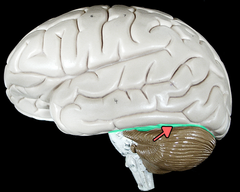
<p>- A deep groove between the cerebrum and cerebellum</p><p>- Marks the boundary between these two brain regions</p>
37
New cards

Parieto-occipital sulcus

- A groove marking the boundary between the parietal and occipital lobes, most clearly seen on the medial brain surface

- Marks the separation between these lobes

<p>- A groove marking the boundary between the parietal and occipital lobes, most clearly seen on the medial brain surface</p><p>- Marks the separation between these lobes</p>
38
New cards

Pons (extra)

- A rounded region of the brainstem

- Relays signals and contributes to the regulation of breathing

<p>- A rounded region of the brainstem</p><p>- Relays signals and contributes to the regulation of breathing</p>
39
New cards

Medulla oblongata

- The lowest part of the brainstem, continuous with the spinal cord

- Helps regulate vital involuntary functions, including breathing, heart rate, and blood pressure
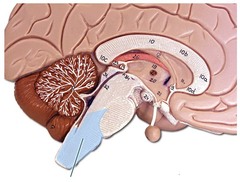
<p>- The lowest part of the brainstem, continuous with the spinal cord</p><p>- Helps regulate vital involuntary functions, including breathing, heart rate, and blood pressure</p>



