psych 313 exam 3
 Call Kai
 Learn
 Practice Test
 Spaced Repetition
 Match
 Flashcards
 Knowt Play
1/72

There's no tags or description
Looks like no tags are added yet.
73 Terms
attention
seeking to understand a partner’s behaviors and experiences
feeling understood effect on relationship satisfaction
feeling understood/seen is linked to relationship satisfaction, especially when conflict is high
relationship satisfaction decreased in high conflict when someone felt misunderstood
manifest content (positions)
topic of the communication, what partners are communicating about
latent content (interests)
unstated needs/goals that give rise to the communication
mutual attention to latent content is linked to greater intimacy and stronger communication
bid for attention
attempt for attention, affirmation, affection, or other positive connection
responding responsively involves “turning toward” instead of “turning away”
selective listening
our motives and needs influence what we hear when listening to our partner
biased processing highlights our most salient priorities
self-disclosure
process of revealing personal information, involves risk
self-disclosure study w/ college students
74% indicated that they avoid at least one topic in their relationship
6 most common categories of topics avoided (low to highest percentage): negative life experiences, relationship norms, conflictual topics, prior romantic relationships, extrarelationship activity, state of the relationship
self-disclosure study w/ 36 questions
experimental self-disclosure manipulations can foster closeness among strangers
Ps discuss 3 increasingly intimate sets of topics across 45 minutes
set 1 example: “would you like to be famous? in what way?”
set 2 example: “what do you value most in a friendship?”
set 3 example: “of all the people in your family, whose death would you find most disturbing? why?”
relative to Ps in a small talk condition, Ps in the 36 questions condition felt MUCH closer afterwards
self-disclosure effect on attraction
even with asymmetric disclosures, we have greater attraction to strangers who have self-disclosed to us
mutual self-disclosures promote closeness more strongly
how can self-disclosure backfire?
self-disclosure can undermine closeness if it’s inappropriate, excessive, or unreciprocated
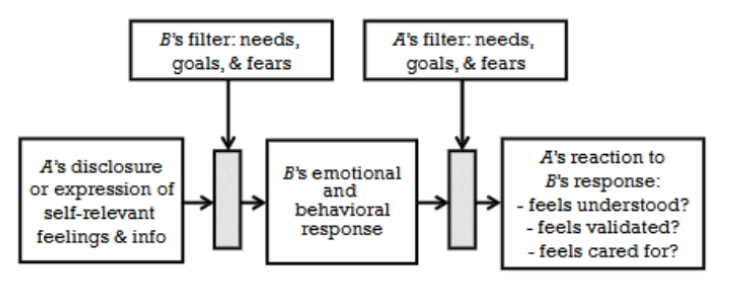
interpersonal process model
3 steps in creating intimacy
A’s disclosure or expression of self-relevant feelings/info
B’s emotional and behavioral response
A’s reaction to B’s response: is A feeling understood/validated/cared for?
according to the interpersonal process model, when would person A perceive person B as responsive?
A perceives B as responsive when A believes that B
accurately perceives A (A feels understood)
values and appreciates A’s perspective (A feels validated)
oriented toward A’s well being (A feels cared for)
one-size-fit-all platitudes vs. tailored reactions in responsiveness
one-size-fits-all platitudes can be somewhat effective responses
but most responsive reactions are tailored to make the partner feel understood/validated/cared for
some reactions are completely unresponsive
IM chat study on responsiveness
2 strangers chatted for 15 min via instant message, A was randomly assigned to ask B either few questions (<4) or many (>9)
B liked A more when A asked more questions (especially follow-up questions), which is driven by B’s perceptions of A’s responsiveness
however, 3rd party observers of the chat didn’t show this preference
result: one way to be responsive is to ask follow-up questions
filters in responsiveness
our reactions are biased by our own motivations
ex. attachment anxious individuals are vigilant for signs of rejection, might see it when it’s not there
we have filters that can affect their perception of the self-disclosure and how we interpret it or respond
3 methods of responsive communication during conflict
paraphrasing, validating, XYZ statements
easier said than done (esp when we’re angry)
paraphrasing in responsive communication during conflict
repeating partner’s comments in our words to ensure we heard correctly
validating in responsive communication during conflict
acknowledging legitimacy of (valuing + respecting) our partner’s experience
XYZ statements in responsive communication during conflict
“when you do X in situation Y, i feel Z”, power of “I” statements
flooding during responsiveness
responsiveness is also important in the role of a self-discloser
flooding - the feeling of being overwhelming by a partner’s emotions (even positive emotions)
undermines the ability to process information rationally, linked to maladaptive responding (ex. stonewalling)
michelangelo effect in relationships
actual self - rough block of stone
ideal self - beautiful form in the stone
we sculpt our partner to help them grow closer to their ideal self
if we treat our partner as if they already embody their ideal self, they grow closer to it over time
also makes the relationship stronger
sacrifices effect on relationship quality
making sacrifices is required to maintain a healthy long-term relationship
ex. skipping exciting work opportunity to be near our partner
relation between relationship commitment and willingness to make sacrifices
greater relationship commitment = greater willingness to make sacrifices to promote our partner’s goals
opposite effect when partner’s goals threaten the relationship
ex. if a partner wants to move to another state/country
existential threat study for willingness to sacrifice
Ps reported on commitment to the relationship and their partner’s most important goals
IV: moderate vs. existential threat, low vs. high commitment
DV: supporting the partner’s goal
results: moderate threat less likely to end the relationship than an existential threat
moderate threat - high commitment has more support
existential threat - high commitment has less support
are relationships happier when partners have accurate vs. idealized (pos. biased) perceptions of each other?
idealization is better
research found that satisfaction declines more over time w/ low idealization vs. remaining relatively constant w/ high idealization
general vs. specific qualities effect on idealization
w/ general qualities, idealization is beneficial, since it’s easy to interpret many behaviors consistent w/ it
ex. “my partner is a good person”
w/ specific qualities, accuracy is beneficial, since it protects us from disappointment when counter-evidence emerges
ex. “my partner listens well when we go out to dinner w/ our friends”
2 mindset theories on how relationships function
growth/work-it-out and destiny/soulmate
growth / work-it-out mindset theory
mindset that successful relationships are cultivated over time
“successful relationship evolves through hard work and resolution of incompatibilities”
destiny / soulmate theory
mindset that potential partners are/aren’t meant for each other
“successful relationship comes from finding compatible partner from the start”
leads to disengagement in relationship challenges
passion regrowth mindset idea
passion can be rekindled (vs. “if you lose sexual attraction, you can’t recover it”)
2 studies on passion regrowth mindset
study 1 on passion regrowth mindset - cross-sectional / correlational
study 2 on passion regrowth mindset - experimental and longitudinal
IV conditions: control, passion regrowth (participants wrote 2 essays on how passion can be rekindled)
DV: 4 assessments of commitment over 9 months
essay prompts: asking P to reflect on when something new/exciting led to more passion, asking P to identify things to do to introduce excitement/passion into the relationship
results
study 1: passion is associated with commitment, the slope is less steep with the passion regrowth mindset, but still higher (correlation only)
study 2: more commitment with passion regrowth mindset, but the slopes are more similar

benefits of forgiveness
forgiveness has relational, psychological, and physiological benefits, BUT ALSO costs, if the perpetrator hasn’t made amends
doormat effect in forgiveness
forgiving is the absence of amends undermines our self-respect
correlation of forgiveness and self-respect
with high forgiveness and weak amends, self-respect declines heavily

what is the demographic of most studies in relationship science?
most studies are done on white, heterosexual, and high-SES couples
social class and SES effect on independence
social class results in different selves due to adversity
high SES - expressive independence; focus on unique, self-expressive self
more likely to endorse for a relationship to end
lower SES - hard interdependence; responsive and connected to others, but also tough and resilient
more likely to endorse being connected for life
social class and reasons for divorce
high SES - divorce due to incompatibility, partner’s personality
lower SES - more external strains, divorce due to reported money problems, drinking/drug use
vignette study on social class/SES
Ps given a scenario and asked about what to do
higher-SES P more likely to suggest to break off the relationship compared to lower-SES P
social class and couple identity study
stressors in lower-SES context = stronger couple identities
couple identity study - Ps told to write 10 answers to the question “who are we” → lower-SES couple identities have more resilient themes
cross-class relationships
one partner grew up lower-SES, one partner higher-SES
childhood social class shapes thoughts and behavior, so there’s still tensions of finances, childrearing, emotional, expression
meet in workplace or college
racial romantic preferences effect on perception of the person
stating racial romantic preferences changes the perception of the person (ex. white person stating no preference vs. racial preference)
effects reduced if the person is the same race as their preference
white women find racial preference aversive (no matter if same race vs. diff. rage)

interracial relationships
divorce rates were higher in 1980s, but not now
can face external disapproval from family and public linked to depression and anxiety → race is used as a cue for status
dyadic coping (supporting each other) buffers couples vs. family disapproval
political ideology also matters (more conversative vs. liberal along with same-race / diff-race)
combatting prejudice through relationships
intergroup contact can be effective and can go wrong
effective - predicted less transphobia, prospective voters to protect trans people from discrimination
can go wrong - supporting exclusionary policies after exposure to other races
intergroup contact can go wrong due to anxiety
solution: don’t go alone
same vs. different gender couples in relationship quality
same and different gender couples are similar in relationship quality (satisfaction and commitment)
same things also predict quality relationships (viewing partner positively, conflict management, etc)
parent study in LGBTQ relationships
parents in same-gender couples split up childcare and time-consuming household tasks more equally
division of labor not equal, but same-gender couples perceived division as more fair than mixed-gender couples do
bisexuality and bi+ people
bisexuality is the most common identity in people who are LGBTQ+
bi+ people - people attracted to more than one gender group who use identity labels like bisexual, pansexual, queer, or fluid
bias from partners in bi+ experiences
gay/straight people prefer to date gay/straight people rather than bisexual people
relationship challenges with bi+ visibility
relationships can pose challenges to bi+ visibility, which is linked to well-being
bi+ people w/ heterosexual partners felt less visible than people with bi+ or gay/lesbian partners
people in mixed-gender relationships w/ bi+ partners felt equally visible as people w/ same-gender relationship w/ bi+ partner
bi+ identity denial experiences
bi+ people experience identity denial, which differs based on gender
bi men - identity denied as actually gay
bi women - identity denied as actually straight
trans experiences in relationships
prejudice and exclusion in dating, especially from cisgender, heterosexual men and women
study on trans experiences in relationships
trans women in relationships w/ cisgender men, greater relationship commitment buffered the negative association between interpersonal stigma and psychological distress
small daily gestures from romantic partners can help to affirm trans partners’ identities
ways of improving trans experiences in relationships
using affirming language - being supportive and accepting of transitioning
showing support - communicating that surgically transitioning isn’t needed to validate the love, support, and attraction to the partner
helping to process - helping find useful resources, helping making decisions, and helping to process the feelings
how have sexual attitudes changed over time?
sexual attitudes have become more permissive over the past half-century
full, unambiguous approval of premarital sex and same-gender sex
but not in all ways, ex. extramarital sex
sex recession
since 2000, americans have been having less sex
adults have sex 15-20% fewer times per year than late 20th century
young men (age 18-34) are far less likely to have sex at least weekly and far more likely to have no sex in the past year
sexual fantasy
sexually exciting mental image that comes to mind while we’re awake
misaligns w/ our preferences in nonsexual domains
survey on sexual fantasies
2018 survey w/ 4200 adults reveal that our fantasies are transgressive
how does shame about our sexual fantasies affect us?
many of us feel ashamed about our fantasies
linked to lower sexual fulfillment and mental health challenges
what do people typically fantasize about? - group sex, novelty, adventure, variety, power, control, rough sex/BDSM
men vs. women in fantasies
fantasies in men and women are similar, with some differences
women - sexual orientation more flexible, care less about who their partners are and more about where they have sex, BDSM
men - group sex
lust
nontargeted physiological state oriented toward sexual expression
horniness and arousal, but not for a specific partner
cold-hot empathy gap
when we’re in a “cold” cognitive state, we can’t fully forecast what our preferences will be when we’re in a “hot” state
ex. dieters who aren’t currently hungry underestimate their desire to eat will be when they’re hungry
lust / sexual arousal has similar effects
masturbation study
male undergrads answered questions w/ 2 conditions: sexually aroused (masturbating) or not
special keypad allows responses w/ one hand (0-100 scale)
arousal/lust condition: Ps only allowed to answer if their arousal was at least 75 (right panel)
Ps were shown their state of arousal (right panel) and an erotic image (top panel)
no-arousal condition: top and right panels empty
results from masturbation study
result: kinkiness - sexual arousal makes us kinky
result: sexual arousal makes us more likely to indulge in cravings, even if they more risky
BUT doesn’t make us oblivious to facts (ex. pulling out before ejaculating can still lead to getting pregnant)
result: sexual arousal increases our tendency to be manipulative to get sex
related to the hot-cold empathy effect
subsequent study to the masturbation study on lust
results: men and women expressed greater willingness to take sexual risk when aroused vs. not
conditions: watched either sexual or nonsexual films before responding to sexual scenarios
sex effect on personal well-being
frequency and quality of sex predict psychological and physical well-being
sex is our most pleasurable daily experience
frequency of sex effect on well-being
more frequent sex is linked to greater happiness with life, BUT more frequent then weekly isn’t better
study told couples to double their frequency and they were no happier as a result (they might’ve already had enough)
sexual frequency effect on relationship well-being study
study: clit stimulation procedure (orgasmic meditation) increased feelings of closeness in the woman and her partner
especially if they weren’t already romantic partners
sexual afterglow: short-term surge in relationship satisfaction following sex (effect lasts ~48 hours)
sexual frequency effect on high neuroticism
more frequent sex can help to buffer our relationship against other risk factors
highly neurotic partners have less satisfying marriages, but this effect disappears w/ frequent sex
sex buffers against the adverse effects of conflict
sexual desire
targeted physiological state oriented toward sexual expression
sexual desire over time
frequency and intensity of sexual desire for one’s partner tend to decline over time
potential reasons: (1) can be due to inherent tension at the heart of romantic relationships, (2) transition to parenthood depresses desire, at least during the newborn stage
intimacy thrives on familiarity and security, desire/passion thrives on novelty and risk