WK 3- Qualitative research methods: Interviewing
 Call Kai
 Learn
 Practice Test
 Spaced Repetition
 Match
 Flashcards
 Knowt Play
1/16

There's no tags or description
Looks like no tags are added yet.
17 Terms
Interviews- types of interviews (3 and their features)
•Most common qualitative method for generating data
•Interviews can be:
Structured = set questions, standardised, probing ect, following a script
Semi-structured = use of a topic guide, can probe and follow up
Unstructured = unstructured conversation
•Conversational – two people discussing a topic
Researcher asks questions and follows up responses
•Length: ranges depending on topic and interviewer skill
•Mode: face-to-face, online, phone
strengths of interviews
•Access rich personal data
•Understand individual context and motivations
•Follow up and probing of responses
•Interviewee guides the interview – talk about what they think is important
•Capture non-verbal information
limitations of interviews
•Inaccurate information presented?
•Not generalisable
•Time and effort
•Expensive
When to use interviews? (suitable and not suitable)
Suitable | Unsuitable |
•Suitable research question •Interested in lived experience •Interested in nuance and subtlety •Sensitive topics | •Research question better suited to other methods •Aim to generalise findings |
what does ethical interviews look like
•Participants must be fully informed about the research to provide informed consent
•Confidentiality must be maintained and anonymity protected
•Harm to participants and researchers must be avoided
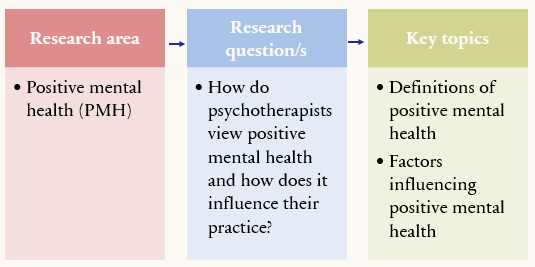
Developing an interview protocol (6)
Decide on your general research area
Generate specific research question/s
Decide on key interview topics
Formulate primary interview questions
Pilot interview protocol
Review and finalise interview protocol
Example in photo
types of interview questions (3)

Primary Interview questions- types of questions (4)
•Types of questions
Experience/ behaviour – what a person does or has done
“How do you typically spend your day?”
Opinions/ values – asking opinion on a topic
“What role do you think employers play in the health of their staff?”
Feelings – aim to understand emotional responses
“How did you feel when …”
Sensory experience – focus on what interview has seen, heard, touched, tasted, smelled
“What do you see when you walk into the office?”
Example Follow-up interview questions
Interviewee: I haven’t had an easy life with friends, I’ve always been sort of erm bullied. Some of my friends you know took- I got taken advantage of. I’m a nice guy, you know does everything for everyone, doesn’t say no, and people took advantage of me so, I sort of learnt the hard way …
Interviewer: What sort of things do you mean by you were taken advantage of?
Probes (3)
•Continuation probes – encourage continued talking
Paraphrasing
Minimal encouragers e.g., mmm hmm
“then what?”
“what happened next?”
•Elaboration probes – asking for more detail
“such as …”
“what else?”
“Can you tell me more about that?”
“Can you give me an example?”
•Clarification probes – asking for more explanation
“Can you run that by me again – I’m afraid I didn’t follow it”

example of the positive mental health research area

Interview protocol sequence (phase 5) start (2) middle and ending
•Processual sequence: introductions, purpose of the interviews, ethics
•Opening sequence: develop rapport
Basic demographic questions
Open-ended, easy-to-answer questions
•Content sequence: Primary interview questions
Logically sequenced – questions should build on each other
Ask challenging questions in the middle
•Concluding sequence: debriefing, summarizing, final thoughts
key things to remember in interview
•Trust is incredibly important – take the time to build rapport
•Do not interrupt before necessary
•Listen more than you talk
•Don’t be afraid of silence
•Follow the interview protocol but be flexible
Attentive (re)listening to interviews features
•Warm-up listening – recall the interview
•Follow-up listening – understand the main points
•Close listening – listen for detailed information to find connections between the research question and emerging findings
•Repeated and selective listening – listening while transcribing interviews line by line
Transcription- 3 principles
•An important precursor to analysis – familiarity
•Time consuming
Principles of transcription:
1.Preserve the morphologic naturalness of transcription – keep words and punctuation as close as possible to original
2.Preserve the naturalness of the transcript structure
3.Exact reproduction – verbatim
1)An interview protocol should be guided by:
a)Key topics
b)The research question
c)Previous research
d)All of the above
d)All of the above
Which of the following is a strength of qualitative interviews?
a)They are a cost- and time-effective way of generating data
b)They provide access to rich and nuanced data
c)Their findings are generalisable
None of the above
b)They provide access to rich and nuanced data