MH4U Math Terminology and Hacks
 Call Kai
 Learn
 Practice Test
 Spaced Repetition
 Match
 Flashcards
 Knowt Play
1/39

Earn XP
Description and Tags
This is my 2026 MHF4U deck, it covers all the terminology I need to remember as well as any hacks or tips I need to remember when solving specific things I often forget and also I'm going to add answers to any concept questions I have to remember them for the exam.
40 Terms
Domain
All possible and allowable input values OR values for the independent variable [x]
Range
All possible and allowable output values OR values for the dependent variable [y OR f(x)]
Relation
A set of ordered pairs or a rule connecting the input and output values. [for example y = x²]
Function
A relation in which each element of the independent variable or domain (input) has ONLY ONE dependent value (output) which is represented by the range.
Vertical Line Test (VLT)
An imaginary vertical line used to test if a graph has more than one x value for one y value. [Determines if the relation is a function or not]
Horizontal Line Test (HLT)
An imaginary horizontal line used to test if a graph has more than one y value for one x value. [Determines if the relation's inverse is a function or not]
Inverse Relation
A version of the original relation in which all of its x and y coordinates have swapped places. The relation is reflected across the y = x axis. [for example original function (3, 7) -> inverse (7, 3)]
Set Notation
Gives a set of values for the domain and range with added limitations and specifications. It is represented with {} curly brackets!!! [example D = { x E R | x > 5}]
Interval Notation [ ]
Gives a range of numbers in between. The square brackets mean the final numbers are included so the range is defined.
[example D = [-4 , 4]]
Interval Notation ( )
Gives a range of numbers in between. The round brackets mean the ends are never actually reached so it can be infinite and not necessarily defined.
[example D = (-∞,∞)]
Function Notation
Generally represented by f(x) but it can be any letter. It is a symbol that represents a function of x. It is used in place of y or the output, as it represents the overall relation more simply.
one-to-one function
A function in which each element of the domain and each element of the range never repeat and are unique for every point. [Example: any straight line with a slope]
A HORIZONTAL LINE IS NOT A 1-1 FUNCTION.
Linear modal
A horizontal line in which every x value has one y value. Both the domain and range are infinite unless restricted by context. [example y = mx + b]
Quadratic modal
A parabola that opens either up or down has two x values for one y value. The vertex gives the max or the min which gives the range; the domain is infinite.
[example y = ax² + bx + c for standard form]
Rational modal
A modal in which there are two asymptotes. The denominator cannot be zero so the domain is restricted by whatever makes x = 0, that is also the vertical asymptote. The range is that y cannot be zero unless otherwise stated, that is the horizontal asymptote.
[example y = 1/x]
How to find the restriction on a rational modal?
Solve for x set x = 0
How to find the inverse?
Set x to y and y to x. Then solve for y.
What to do when taking the square root of a variable? (unknown like x or y)
Add a + and - in front of the square root indicating two possible answers.
Radical modal
An equation in which x is squared. If the index (the small number) is any even number the total value of the radicand (the inside number) must be greater than zero so the domain is restricted by that. The range is typically any number larger than zero unless otherwise indicated by transformations.
[example y = √x²]
Exponential or trigonometric modals
Either an equation where x is an exponent or where you can see sin or cos. To find the restrictions you can refer to the parent functions.
[example y = b^x or y = sinx]
Circle modals
An equation in which both the x and y values are squared. You can find the domain and range using the radius as the circle cannot exceed those limits.
example [x² + y² = r²]
How to find the radius in circle modals?
Take the square root of both sides!!! then you can use the postive and negative of that number to find the domain and range. visualize.
Domain and Range with asymptote
The asymptote is NEVER included as the function never reaches that number!
Use a ( bracket or ≠ or < to indicate that.
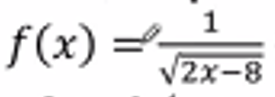
How to find the restriction here?
You must ensure that you meet both the requirement of x being greater than or = to 0 for the square root, and also ensure that the total value of the denominator does not and cannot equal 0.
Absolute value
The distance of a number from 0, always positive.
[example |x| = a, a ≥ 0 → meaning x is a units from 0 whether x = -a or x = a]
If x is in between two numbers? (absolute value)
It is LESS than
If x is outside of two values? (absolute value)
It is GREATER than
You can represent absolute value on a?
Number line!
Compound inequalities
The breakdown of what values x can take on. Changes depending on if the absolute value is greater or less than.
[example the absolute value notation is |x| < 8 then the compound inequality is -8 < x < 8. ]
Absolute value notation
To represent a compound inequality as an absolute value.
example: |x| > 9
≥ is the end point included?
Yes the end point is included because it can be equal to it.
< is the end point included?
No the end point is not included.
How to solve when there is a number added or subtracted inside the absolute value?
Simplify the inside first! and then find the value like normal
How to solve when there is a negative sign in front of the absolute value?
Find the absolute value and then multiply by -1
|x| < any negative number
No solution. Absolute value cannot be negative because it calculates distance.
|x| > negative number
Any number substituted for x will fit this requirement. So all numbers.

What is this?
Absolute value parent function. y = |x|

What transformation? Why?
2 units to the right. Because the value of d is 2, anything added or subtracted from x moves it on the x axis.
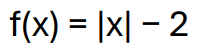
What transformation? Why?
2 units shifted down. Because the c value is -2, anything added or subtracted outside the absolute value moves the function on the y axis.
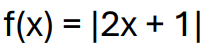
What is k and what is d? How to find these values?
To find k and d you first need to divide x and d by whatever number is in front of x. Then you will find that d is = -0.5 and k is = 2.