Ecology E3 Lec`1
 Call Kai
 Learn
 Practice Test
 Spaced Repetition
 Match
 Flashcards
 Knowt Play
1/46

There's no tags or description
Looks like no tags are added yet.
47 Terms
Species can be strong interactors for what two reasons?
They are abundant (or have high biomass)
They have high per capita interaction strength
What are three types of species that are strong interactors?
Keystone species, dominant species, foundation species
Direct interactions define
Direct interactions between two species and do not involve intermediary species
Indirect interactions define
Indirect interactions is the effects one species on another through a third species
What are general examples of direct interactions?
Competition, predation, herbivory, mutualism
What are general examples of indirect interactions?
Predator-mediated, apparent competition, trophic cascades, indirect commensalism
How are indirect actions shown on interaction diagrams?
Dashed lines
Give a specific example of indirect interaction
Giant Kelt Forest Community Interactions
Understory algae compete with giant kelp for light
Sessile invertebrates compete with understory algae for space
Giant kelp out competing understory algae indirectly benefits sessile invertebrates
How can you quantify interaction strength? Use Giant Kelp Forests as the example
Remove the kelp
Measure changes in the abundance of understory algae and sessile invertebrates in removal treatments and controls
Percent space cover, Biomass, tagging, mark & recapture
What is predator-mediated coexistence
Indirect positive effect of predators on inferior competitors

Give an example of a keystone species that involved predator-mediated coexistence
Starfish are the predators; Mussels (mobile) are dominant prey; Barnacles (sessile) are other prey
Starfish prevent mussels from outcompeting algae and other invertebrates in the intertidal
When starfish are removed, the number of species fell from 15 to 8
Can herbivores mediate coexistence among plants? Yes/No
Yes, herbivores can mediate coexistence among plants
In what ways can herbivore abundance effect plant diversity
Herbivores abundance can increase, decrease, both increase and decrease, or not change plant diversity
What are the three understandings to help explain the impacts of herbivores on plant diversity
Food preferences of herbivores
Competitive relationships among plant species in local community
Variation in competitive relationships and feeding preferences across environments
Discuss a keystone herbivory example
Littorina preferentially consumes the competitively dominant species, Enteromorpha
This has a positive indirect effect on Chondrus, the inferior competitor
Study
Without manipulation of Littorina, the abundance of dominant algae remained constant
Adding Littorina to a tide pool that had few of the snails reduced Enteromorpha cover
Removing Littorina from a tide pool where it had been abundant increased Enteromorpha cover
Intermediate Predation Hypothesis define/discuss
When there is very low amount of predators, the competitive dominant species wins. Low number of species.
When there is high levels of predations, most species are eaten. Low number of species
When there is intermediate levels of predators, there is coexistence. Highest species richness
Apparent competition define
Apparent competition is a type of competition where two different species of prey compete for survival from the same predator. Indirect negative effect on both competitors driven by a shared predator
Apparent competition example
Influences dynamics of endangered island foxes on Channel Islands
A decline in the abundance of bald eagles caused in increase in golden eagle colonization
This caused a decline in the abundance of Island foxes, a resident prey
Golden eagles have two native prey: Foxes and Skunks
Golden eagles also have invasive prey: Feral pigs
Model predicts native prey, which leads to the hypothesis that pigs support eagle population
Model predicts that the addition of pigs allows eagles to colonize the island and suppress fox populations
Pigs are not excluded because the feral pigs sustain the golden eagle population and tolerate high predation, whereas foxes are naive to golden eagles and are heavily overexploited
An example of how knowing about apparent competition interactions and help recover endangered species
Golden eagles and endangered island foxes due to their overexploitation and introduction of feral pigs
Removing only pigs may not have eliminated eagles since they were will established
Removing only eagles would not have prevented them from reestablishing
Therefore, removing both allowed the fox to rebound
Trophic cascade define
Indirect positive effect of predator on resources of its prey
Give examples of cascading impacts of predators
Otters, Urchin, and Kelp
Otters eat high levels of urchins, fishes, and invertebrates
Otter presence means size-selective predation on urchins
Increased urchins mean increased grazing and decimation of kelps, having a cascading effect on nearshore production (fish, seals, eagles, etc)
Therefore, otter presence leads to increased kelps
Wolves, Elk, and Aspen
Wolves were removed from Yellowstone, causing an increase in elk population
Increased elk population caused overgrazing and a decrease in aspen recruitment
Wolves were reintroduced, causing a decrease in elk and a change in elk behavior (lethal and non-lethal), a decrease in elk browsing, and therefore aspen trees grew taller
Density-mediated indirect effect: Indirect effect transmitted by a change in population density of species.
Trait-mediated indirect effect define
Indirect effect transmitted via changes in trait of species.
Trait-mediated indirect effects modify interaction strength
Example of Trait-mediated indirect effect
Wolves have high amounts in aspen stands.
This causes a low amount of elk to select aspen stands as a habitat
True of False: Ecological communities CAN NOT be understood as a sum of pairwise species interactions studied in isolation
True. Ecological communities cannot be understood as a sum of pairwise species interactions studied in isolation
How does energy flow on food webs? Up or down?
Energy always flows up the page on food webs
What interactions are typically missing on simplified food webs?
Competition (-/-)
Commensalism (+/0)
Such as animals using kelp as a refuge
Why are simple food web structures used even though they are typically incomplete?
The simple structure makes it clear what species are dependent on one another

Skua lose their source of food and decrease
Small fish and squid increase directly as penguins dont eat them anymore
Leopard seals heave to eat more other species causing indirect negative effects on those species, which causes indirect positive effects on the food level below

Increase in krill
Killer whales have to find other food sources, causing indirect negative effects on the other species they eat
This causes indirect positive effects on the food level below
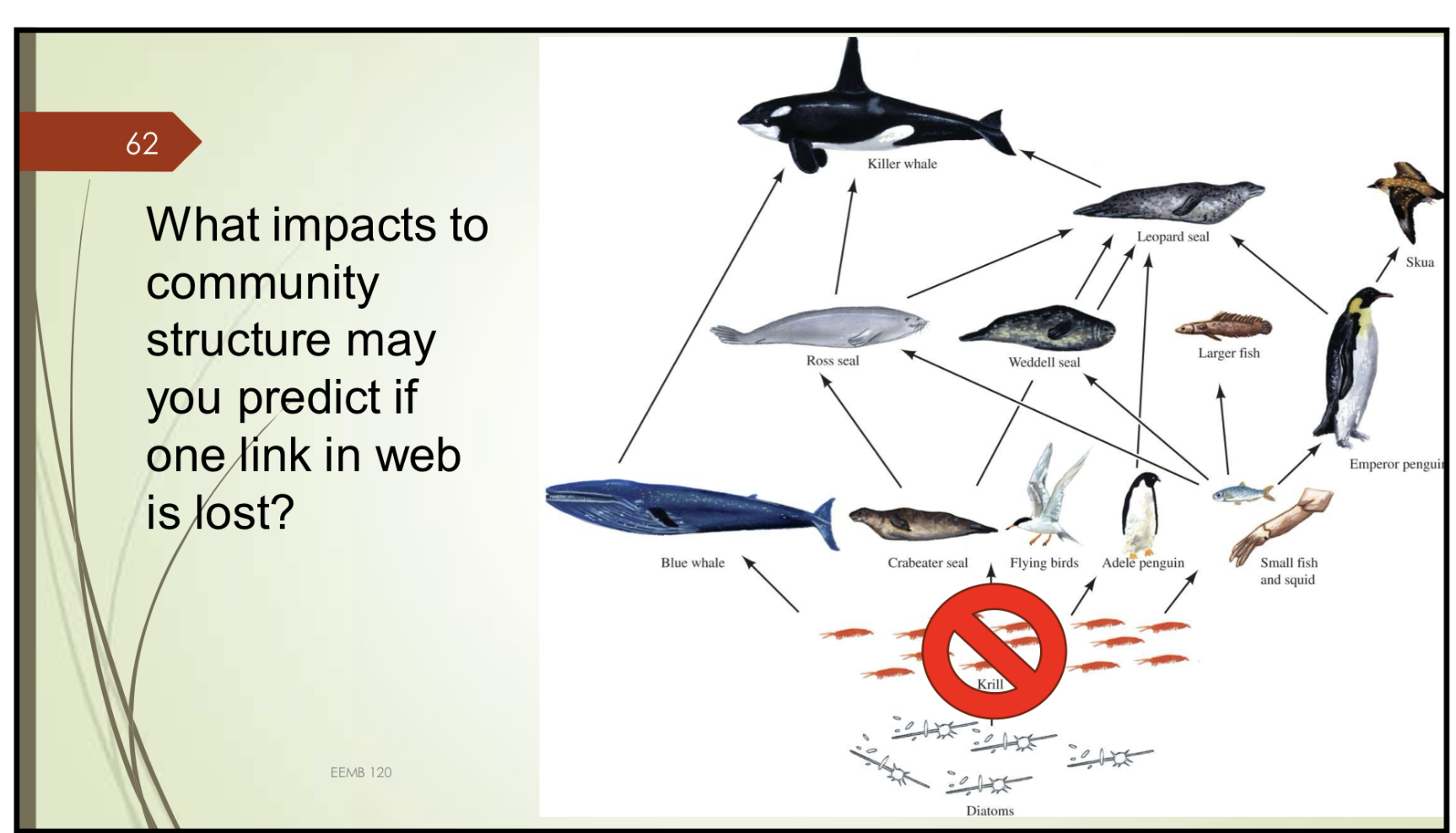
All species are effected negatively
Having no food source they all go extinct
Community Ecology vs Ecosystem Ecology
Community Ecology: Takes a numerical view of the community. How many of each species are there, how do they interact, and how does the abundance of one species impact the abundance of another?
Ecosystem Ecology: Focused on the flow of energy and material within a natural system — which species are important for moving energy through the system?
What are the three types of food webs?
Food webs: Emphasize feeding relationships among organisms
Energy flow webs: Show energy flow between resources and consumers
Functional interaction webs: Show links that maintain the integrity of community

How can you define interaction strength (includes equation and variables)
Per capita interaction strength
Interaction strength = (E - C) / C
E = Treatment (enclosure)
C = Control (No herbivore)
What is the effect of including herbivore in the interactions strength equation? Negative and Positive
Negative interaction strength when grazing decreases target abundance (E < C)
Positive interaction strength when it increases target abundance (E > C)
True or False: Community is often dominated by strong interactions
False: Community is often dominated by weak interaction
Strong interactions define
Feeding activities of a few species mayhave a dominant influence on community structure
In general, food webs have many weak/strong interactions and few weak/strong interactions
Why?
In general, food webs have many weak interactions and few strong interactions
Abundance of weak links stabilize food webs
Variation in organism abundance due to disturbance will rarely be felt across community

Label arrows and explain

Indirect Commensalism define
One species indirectly benefits another species (through a 3rd) while neither is helped or harmed
Discuss an example of indirect commensalism
Beavers fell cottonwood trees which then produce stump sprouts
Herbivorous beetles prefer consuming high nutrition sprout leaves
Beetles grow larger, faster, and utilize defensive compounds found in leaves
Beavers have positive effect on beetles through cottonwood trees. An indirect effect
Keystone species define
Feeding activities of a few species that have inordinate influences on community structure
What contributed to the keystone species hypothesis?
There being higher diversity when there are more proportion of predators in a community
Keystone species examples
Starfish
When starfish are removed, the number of species fell from 15 to 8
Community then dominated by mussels and barnacles
Fish
Predatory fish decrease → increase in midge production → decreased algal populations
Enclosing fish over an area of streambed
Decreased density of predatory insects
Decreased numbers of young roach and sticklebacks
Increased densities of herbivorous chironomids
Reduced algal biomass
Mutualistic Keystones define
Mutualists can act as keystone species despite low biomass
Give an example of a mutualistic keystone species
Cleaner fish
Fish species on coral reefs clean ectoparasites from other fish.
Fish species richness on coral reefs decreased significantly when cleaners were removed and increased significantly when added
Biological control define
Use of one organism by humans to control another
Give examples of humans modifying food webs
Human manipulate food webs by focusing on keystone species
Ex: Parasitic wasps used for biological control of cabbage worm