Transport and Cells Diagram
 Call Kai
 Learn
 Practice Test
 Spaced Repetition
 Match
 Flashcards
 Knowt Play
1/68

There's no tags or description
Looks like no tags are added yet.
69 Terms
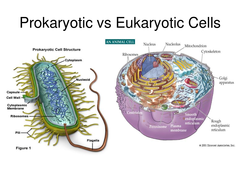
Eukaryotic Cell
cell that has a nucleus surrounded by a membrane, contain ER, mitochondria, Golgi Bodies.

Prokaryotic Cell
a cell from domain Archaea or Bacteria which is usually unicellular and lacks a distinct nucleus and has no membrane-bound organelles.
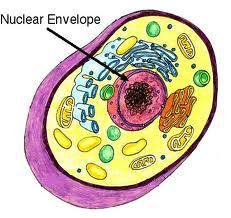
Nuclear Membrane
a double membrane that encloses the nucleus in which its outer part is continuous with the endoplasmic reticulum.
Nucleolus
manufactures the cell ribosomes.

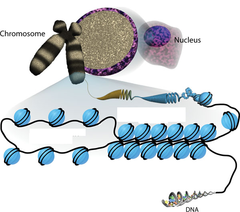
Chromatin
located in the eukaryotic nucleus; it is composed of DNA double helix wrapped in special proteins called histones; it is the ensemble of genomic DNA and a large number of proteins usually sprawled out like beads on a string.
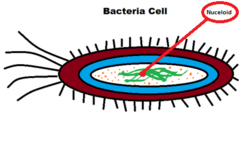
Nucleoid
the space in the prokaryotic cell's cytoplasm where genetic information (DNA) is found.
Ribosomes
site of protein synthesis
Smooth Endoplasmic Reticulum (SER)
Fatty acid and steroid synthesis (makes lipids); detoxifies toxic substances and contains no ribosomes.

Rough Endoplasmic Reticulum
An endomembrane system which functions to compartmentalize the cell providing a site-specific for protein synthesis with membrane-bound ribosomes and plays a role in intracellular transport.

The Golgi-Complex
is a membrane-bound structure that consists of a series of flattened membrane sacs called cisternae that functions to synthezise and package materials for transport (in vesicles) and the production of lysosomes.

Mitochondria
have a double membrane, the outside that is smooth and in the inside that is highly convoluted forming folds called cristae (to increase surface area) which contain enzymes important to ATP production.

Lysosomes
are membrane-enclosed sacs that contain hydrolytic enzymes which are important in intracellular digestion, the recycling of cell's organic materials, and programmed cell death (apoptosis).

Large Central vacuole
are present in plants and serve many functions such as storage of pigments and the large central vacuole holds large amounts of water or food.

vesicles
small membrane sacs that specialize in moving products into, out of, and within a cell

chloroplasts
organelles containing chlorophyll which is responsible for the green color and are the key light-trapping molecules of photosynthesis. These organelles have a double outer membrane that creates compartmentalization for thylakoids where the chlorophyll is housed to produce ATP and NADPH to fuel carbon-fixing reactions in the stroma where molecules of CO2 are converted to carbohydrates (glucose, C6H12O6).

Cytoskeleton
network of protein filaments within some cells that helps the cell maintain its shape and is involved in many forms of cell movement. Composed of microtubules that can form flagella or cilia, move chromosomes during nuclear division or provide a pathway for motor proteins to transport vesicles throughout the cell and composed of microfilaments for cell shape and movement.

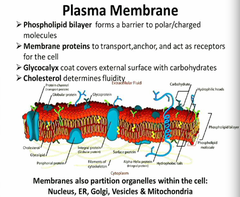
Cell membrane (plasma membrane)
phospholipid bilayer that surrounds all cells and regulates what enters and leaves the cell.
selectively permeable
a property of cell membranes that allows some substances to pass through, while others cannot
Phospholipid molecules
compose the membrane structure; have polar phosphate heads (hydrophilic) and lipid non-polar tails (hydrophobic)

Phospholipid bilayer is best described as
a two-layered arrangement of phosphate and lipid molecules that form a cell membrane, the hydrophobic lipid ends facing inward and the hydrophilic phosphate ends facing outward.

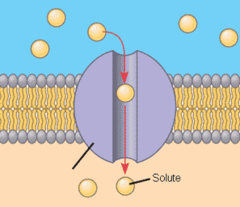
Channel proteins
have a hydrophilic channel that certain molecules or ions can use as a passageway.
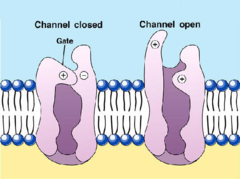
ion gated channels
proteins responsible for allowing sodium or potassium to diffuse into or out of the axon
Aquaporins
water channel proteins that allow water to diffuse from regions of high water to regions of low water.

Plasmolysis (plant cells)
The pulling away of the cytoplasm and plasma membrane from the cell wall due to lack of water

receptor proteins
Proteins that transmit information in and out of cells. They allow communication between cells.

Cholesterol in membrane
a lipid embedded in the phospholipid bilayer that helps maintain fluidity of the membrane, especially in cold temperatures.

Diffusion
Movement of molecules from an area of higher concentration to an area of lower concentration or down the concentration gradient.

facilitated diffusion (passive transport)
Movement of specific molecules across cell membranes through protein channels without energy (ATP) down the concentration gradient.

active transport
Energy-requiring (ATP) process that moves material across a cell membrane against a concentration gradient (from low concentration to high concentration).

exocytosis
release of substances out a cell by the fusion of a vesicle with the membrane.
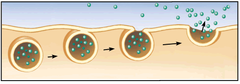
Endocytosis (phagocytosis and pinocytosis)
A process in which a cell engulfs extracellular material through an inward folding of its plasma membrane.
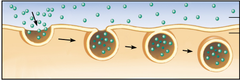
Receptor-mediated endocytosis
This process forms vesicles containing the absorbed substances and is strictly mediated by receptors on the surface of the cell. Only the receptor-specific substances can enter the cell through this process.

Glucose transport protein
a type of protein molecule that responds to the insulin signal to facilitate glucose uptake from the blood stream into liver cells or skeletal muscle cells.

insulin
A protein hormone synthesized in the pancreas that regulates blood sugar levels by signaling the cells to uptake of glucose from the blood into the cytoplasm of the cell.

osmosis
Diffusion of water through a selectively permeable membrane
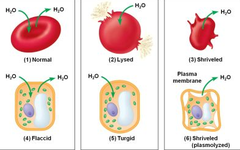
A hypertonic solution surrounding a cell
has a solute concentration greater than that inside the cell whose solution is described as hypotonic; the cell responds with a net flow of water loss.
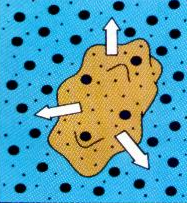
A hypotonic solution surrounding a cell
has a solute concentration less than that inside the cell which is described as hypertonic; the cell responds with a net gain of water, swells.

An isotonic solution surrounding a cell
is a solution whose solute concentration is equal to the solute concentration inside a cell which is described as isotonic.
water potential
The physical property predicting the direction in which water will flow, governed by solute concentration and applied pressure. Water potential = solute potential + pressure potential.

solute potential
This measurement has a maximum value of 0; it decreases as the concentration of a solute increases.

Equation for solute potential
-iCRT in which i = the ionization constant C = molar concentration (moles/L) R = pressure constant (0.0831 liter bars/mole K) and K is temperature in Kelvin. T= temperature in degrees kelvin = 273 +C'
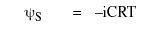
What is the solute potential Ψs of a 1.0M sugar solution at 22 degrees Celsius under standard atmospheric conditions Ψp=0 ? Round to the nearest tenth.
-24.5 Bars
A plant cell has a solute potential of -4.0 bars and a pressure potential of 1.0 bar. What is its water potential to the nearest whole number? If this cell is placed in a solution with a water potential of -5.0 bar. What will happen to this cell?
-3.0 Bars. If this cell is placed in a solution with a water potential of -5.0 bars, the cell will lose water by net flow and shrink.
endomembrane system
is a group of membranes and organelles in eukaryotic cells that works together to modify, package, and transport lipids and proteins. It includes a variety of organelles, such as the nuclear envelope and lysosomes, and the endoplasmic reticulum and Golgi apparatus, and vesicles.
How does surface area to volume ratio affect cells?
The surface area to the volume ratio gets smaller as the cell gets larger. If the cell grows beyond a certain limit, not enough material will be able to cross the membrane fast and far enough to accommodate the increased cellular volume. This is why cells are so small.
surface area of a cell is like the
plasma membrane
volume of a cells is like the
cytoplasm
fluid mosaic model
describes the arrangement and movement of the molecules that make up a cell membrane
small polar molecules
Water, oxygen and carbon dioxide
- can go through membrane but more slowly
- do not require proteins
cell wall structure
made of cellulose in plants chitin in fungi and peptidoglycan in bacteria
cilia and flagella
hairlike structures that extend from the surface of the cell, where they assist in movement
passive transport and examples
does not require energy
eg. diffusion and osmosis and facilitated diffusion
Active transport requires
the direct input of energy to move molecules from regions of low concentration to regions of high concentration
phosphorylation
the addition of a phosphate group to a molecule
ATP/ADP cycle
When a phosphate is added to a protein, through chemical reactions called phosphorylation in a cell, so that the cell can do cellular work. The lower energy Adenosine Diphosphate (ADP) is then re-energized during cellular respiration when a phosphate group is re-attached, thus completing the cycle of ATP to ADP to ATP.
Turgor pressure in plant cells is
-A way to help the cell maintain its structure by pushing outward on the cell wall -The force of water against the inside of the cell wall -Necessary to keep plants from wilting -A result of the walled cell being in a hypotonic environment -Due in part to osmosis
endosymbiotic theory
a theory that states that certain kinds of prokaryotes began living inside of larger prokaryotes and evolved into the organelles of modern-day eukaryotes
meaning of hyper-
excessive, above, more than normal
Meaning of hypo-
less
meaning of iso-
equal
meaning of -tonic
solute
Neuron
a nerve cell; the basic building block of the nervous system
amphipathic
A molecule that has both a hydrophilic region and a hydrophobic region.
If a human red blood cell is placed in
pure water, it will
bloat up and may explode.
When two aqueous solutions that differ in solute concentration are placed on either side of a semipermeable membrane and osmosis is allowed to take place, the water will _____
A) exhibit a net movement to the side with lower solute concentration.
B) exhibit a net movement to the side with higher free water concentration.
C) exhibit an equal movement in both directions across the membrane.
D) exhibit a net movement to the side with lower free water concentration.
D)
In the lab, you use a special balloon that is permeable to water but not sucrose to make an "artificial cell." The balloon is filled with a solution of 20% sucrose and 80% water and is immersed in a beaker containing a solution of 40% sucrose and 60% water. Which of the following will occur?
A) Water will leave the balloon.
B) Sucrose will leave the balloon.
C) Sucrose will enter the balloon.
D) Water will enter the balloon.
A)
Some protozoans have special organelles called contractile vacuoles that continually eliminate excess water from the cell. The presence of these organelles tells you that the environment
A) is isotonic to the protozoan.
B) is hypotonic to the protozoan.
C) is hypertonic to the protozoan.
D) contains a higher concentration of solutes than the protozoan.
B)
A plant cell in a hypotonic solution
A) shrivels because of an outflow of water.
B) bursts because of an inflow of water.
C) becomes turgid because of an inflow of water.
D) wilts because of an outflow of water.
C)
Phosphorylation
The transfer of a phosphate group to a molecule or compound