Flashcards Clemson Bio 1030 Exam 2 Chapter 5
 Call Kai
 Learn
 Practice Test
 Spaced Repetition
 Match
 Flashcards
 Knowt Play
1/64

There's no tags or description
Looks like no tags are added yet.
65 Terms
Examples of Cellular Work
- active transport of ions across
membranes
- the beating of cilia or flagella to
move a cell
-the contraction of a muscle to
walk or run
-the manufacture of polymers
from monomers
-the metabolic generation of
heat to stay warm
-the flash of a firefly
The fluid mosaic model for membrane structure
proteins floating in a sea of lipids
-membranes are composed of a bilayer of phospholipids in the fluid state
Integral proteins
Are embedded in the membrane
Peripural Proteins
are loosely attached
Proteins and lipids move....
freely about in the membrane
lipid Rafts
-solidifed subdomains of the plasma membrane enriched in cholesterol, glycosphingolipids containing saturated fatty acids and signal proteins
-aka lipid domains
-freely float in fluid lipid bilayer
-thought to be involved insignia transduction
Functions of membrane Proteins
-attachment proteins
-receptor proteins
-channel proteins
-active transport proteins
-junction proteins
-recognition proteins
-enzymes
Impermeable molecules
- Charged Ions and Molecules
- Macromolecules and proteins
- Polar Molecules
Permeable molecules
- uncharged molecules
- lipid-soluble molecules
- gases (CO2, O2)
- water
-note most biologically relevant molecules have specific transporters that move them across the membrane
The spontaneous formation of membranes was a critical step in origin of life
-conditions of ancient earth favored the spontaneous production of amphiphiles
-phospholipids are amhiphiles
-they spontaneously form bilayers and vesicles when mixed with water
-vesicles resemble the first cells
Diffusion
the spontaneous net movement of a substance from a region where it has a high concentration to a region where it has a low concentration
OR
The tendency of particles to spread out evenly in an arable space
Passive
No energy is needed to allow material passage.
due to the random kinetic motion
-occurs down a concentration gradient
-one type of molecule moves independently of another
-continues until equilibrium is achieved
Passive Transport
Diffusion across a membrane
Factors that affect the rate of diffusion (Governed by flicks law)
-Concentration difference
-temperatrue
-area for diffusion
-molecular size
-distance for diffusion
-resistance of diffusion medium
Osmosis is....
is the diffusion of water across a membrane
Osomis
The diffusion of water across a selectively permeable membrane from a region of a low solute concentration to a region of low solute concentration to a region of high solute concentation
-solutes do not cross membrane
-water molecules are attracted to solute molecules
-water levels change accordingly
water balance between cells and their surroundings is crucial to organisms
-all aline and life processing occur in an aqueous environment
-water moves freely across all mebrained by osmosis in response to differential solute concentrations
All cells must _________ to maintain optimum water balance
Osmoregulate
Toxicity
A term that describes the ability of a bathing solution to cause a cell to gain or lose water
Types of toxic solutions
Hypotonic, Isotonic and hypertonic
Hypotonic
Solute and water concentration outside the cell is less than inside the cell; water enters the cell
Isotonic
Solute and water concentration inside and outside of a cell are equal; no net water movement
hypertonic
Solute concentration outside the cell is greater than inside the cell; water leaves the cell
Facilitated diffusion
The passive carrier- mediated (ie assisted) transport of a substance across a biological membrane down a concentration gradient
Mechanisms
Some proteins form a hydrophilic tunnel for passage of specific ions or molecules
other proteins specifications or molecules
-other proteins specifically bind substances, change their shape and release them on the other dise
-eg the Na+ and K+ gated channels in nerve impose transmission; aquaporins
Aquaporins
membrane bound transport proteins that facilitate the diffusion (ie osmosis) of water across membranes
-especially important in cells that process a lot of water
-kidney cells
-plant cells involved in symplastic transport
active transport
The energy (ie ATP) - dependent transport of a substance across a biological membrane.
-Involves the hydrolysis of ATP and specific transport proteins.
-Results in transport and accumulation against a concentration gradient
-includes endocytosis and exocytosis

The Hydrolysis of ATP
ATP + HATP + H22O O ADP + P ADP + Pi i + Energy
Exocytosis
The process by which the contents of intra-cellular vesicles are released to the outside of a cell by fusion with the plasma membrane
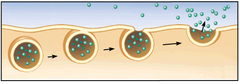
Endocytosis
The process by which extracellular materials are taken into a cell via the infolding of the plasma membrane and the formation of vesicles
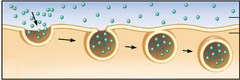
Energy
the capacity to do work
Examples of Biological work/change
-Active Transport of ions across membranes
-The movement of cillia or flagela to move a cell
-The contraction of a muscle to walk or run
-The manufacture of polymers from monomers
-The metabolic generation of heat to stay warm
-The flash of firefly
Kinetic Energy
The energy of motion (of waves, molecules, objects, substances, ect.)
Examples of Kinetic Energy
-Solar/radient energy (light, x-ray, gamma ray, radio waves)
-Heat energy (vibration and movement of atoms and molecules)
-Motion energy (moving cars, bullets, muscles)
-Sound energy (damaged ear drumbs, shattered glass, sonic boom)
Potential Energy
Stored energy
Examples of Potential Energy
- Chemical energy (bond energy between atoms & molecules; food).
- Nuclear (atomic) energy (within atoms; fission & fusion of atoms).
- Electrical energy (batteries).
- Gravitational energy (energy of falling objects; waterfalls).
- Mechanical energy (elastic materials; springs, rubber bands)
-Pressured energy (Pistons, balloons, osmotic)
Energy transformations
-living systems function by transforming one form of energy to another
Thermodynamics
The study of energy transformations that occur in a collection of matter
Laws of Thermodynamics
rules to help explain energy transformations and flow
First law of thermodynamics
The total amount of energy in the universe is constant
-energy cannot be created or destroyed but it can be transformed from one form into another
Second law of thermodynamics
no energy transformation process is 100% efficient
-Every transformation involves the loss of heat energy
-Heat energy is a "disordered" form of energy that is unavailable to do work (aka "entropy")
-Every energy transformation increases the "disorder " of the universe
-Entropy is the measure of disorder or randomness
Examples of entropy increases
-melting of ice
-Dissolution of NaCl
-Oxidation of Glucose
Examples of entropy increasing energy transformations
-Both cars and cells...
burn fuels to release energy
Have the same summary reaction: Fuel + o2-> CO2 + H20
Give off heat and increase Entropy
-Automoblies- convert stored chemical (potential energy) into kinetic energy
-Cells convert stored chemical (potential) energy into metabolic energy
Cells are 34% efficient
Cars are 25% efficient
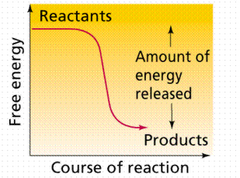
Exergonic (Exothermic)
-Give off energy
-Products have less energy than reactants
-eg cellular respiration
Endergonic (Endothermic)
-Consumes (requires) energy
-Products have more energy than reactants
-eg photosynthesis
Metabolism
The total of an organisms reactions
-Divided into metabolic pathways
Anabolism
Catabolism
-involves energy coupling via ATP
Anabolism
Builds up molecules
Catabolism
Breaks down molecules
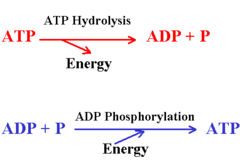
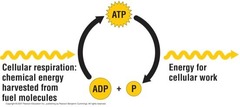
The hydrolysis of ATP
ATP + H2O --> ADP + Pi + energy
Energy use involves phosphorylation reactions
Phosphorylation reactions are involved in biological work
Note:Only the bonds between the 1Only the bonds between the 1stst & 2 & 2ndnd P Pi i and the and the 22ndnd & 3 & 3rdrd P Pii have usable energy. These bonds are have usable energy. These bonds are sometimes emphasized as a "squiggle" (i.e. "sometimes emphasized as a "squiggle"
ATP
energy currency of the cell

ATP cycle
How enzymes function
Enzymes speed up the cells chemical reactions by lowering energy barriers
Enzymes are.....
biological catalysts
Not consumed in the reaction
Normally proteins, sometimes RNA molecules
Characteristics of Enzymes
-Very specific- can catalyze one specific reaction
-Specificity is aided by shape of the active site
-Originally explained as the "Lock and Key Model" for enzymes but now explained by the "induced fit model"
-Weakness of lock and key model: Enzymes and reactants are not rigid molecules
Reversible - can carry out a reaction in the forward or reverse direction; bring reactions to equilibrium
Active Site
The part of an enzyme where the Substrate binds and the catalytic reaction occurs (aka the catalytic site)
Induced fit
active site and substrate both change shape during binding
enzyme-substrate complex is formed
reaction may or may not proceed forward
products are formed and released
enzyme reverts back to relaxed state
Enzyme cofactors
2 types
-inorganic metal ions (Mg 2+, Fe 2+, Cu 2+, Zn 2+).
-Organic co enzymes - non protein molecules (often dirived from vitamins)
Competitive inhibitor
inhibitor has a similar shape to substrate
inhibitor binds to active site preventing binding of substrate
inhibitor comptes with substrate for active site
non-competitive inhibitor
inhibitor has a different shape than substrate
binds to an allosteric ("other shape") site
binding to inhibitor changes shape/affinity of active site
Ibiprofen
inhibits prostaglandin synthesis (signal - inhibits prostaglandin synthesis (signal molecules for pain & inflammation).
Lipitor
inhibits pathway for cholesterol synthesis.
Penicilin
inhibits bacterial cell wall synthesis.
Glyphosate
aka "Roundup"; inhibits aromatic amino acid synthesis.
Hydrogen Cyanide
inhibits respiratory electron transport (ATP synthesis).
Sarin Gas
aka "Nerve Gas"; inhibits nerve impulse transmission & muscle contraction; results in transmission & muscle contraction; results in paralysis of vital organs & death.