Skin Diseases in Horses 2
 Call Kai
 Learn
 Practice Test
 Spaced Repetition
 Match
 Flashcards
 Knowt Play
1/32

There's no tags or description
Looks like no tags are added yet.
33 Terms
When should you biopsy a nodule in equine medicine?
Neoplasias (caution with suspect sarcoids), persistent ulcerations, unusual dermatopathies, vesicular dermatopathies, lesions with poor response to rational therapy, when treatments are expensive dangerous and/or time consuming
What should you biopsy?
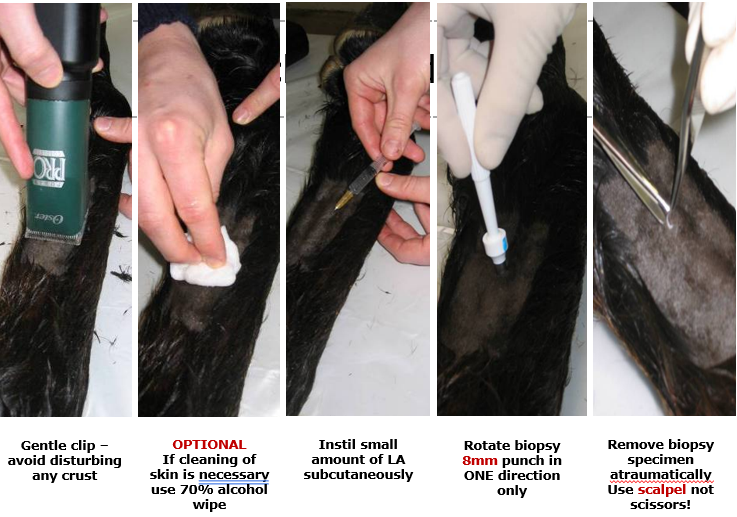
Primary lesions if identifiable, if multiple find one that is typical, if all varied then find a spectrum of lesions and take multiple biopsies, include crustss!
Where should you avoid biopsying in the horse?
Saddle area if possible
What options do we ahve for obtaining a biopsy of a lesion?
Biopsy punch, tru-cut, excisional, wedge, ‘shave’, or FNA biopsies
How should you prepare the horse for a biopsy?
Physical restraint/sedation and local anesthesia, clip area (without touching the skin surface), DON’T scrub skin
Minimal manipulation of sample itself
Appreciate
I Arpiciated it thx dad
With punch biopsies from a superficial skin disease, how many smaples and where should the samples go?
3-4 taken and put into 10% formalin or direct into media for microbial culture
What should you do if your biopsy sample is large?
Partially dissect at 1 cm intervals
What should be provided to all histoapthologists along with the sample?
Historical and clinical information
What is the most common skin neoplasm in horses?
Sarcoids
Describe what type of lesion sarcoids are.
Locally invasive, fibroblastic tumor. Produce granulomatous lesions and do not metastasize but are unpredictable.
What are the risk factors that may predispose a horse to sarcoids?
Younger horses ,Quarter horse, Appaloosas, Thoroughbreds, Arabians all more prone to developing.
Geldings?
What is the etiology of sarcoids?
Likely bovine papillomavirus I/II involved, possible link with trauma/surgery, genetic link as well
What are the predilection sites of sarcoids?
Head, ventral abdomen/thorax, axillae, groin, and limbs
What can sarcoids appear like?
Variable. Some have dermal thickening, some are firm, some just in epidermis, some ulcerated. Sometimes one, sometimes multiple
Why do we bother to categorize sarcoids?
Six groups, each has different implications for biological activity and treatment. Can transform from one to another
What are the different groups sarcoids can be categorized as?
Occult, Verrucose, Nodular, Fibroblastic, Mixed, Malignant

What is shown here?
Sarcoids, Occult classification
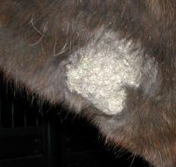
What is shown here?
Sarcoids, Verrucose classification

What is shown here?
Sarcoids, Nodular classification

What is shown here?
Sarcoids, Fibroblastic classification
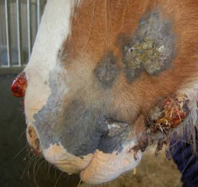
What is shown here?
Sarcoids, Mixed classification
How can we diagnose a lesion as a sarcoid?
Clinical appearance, biopsy (with EXTREME caution), characteristic histopathology
What is the prognosis of sarcoids in a patient?
Guarded, recurrence is common so repeat treatments often necessary
How can we treat sarcoids in horses?
Conventional surgery, laser surgery, ligation, cryosurgery, chemotherapy, or a mix of several of the above.
What are some cons of conventional surgery treatment to sarcoids?
High recurrence rates (up to 50%), large margins required
What are some pros and cons of laser surgery treatment to sarcoids?
Possibly reduced recurrence rates, can destroy marginal cells. Cons: delayed healing
What are features of the cryosurgery treatment to sarcoids?
2-3 freeze-thaw cycles (often with debulking), better with adjunctive treatments
Depigmentation possible
How does Cisplatin work on a cellular level?
Interferes with DNA replication
How does 5-fluorouracil work on a cellular level?
Stops DNA production

Look at it
So fancy
What type of medication is Liverpool cream?
A topical chemotherapy (cytotoxic)
Slide 23