2.8: Industrial "white" biotechnology
 Call Kai
 Learn
 Practice Test
 Spaced Repetition
 Match
 Flashcards
 Knowt Play
1/53

There's no tags or description
Looks like no tags are added yet.
54 Terms

Outline 2.8
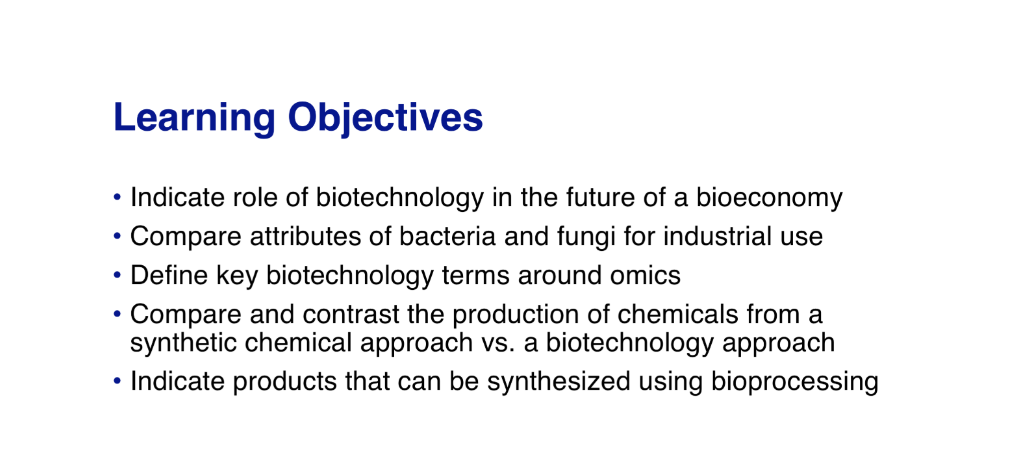
Learning Obj 2.8
Biotechnology
Biotechnology is technology that utilizes biological systems, living organisms or parts of biological system to develop or create novel products.
Also, for redesigning products to make them more effective
What is industrial biotechnology?
Using microorganisms and enzymes to produce useful biobased products.
Which sectors use industrial biotechnology?
Chemicals, food and feed, healthcare, and biofuels.
Which organisms are commonly used IN BIOTECHNOLOGY?
Yeasts, fungi, and bacteria.
What characterized early biotechnology?
Traditional, largely uncontrolled food fermentation and processing.
EX: Wine, beer, vinegar, bread, and cheese production.
How is modern industrial biotechnology controlled?
By managing strains and conditions such as temperature, pH, and dissolved oxygen.
Colors of Biotechnology Revolutions
RED
medical
Colors of Biotechnology Revolutions
WHITE
biofuels
Colors of Biotechnology Revolutions
BLUE
water/ocean based
Colors of Biotechnology Revolutions
GREEN
food based
Chassis for Biotechnology
Food security
Biofuel Development
Waste Management
Manufacturing
Genomics
Antimicrobial and Pharmaceutical Production
Biofuel Development
Chassis for Biotechnology—FUNGI
AGRICULTURE
ENERGY
ELECTRICITY
ELECTRONICS
PULP & PAPER
AUTOMOTIVES
CONSTRUCTION
CHEMICALS
TRANSPORT
WATER
PHARMA
SHIPBUILDING
AEROSPACE
COMPUTER
TEXTILES
FOOD

What is bioprocess engineering?
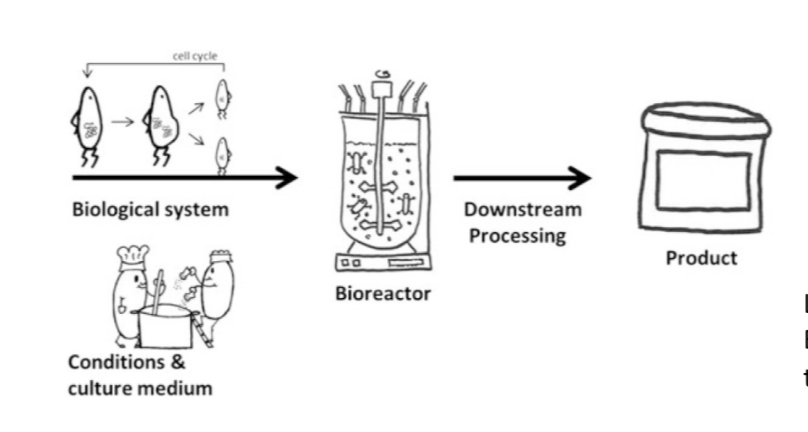
Applying engineering principles to scale up biological processes using biocatalysts, microorganisms, cells, or their components to produce valuable products commercially.
What are the three phases of bioprocess engineering?
Upstream processing, bioreaction, and downstream processing.
Why is downstream processing critical in bioprocess engineering?
Products are only 10–15% of the broth, so separation and concentration are essential and time-consuming.
What does bioprocess engineering use to generate value-added products?
Biocatalysts, microorganisms, cell lines, or parts of them
bioprocess engineering
What are prokaryotes?
Single-celled organisms without a membrane-bound nucleus or specialized membrane-bound organelles.
bioprocess engineering
What are eukaryotes?
Organisms with a membrane-bound nucleus and other membrane-bound organelles
What are the main advantages of bacteria in biotechnology?
Easy genetic manipulation, high productivity, fast growth, and resistance to stress
Why are bacteria cost-effective for industrial biotechnology?
They grow in comparatively inexpensive growth media.
Which stresses can bacteria tolerate?
Shear stress, pressure, and osmotic stress.
What are examples of bacteria used in biotechnology?
E. coli, Bacillus spp., Clostridium (able to use syngas) , and Corynebacterium glutamicum.
What are recombinant proteins? bacteria
Proteins produced by genetically engineered host cells using recombinant DNA.
→ an artificially created DNA molecule formed by joining genetic material from two or more different sources, often from different specie
What are the main benefits of fungi / yeast in biotechnology?
High productivity of homologous proteins, fast growth, and high cell densities.
Why is large cell size useful in fungal/ yeast biotechnology?
It can support high productivity and efficient industrial processes.
Why is extracellular enzyme secretion important fungi/yeast ?
Fungi can release enzymes outside their cells, making collection easier.
Why is pH tolerance important in fungal/ yeast biotechnology?
It allows fungi to tolerate acidic conditions, useful for acid production.
Which fungal/ yeast organisms are commonly used in biotechnology?
Saccharomyces, Penicillium, and Aspergillus.
Upstream processing, strain development
Strains:
Sub-classification of species that show a variant
Upstream processing, strain development
Wild-type strains vs engineered strains:
Strains can be developed to improve productivity and tolerance
Methods include: screening & mutagenesis, genetic engineering, metabolic engineering (directed mutagenesis), and synthetic biology
Upstream processing, strain development
Micro-organisms reproduce relatively rapidly so:
Strains can be mutated via external component→directed evolution
Genetic engineering→genes inserted into organism with a vector or chromosomal integration
Metabolic engineering → Pathways enhanced or deleted via metabolic flux
Synthetic biology → metabolic pathways designed/inserted into suitable organism
metabolic engineering → synthetic biology

Synergies between synthetic biology and metabolic engineering
improvement and/or design cells vs. cell factories tailormade for efficient production of fuels and chemicals
Different biotechnology “omics” fields that are sueful for strain development
Genomics: DNA
Transcriptions: RNA
Proteomics: Proteins
Metabolomics: Metabolites
“omics”
What is genomics?
Study of an organism's entire genome (DNA and genetic information).
“omics”
What is transcriptomics?
Study of RNA transcripts to understand gene expression and when genes are active.
“omics”
What is proteomics?
Study of which proteins are expressed and when they are produced.
“omics”
What is metabolomics?
Study of metabolites produced by cells, including compounds valuable for industrial biotechnology.
“omics”
What is a transcriptome?
The complete set of RNA transcripts produced by an organism or cell.
“omics”
How does RNA become a protein?
RNA is processed (including cutting and splicing) into mature mRNA, which carries genetic instructions to the ribosome, where it is translated into protein
“omics”
What is protein expression profiling in proteomics?
Identifying which proteins are present at a specific time, often in response to a stimulus.
What is genotype?
The genetic makeup of an organism: the genes or alleles it carries
What is phenotype?
The observable characteristics or traits of an organism, resulting from its genotype and environmental influences
How are genotype and phenotype related?
Genotype provides the genetic instructions that influence phenotype, while the environment can also affect how traits develop
Bioprocess Engineering
What is a biocatalyst in bioprocess engineering?
A living cell or an enzyme used to catalyze a biological reaction.
Bioprocess Engineering
Why do we need to grow biocatalysts?
To obtain a sufficiently high concentration of cells or enzymes for the bioprocess.
Bioprocess Engineering
How do bacteria and yeast generally reproduce?
Bacteria reproduce through binary fission (one cell divides into two). Many yeasts reproduce by budding, while some use fission.
Bioprocess Engineering
How do fungi grow?
via apical growth or “ramification” new cell is added to an existing one
What are specific growth rate and optical density (OD)?
specific growth rate → growth in reactor
Optical density→provides the idea of growth
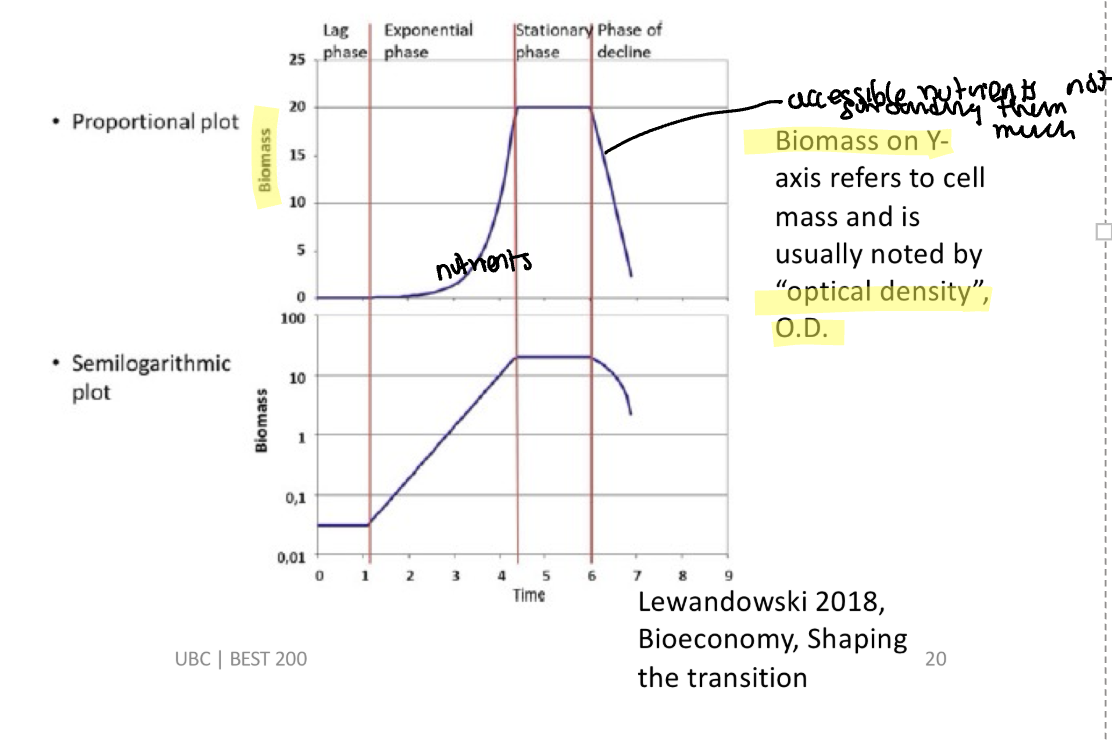
Cell growth curves important for screening to production
Lag phase:
Adapt to the new environment with zero growth

Cell growth curves important for screening to production
Exponential phase:
growth occurs
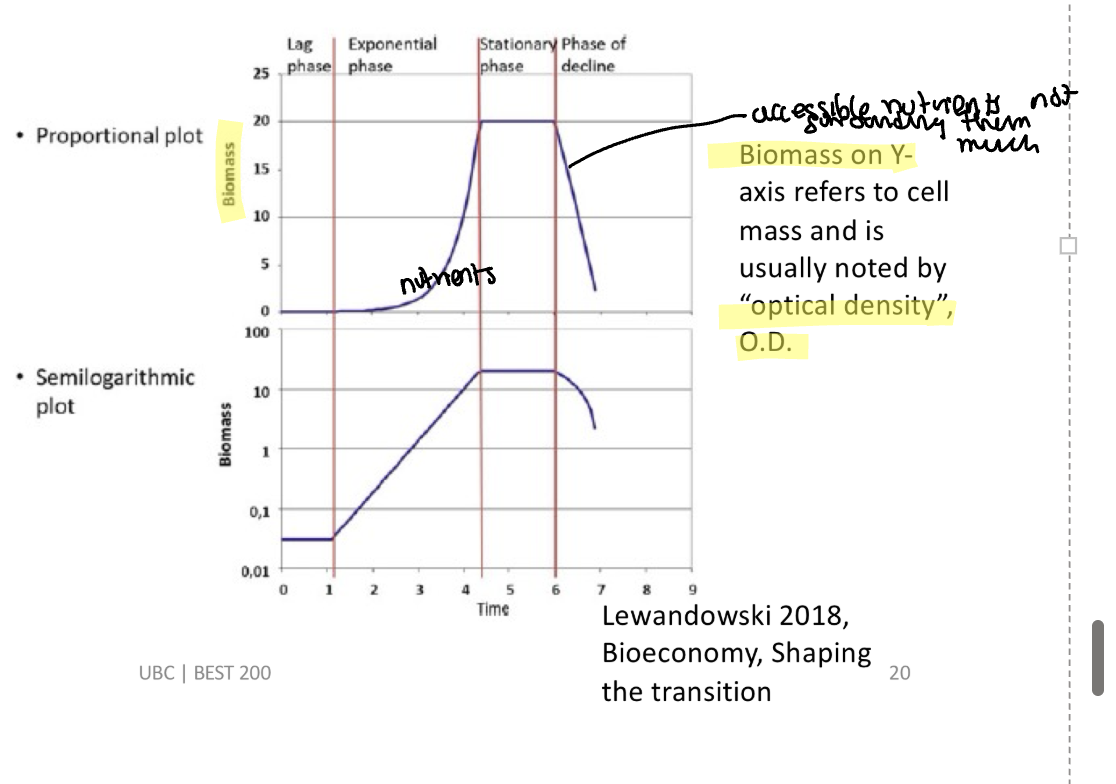
Cell growth curves important for screening to production
Stationary phase:
limited by consumption of available nutrients and levels off