Module 5: Cell Communication
 Call Kai
 Learn
 Practice Test
 Spaced Repetition
 Match
 Flashcards
 Knowt Play
1/45

There's no tags or description
Looks like no tags are added yet.
46 Terms
why do cells communicate
there are a lot of them and they all need to communicate to stay health with eachother and their environment. Both single and multicellular organisms need to do this
how concentration of cells in bacteria affect chemical signals
the more cells the stronger the chemical signal
quorum sensing
chemical signal conccentrations allow bacteria to monitor local cell density
what happens when threshold(max) levels of signaling are reached
the bacteria responds by:
the formation of fruiting bodies/spores (thick walls that allow bacteria to survive low nutrient conditions)
formation of biofilms (large sheets of films of bacteria, form when there are a lot of nutrients)
secretion of toxins (some signals are a danger sign, so toxins form to protect themselves)
direct cell comunication
junctions
cell-to-cell connections

indirect cell communication
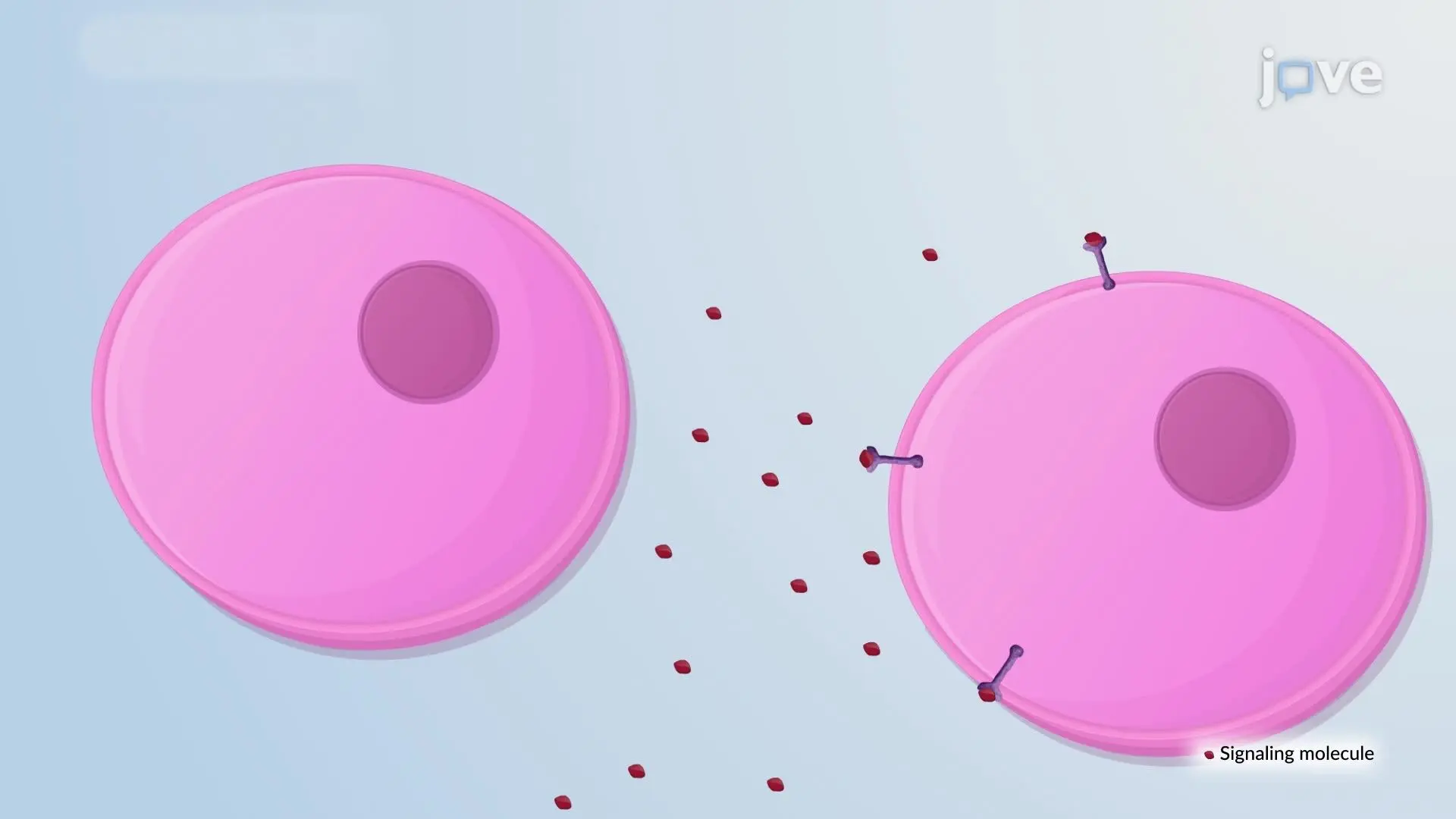
the cell sending the signal will create a signaling molecule and that then travels to the target or recieving cell
paracrine signaling
local (target/signaling cell are close together)
synaptic signaling
local (specific to neurons, when the signaling molecules reaches the end a neuro transmitter is released)

endocrine signaling
long distance (hormones travel through bloodstream to get to target)

step 1 cell signaling
Reception: target cell detects/recieves signal
step 2 cell signaling
transduction: message is relayed into the cell. The connection between the signal/response. often a series of steps
step 3 cell signaling
response: target cell changes behavior based on signal
where r signal receptors found
in the cytoplasm/nucleus (few)
In the membrane (most)
ligand
a molecule that binds to another molecule. Receptors bind to this
where r intracellular receptors located
cytoplasm/nucleus of target cell
characteristics of ligand binding to intracellular receptor
the ligand has to be able to pass through the membrane to reach the receptor so they have to be:
hydrophobic
steroid hormones
thyroid hormones
small (nitric oxide)
Intracellular Aldosterone Signaling
1) Aldosterone secreted by adrenal glands on kidneys
2) circulates / enters cells throughout body using endocrine signaling
3) aldosterone binds to receptors in the cytoplasm of the kidney
4) Complex travels into the nucleus
5) Causes cell to make a protein it wasn’t before leading to
change in water/Na+ balance in Kidneys
blood volume change
cell surface receptors
1) ion channel receptors
2) g protein coupled receptors
3) receptor tyrosine kinases
ligand gated ion channells
span the entire membrane from top to bottom
Ligand binds and channel opens
ions will pass through down the concentration gradient triggering a cell response

GTP
when a protein is attached to this it acts as an on switch
GDP
when a protein is attached to this it acts as an off switch
G protein coupled receptors (on/off switch)
most proteins are off and turn on for a signal, when there is a signal the GDP get taken off and the cell brings in a molecule of GTP turning the protein on, triggering a response. When the signal ends GTP converts to GDP, by 1 phosphate being removed
steps of g protein coupled receptor
1) ligand bings to GPCR and activates it
2) G protein is activated and is able to touch the GPCR, which makes the change from GDP to GTP
3) The g protein will then detach from the GPCR and attach to an enzyme
4) The g protein is then inactivated (looses P)

phosphorylation
adds phosphates to molecules
dephosphorylation
removes a phosphate to form a protein
protein kinases
add phosphates to molecules
protein phosphotases
removes a phosphate to turn off a protein
Receptor tyrosine kinases
1) ligand binds to two RTK subunits in the membrane (when they are seperate = inactive)
2) RTK subunits dimerize and become active
3) RTK phosphyroylates itself on tyrosine
4) Since RTK are kkinases they can attach proteins, so when they become active they start phsophorylating themselves, they add the phosphate groups on the amino acid tyrosine (using 6 ATP)
5) other signaling proteins bind to the phosphorylated RTK leading to cell responses
signal transduction
1) the signal is transmitted across the membrane
2) the first protein activates the second protein in the strucutre, the second protein activates the 3rd protein
3) this continues until the cell activates the protein that will screate a cellular response which is why this is often referred to as a reaction cascade
second messsenger
how information is transmitted within the cell, either produced or released from storage with the presence of the first messenger
first messenger
extracellular signal
examples of 2nd messenger
cAMP, IP3, calcium ions
signal amplification
taking a weak signal and increasing the strength of the cellular response
pathway branches
2 different responses

cross talk
occurs between 2 pathways

saturation
how many of the receptors are bound to ligand
specificity
receptors and ligands mush have matching shapes in order to bind to eachother
competition
similarly shaped molecules can compete for binding to the same receptor
primary ligand
leads to a base level of signaling
agonist
leads to increased level of signaling (epinephrine)
antagonist
blocks signaling (antihistamines)
scaffolding proteins
can serve as anchoring points for enzymes involved in successive steps in a chemical reaction (a signaling complex). this can assist with rapid signal transduction
apoptosis
programmed cell death and is controlled by mutliple signaling pathways, they shrink, condense and then collapse, the plasma membrane blebs, and remnants are eliminated through phagocytosis, it is important in development
ced-4 and ced-3
pro apotosis proteins
what inhibits ced 4 activity
ced-9
biological process behind apoptosis
ced-4 and ced-3 are pro apotosis proteins, when they are activated they activate other proteases and nucleases which kill DNA/RNA which lead to apoptosis, Ced-9 inhibits Ced-4 activity, the signaling molecule deactivated ced-9 so ced-4 can work