Muscular System pt. 3
 Call Kai
 Learn
 Practice Test
 Spaced Repetition
 Match
 Flashcards
 Knowt Play
1/36

There's no tags or description
Looks like no tags are added yet.
37 Terms
origin
attachment point that remains fixed when muscle produces its main movement
often the most proximal attachment, or closest to body midline
insertion
attachment point that moves when muscle produces its main movement
often distal attachment, or farthest from body midline
which 3 muscles move head, neck, &/or back
sternocleidomastoid
splenius capitis
erector spinae
which 4 muscles move the abdomen?
rectus abdominis
external oblique
internal oblique
transversus abdominis
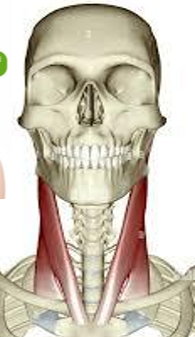
sternocleidomastoid
anterior muscle of the neck; rotate and laterally flex head & flex head (if both R&L used)
origin: sternum & clavicle
insertion: mastoid process (temporal)
torticollis
when one side of the sternocleidomastoid is shorter than the other; leads to head rotation and laterally flexion
in infants, caused by development tissue or trauma
in adults, caused by muscle spasm
splenius capitis
deep muscle of the back; laterally flex & extend head (if both R&L used)
origin: thoracic & cervical vertebrae
insertion: occipital & temporal

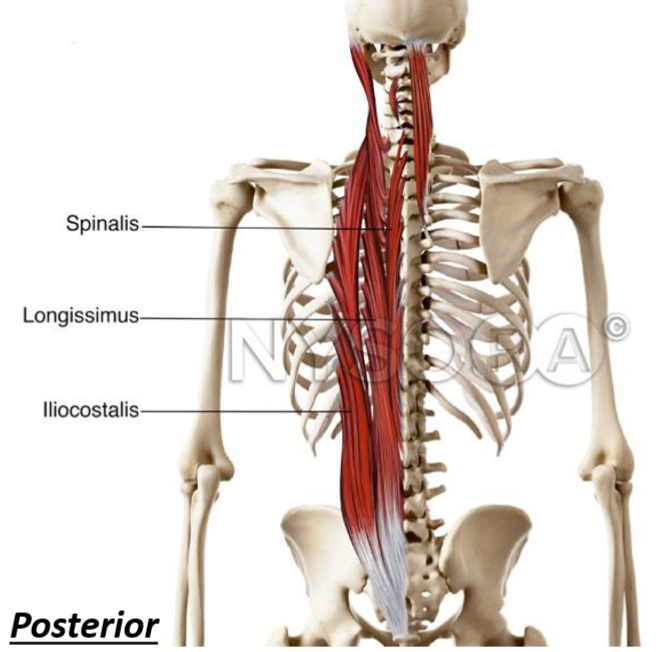
which muscles are part of the erector spinae muscle group?
longissimus
iliocostalis
spinalis
the deep muscles of the back, laterally flex & extend head/back, also helps maintain posture
linea alba
midline connective tissue band running from sternum to pubis
what are the 4 abdominal wall muscles?
external oblique
internal oblique
transversus abdominis
rectus abdominis (formers anterior wall of abdomen)
**action: laterally flex, flex & rotate abdomen
external oblique
most superficial layer of the lateral abdominal wall muscles
origin: ribs
insertion: linea alba & ilium
internal oblique
middle layer of the lateral abdominal wall muscles
origin: ilium
insertion: linea alba & lower ribs
transversus abdominis
deepest layer of the lateral abdominal wall muscles
origin: ribs & ilium
insertion: linea alba
rectus abdominus
forms the midline of the anterior wall of the abdomen
origin: pubis
insertion: ribs & xiphoid process (sternum)
hernia
when internal organs/tissues bulge through a weak spot in surrounding tissue
inguinal hernia
bulge through the abdominal wall in the inguinal region
diaphragm
main breathing muscle
action: expands thoracic cavity
intercostals
origin: ribs
insertion: ribs
action: pulls ribs up or down (changes thoracic volume ot pulling air into or pushing air out of lungs)
muscles of the posterior part of the shoulder
trapezius
latissimus dorsi
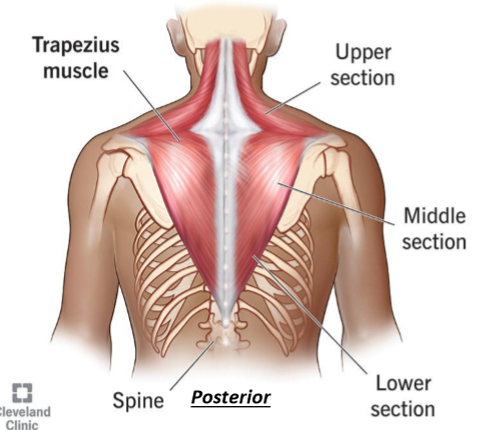
trapezius
superficial shoulder muscle on the back
origin: occipital & vertebrae
insertion: scapula & clavicle
action: MANY movements
latissimus dorsi
superficial shoulder muscle on the back
origin: vertebrae & ilium
insertion: humerus
action: adduct & extend shoulder

muscle of the anterior part of the shoulder
pectoralis major
pectoralis major
superficial shoulder muscle on the anterior trunk
origin: sternum & clavicle
insertion: greater tubercle (humerus)
action: adduct & flex shoulder

muscle of the posterior, lateral, and anterior part of the shoulder (shoulder-covering muscle)
deltoid
rotator cuff muscles
teres minor
subscapularis
supraspinatus
infraspinatus
**action: stabilize shoulder joint, common insertion: humerus
rotator cuff injuries are typically caused by what?
an acute injury-causing event
repetitive stress
age-related degeneration
what are the three anterior arm muscles?
biceps brachii
brachialis
brachioradialis
**action: flex elbow
biceps brachii
main elbow flexor
origin: scapula
insertion: radius

brachioradialis
origin: humerus (distal)
insertion: radius

brachialis
origin: humerus (mid)
insertion: ulna

SLAP (superior labrum tear anterior-posterior)
repetitive stress injury caused by forces placed on biceps tendon when throwing
common in “overhead” athletes
triceps brachii
posterior arm muscle
origin: scapula & humerus
insertion: olecranon process (ulna)
**action: extend elbow (& shoulder)
muscles that rotate the radius
supinator
origin: humerus & ulna
insertion: radius
action: supinate
pronator teres
origin: humerus & ulna
insertion: radius
action: pronate

muscles that flex/extend wrist
flexor & extensor carpi radialis
origin: humerus
insertion: base of metacarpals
flexor & extensor carpi ulnaris
origin: humerus & ulna
insertion: base of metacarpals

muscles that flex the fingers
flexor digitorum superficialis
origin: humerus, radius & ulna
insertion: middle phalanx of digits 2-5
flexor digitorum profundus
origin: ulna
insertion: distal phalanx of digits 2-5
muscle that extends the fingers
extensor digitorum
origin: humerus
insertion: distal phalanx of digits 2-5
carpal tunnel syndrome
flexor tendons and a nerve run through small “tunnel” formed from carpal bones
repetitive movement of tendons can irritate the nerve leading to numbness/tingles/pain