Gene Exchange (W7)
 Call Kai
 Learn
 Practice Test
 Spaced Repetition
 Match
 Flashcards
 Knowt Play
1/29

There's no tags or description
Looks like no tags are added yet.
30 Terms

What is vertical genetic transfer?
Transmission of genetic information from a cell to its daughter cells during cell division
Can include chromosomes, plasmids, and lysogenic phage DNA

What is horizontal gene transfer, or HGT?
Movement of genetic information between cells without cell division
Transferred material can include chromosomal fragments, plasmids, and phage DNA
Compare vertical transfer, horizontal transfer, and eukaryotic sex.
Vertical transfer passes DNA from parent to offspring during division
HGT moves DNA between existing cells
Eukaryotic sex combines genomes through mating and meiosis, producing recombination and new allele combinations.

What can happen to DNA after it enters a cell by HGT?
Cell may or may not maintain horizontally transferred DNA
May integrate into the chromosome
May persist as a replicating plasmid
May be degraded/lost during later cell division

How can horizontally transferred DNA become stably inherited?
Stable genetic exchange can be with or without chromosomal integration
DNA can be integrated into chromosome via homologous recombination
DNA could also be circularized into a plasmid that self-replicates and gets vertically transmitted

What is homologous recombination?
Homology = matching DNA sequence
A double-stranded DNA break occurs
The cell copies a sequence from another DNA strand with homology to repair that break
Allows that incoming DNA to integrate into the chromosome
Can occur on the ends or middle of the new sequence
What is a plasmid?
A usually circular, extrachromosomal DNA molecule that can replicate independently of the chromosome and may carry useful genes, such as antibiotic-resistance genes.
What do homology and homologous mean in recombination?
Homology is identical or highly similar DNA sequence
Homologous means related by descent
More closely related organisms are more likely to have enough sequence similarity for homologous recombination
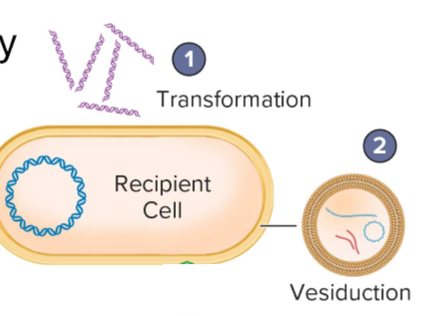
What is transformation?
The uptake of naked environmental DNA by a cell.
This DNA is often plasmids, or can be DNA fragments
Taken into (often stressed) cells
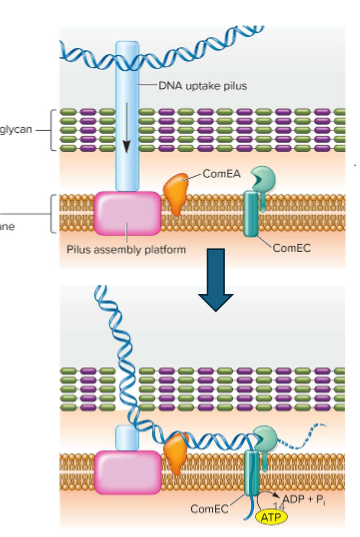
What is a competent cell?
A cell that expresses the proteins and structures needed to actively take up environmental DNA (eDNA).
The DNA uptake pilus binds eDNA
Cell retracts the pilus
Cytoplasmic membrane proteins (ComEA and ComEC) bring ssDNA into the cell
Transformed DNA can circularize to plasmid or recombine in the chromosome
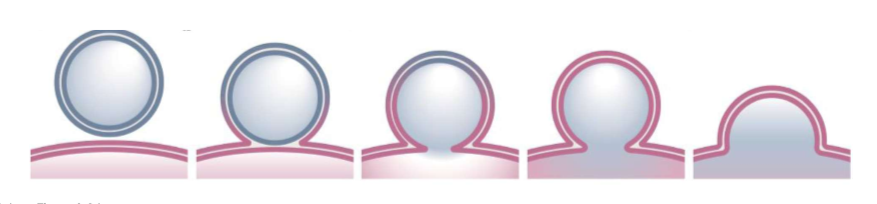
What is vesiduction?
A type of transformation in which DNA is packaged inside a membrane-bound vesicle that fuses with another cell and releases its contents.

How does vesiduction differ from ordinary transformation?
Vesiduction delivers DNA protected within a membrane vesicle
Ordinary transformation uses naked environmental DNA

What is conjugation?
Direct DNA transfer between cells that requires cell-cell contact
Requires F+ donor to have F plasmid
Plasmid codes for the conjugative pilus
Pilus connects the donor and recipient cell cytoplasms
F-plasmid is copied to the recipient
Recipient changes from F- to F+ once it gets the F plasmid

What is the F plasmid?
A fertility plasmid that carries genes for conjugation, including formation of a conjugation pilus and DNA-transfer machinery.
What are F+ and F- cells?
An F+ cell contains the F plasmid and can donate it
An F- cell lacks the F plasmid and can receive it

What is the role of the conjugation pilus?
Establishes contact between donor and recipient cells
Helps form the connection that DNA can be transferred through

How is an F plasmid transferred during conjugation?
One plasmid strand transfers from the donor to the recipient through the pilus
The other remains in the donor
Both cells synthesize the complementary strand to make double-stranded plasmids
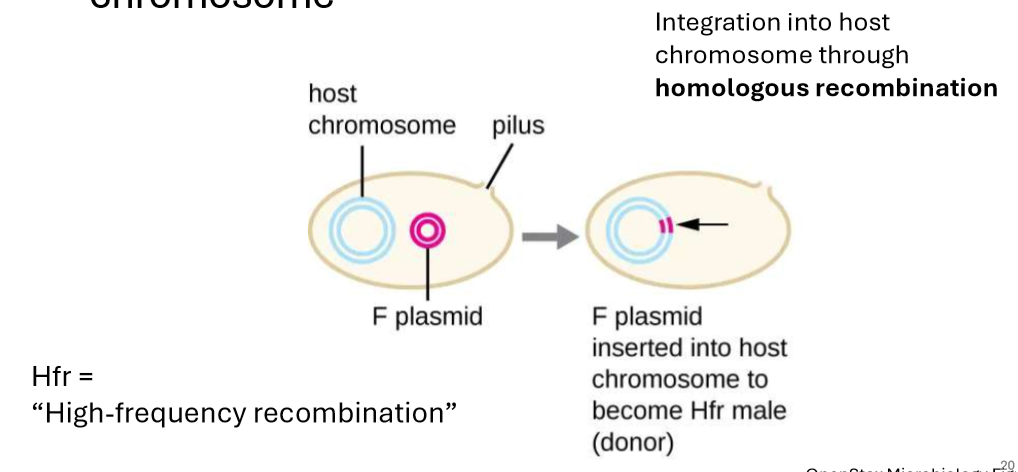
What is an Hfr cell?
A high-frequency-recombination donor in which the F plasmid has integrated into the bacterial chromosome.

Why can Hfr cells transfer chromosomal genes?
The integrated F plasmid begins transfer from its own origin and can carry adjacent chromosomal DNA into the recipient.

What is transduction?
When a bacteriophage transfers bacterial DNA/genetic material from one host cell to another.
Genes get packed in the phage heads during lysis cycle → end up in the next infected cell

What happens if host DNA is packaged into a phage head by mistake before lysis?
The phage particle can still attach to and enter another bacterium, but it cannot continue a normal phage life cycle because it lacks its own genome
Instead, it delivers the bacterial DNA it carrying
That DNA may integrate into the recipient chromosome or become a plasmid
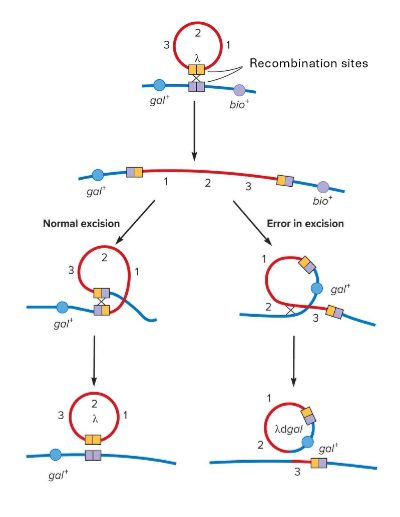
How do normal and errored excision differ in a lysogenic phage?
Normal excision removes only the phage DNA from the host chromosome
Errored excision removes phage DNA plus a nearby host gene, allowing that host gene to be transferred to another bacterium.
What is the “model” organism for microbial eukaryotic life cycles?
Saccharomyces cerevisiae yeast
Single-celled fungus
Has sexual and asexual life cycles
A relatively simple organism
Yeast vegetative/growing cells can be either haploid or diploid
What is a haploid cell?
A cell that contains one set of each chromosome
In humans, it is sperm or eggs
1n
What is a diploid cell?
A cell with two copies of each chromosome
The two “homologous” chromosomes in a pair are very similar in sequence, but not completely identical (may carry different alleles)
In humans, most cells in the body are diploid
2n

What does mitosis do to ploidy and genetic similarity?
Mitosis produces two daughter cells with the same ploidy as the parent and, aside from mutation, the same genetic information.

What does meiosis do?
Reduces a diploid cell to four haploid cells through two divisions and creates opportunities for genetic recombination.
Homologous recombination occurs when homologous chromosomes pair and exchange DNA, producing new combinations of alleles.

How can Saccharomyces cerevisiae, or yeast, exist in both haploid and diploid forms?
Haploid and diploid yeast can each reproduce by mitosis
Haploids can mate to form a diploid
Diploids can undergo meiosis to form haploid spores
Why is sex inefficient as a way to increase cell number?
Mating combines two cells into one
Meiosis turns one diploid into four haploid
Asexual mitosis expands cell number faster