COMM 171 Econ Flaschards NEED TO KNOW
 Call Kai
 Learn
 Practice Test
 Spaced Repetition
 Match
 Flashcards
 Knowt Play
1/34

There's no tags or description
Looks like no tags are added yet.
35 Terms
Economy
System for coordinating a society’s productive activities
Command Economy

Market Economy

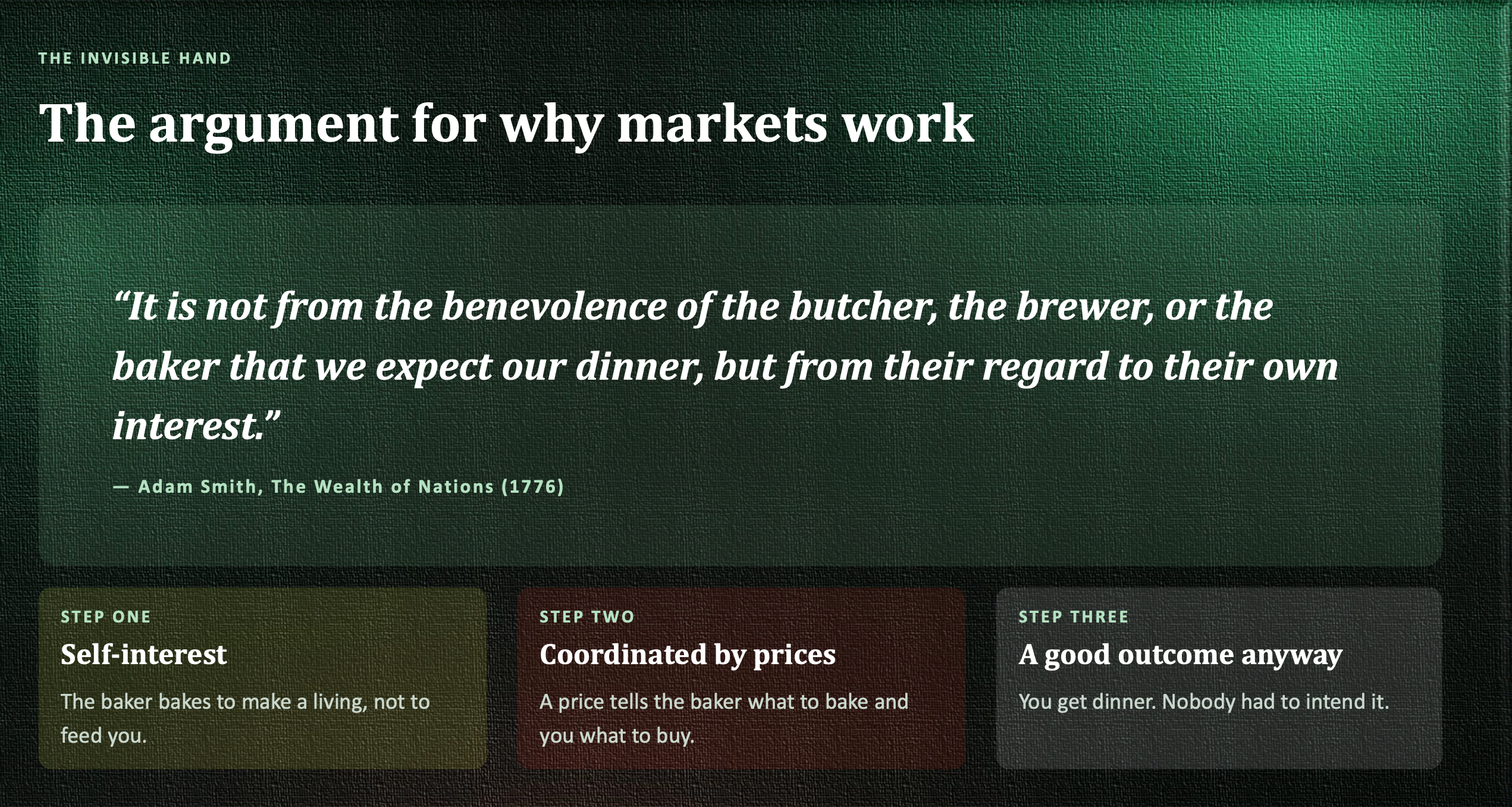
Invisible Hand
Competitive Market
A market with many buyers and many sellers, where no single actor can move the price
Quantity Demanded Effects
Substitution effect, income effect
Consumer surplus
willingness to pay minus what you actually paid
Producer Surplus
Price received minus the seller’s cost
Price Ceilings Effects

Price Floors Effects

Production Function
Relationship between the quantity fo inputs and quantity of outputs
Total Product
Quantity of output produced with a given quantity of the variable input, holding fixed CONSTANT
Marginal Product
Change in total output, when you add one more unit of a variable. MP = change in Q / change in input
Total Product Curve and Marginal Product Curve

Total Cost, VC, FC Graph

Marginal Cost
MC = change in TC / Change in Q
Average Total Cost

Average Variable Cost

Average Fixed Cost

ATC AFC AVC Graph

Perfect Competition
Market with many buyers and sellers of identical product. PRICE TAKERS, free entry and exit.
Perfect Competition Graph

Marginal Revenue
Change in tr/ change in q
When do you produce until
P = MC (MR = MC)
When do you shut down?
P lower than AVC
Profit?
ATC is lower than PRICE
Long Run
economic profit ends at 0

Long run supply curve
Flatish, a jump in demand moves quantity a lot and price only a little
Short Run Supply curve
STEEP, jump in demand moves price A LOT
Negativve, Positive, Production, Comsumption what happens MSC MPC MSB MPB and what’s the solution?

Coase Theorem
Property rights are assigned and cost of bargaining is low, private parties reach efficient quantity on their own
Four ways a government can price a spillover

Four typoes of Good table memorize

Four ways public goods get paid for

Adding curves for MSB and MC **
