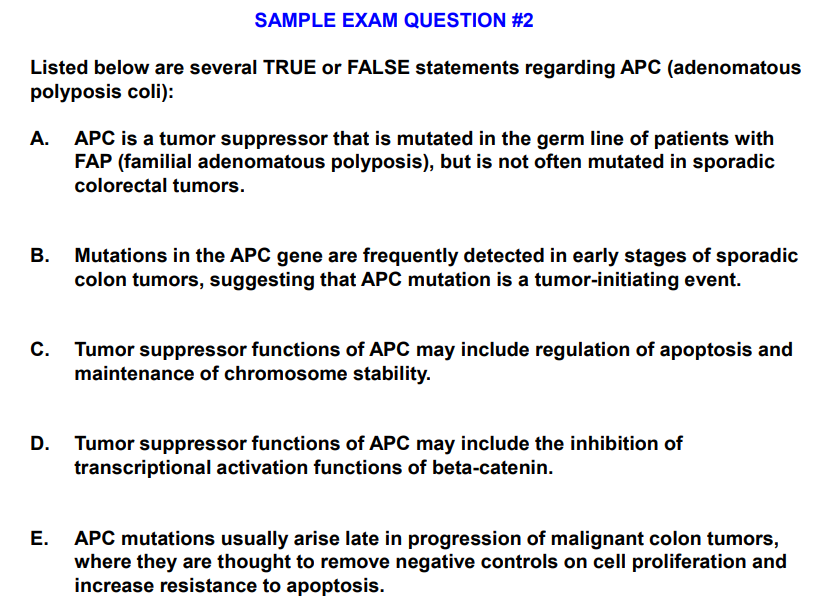
Multi-step carcinogenesis
 Call Kai
 Learn
 Practice Test
 Spaced Repetition
 Match
 Flashcards
 Knowt Play
1/18

There's no tags or description
Looks like no tags are added yet.
19 Terms
learning objectives
Incorporate concepts learned in previous lectures of the Oncology Theme into a comprehensive discussion of Multi-step Tumor Progression.
Discuss colorectal cancer as a model for multi-step carcinogenesis.
Describe muti-step tumor progression from a normal cell to metastesis

Important concepts to remember

Define stromal evolution
Reciprocal interactions between tumor cells and components of the tumor-associated stroma (i.e. fibroblasts, macrophages, endothelial cells, extracellular matrix) lead to changes in the tumor microenvironment, some of which facilitate tumor growth and progression
Linear Progression model
Cancer cells undergo multiple rounds of mutation and selection within the primary tumor, and a small subset of malignant clones acquire genetic and epigenetic properties that support metastasis
This model predicts that metastatic spread is a late event in tumor progression, and that most mutations in the metastasis preexist in the primary tumor

Parallel progression model
Quasinormal cells disseminate relatively early from the primary tumor mass and evolve independently of cells in the primary tumor (strong clinical and preclinical support for breast cancer)
This model predicts that metastasis occurs early in tumor progression, and that metastases will be genetically and epigenetically divergent from primary tumor cells

Describe the multistep model of tumor progression
An initial mutation in an individual cell provides a selective advantage (i.e. it results in a phenotype that enhances cell growth or survival relative to neighboring cells), leading to a wave of clonal expansion and neoplastic growth.
Within this clonally expanding cell population, an individual cell acquires a second mutation, providing additional growth advantages and leading to another wave of clonal expansion. The tumor progresses to the next stage
Each wave of clonal expansion creates many additional target cells for subsequent mutation.
Progression of the tumor to each stage requires a new mutation followed by a new wave of clonal expansion. Repetition of the cycle leads eventually to a fully developed malignant tumor.
reminder that this creates a very heterogeneous tumor
Facts about colorectal cancer
among the leading causes of cancer deaths in the US
deaths are equal between men and women
5% of population develops colorectal cancer
50% carries non-malignant colorectal tumors by age 70
the majority of colorectal cancer are sporadic (no hereditary component)
histology of the normal colon
The invaginations, or crypts, of the colon and rectum are lined with a single layer of epithelial cells.
stem cells at the base of each crypt give rise to specialized epithelial cell types that migrate to the upper portions of the crypt
Homeostasis is maintained through a balance of new cell generation with apoptosis and loss of cells from the crypt apex into the lumen of the bowel.
If the ratio of cell proliferation to cell loss increases, a tumor develops

Why is colorectal cancer a good model
Clinical and histopathological stages of colorectal tumor progression are well-defined.
This staged progression is caused by specific genetic mutations that occur at each stage. These mutations are remarkably consistent and are well characterized compared to other cancers
These mutations cause the activation of oncogenes and the inactivation of tumor suppressor genes

what are the two basic requirements for normal colon cells to develop into cancer
Acquisition of selective growth advantages to drive clonal expansion.
Acquisition of genetic instability to allow for multiple hits to different genes
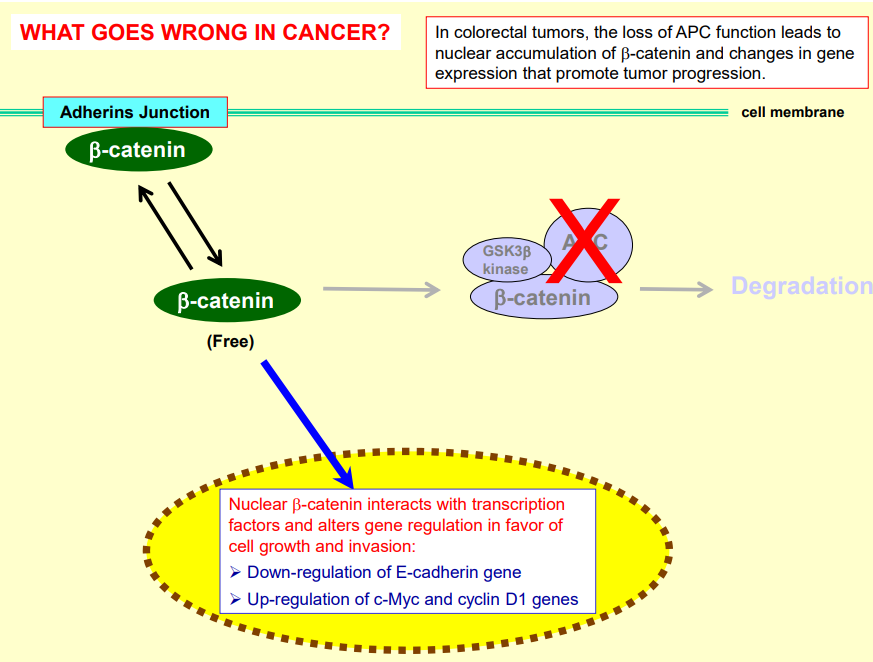
Loss of APC in colorectal cancer
loss of APC function is associated with initial dysplastic growth (first step)
APC is a tumor supressor gene. both copies must be inactivated for tumorigenesis to occur
APC is mutated in the germ line of patients with FAP (familial adenomatous polyposis), as well as in sporadic colorectal tumors
At least 80% of colorectal tumors have somatic mutations in the APC gene
Mutations of APC occur early in tumor development, and appear to be an initiating event:
In colorectal tumors, the loss of APC function leads to nuclear accumulation of β-catenin and changes in gene expression that promote tumor progression.
increases genetic instability
up regulation of proteins involved in proliferation
Ras in colorectal cancer
Activating mutations in ras are associated with transition from early adenoma to intermediate adenoma.
occurs in 50% of colorectal cancers
Ras mutations are not initiating events, but aquired during adenoma progression
Ras oncogenes encode activated ras mutants that promote uncontrolled cell proliferation and tumor growth.

18q in colorectal cancer
Loss of 18q is associated with transition from intermediate adenoma to late adenoma.
Loss of at least one copy of chromosome 18q occurs in ~70% of sporadic colorectal cancers.
Chromosome 18q harbors genes for three candidate tumor suppressors: DCC, Smad4 (DPC4), and Smad2 (JV18-1/MADR2). Somatic mutations have been found in all three genes.
Some evidence suggests that loss of Smad4 or Smad2 promotes resistance of cancer cells to growth-suppressing affects of TGFB.
this event is associated with later stages of tumor progression
p53 in colorectal cancer
p53 is lost in 75% of colorectal cancers, and is a late event in carcinoma progression
However, p53 is important for stress-induced regulation of many functions, including cell growth, genomic stability, apoptosis, and gene expression
Most tumor-derived mutants of p53 have altered ability to bind DNA, leading to loss of p53 ability to stimulate expression of its target genes.
The resulting reduction in expression of growth inhibitory genes and/or apoptosis genes (i.e. Bax) may provide a selective growth advantage to cells, contributing to tumor growth

Why is cancer progression a multi-step process
The requirement for mutations in multiple genes suggests that mammalian cells have evolved several barriers, or levels of protection, against cancer.
The successful cancer cell must overcome these barriers at each stage of progression by accumulating helpful mutations.
Benefits of understanding the multi-step nature of tumor progression
anti-cancer therapy
The identification of molecular determinants that are responsible for each stage of cancer progression, and a better understanding of their chronology, provides potential molecular targets at distinct stages for improving current therapies and for developing new therapies
tumor diagnosis
The ability to detect combinations of gene mutations that are characteristic of specific tumor stages can be combined with histopathology to improve staging and prognosis of a particular tumor.
In addition, specific gene mutations that can be easily identified may be useful as the basis for pre-symptomatic diagnoses for colorectal or other tumors. This opens the door for the development of therapies applied at early stages to inhibit later stages of cancer progression (i.e. recall our previous discussions of anti-MMP therapies)