Chapter 8: Kinetics and Regulation
 Call Kai
 Learn
Learn Practice Test
 Spaced Repetition
 Match
Match Flashcards
 Knowt Play
1/39

There's no tags or description
Looks like no tags are added yet.
Name | Mastery | Learn | Test | Matching | Spaced | Call with Kai | Chat |
|---|
No analytics yet
Send a link to your students to track their progress
40 Terms
kinetics
study of dynamics of enzyme activity
first order reactions
rate proportional to reactant concentration
second order rxn
bimolecular
rate depends on 2 reactants
calc for rate of reaction: second order
V = k[A][B] or [A]2
A is the substrate
k is the rate constant
pseudo first order reaction
bimolecular rxns where [ ] of one reactant greatly exceeds [ ] of the second reactant, making the rxn seem first order with respect to lesser reactant
zero order rxn
rate is independent of reactant concentrations
V0
intial rate of catalysis → initial slope of rxn rate vs time
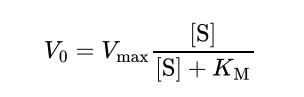
michaelis menten eqn: what does it describe and what are the variables
describes initial rate as a function of substrate concentration
Km → michaelis constants
Vmax → maximal velocity. attained when enzyme is fully saturated
S → substrate
V0 → inital velocity

Vmax relationship to enzyme concentration
directly related. more enzyme → faster rate
Km
michaelis constant
describes enzyme substrate affinity → higher Km means lower affinity
equals [s] at ½ Vmax
when would enzymes display 0 order rxn mechanism
enzyme is fully saturated → increasing [s] has no effect on the reaction rate
what causes alchohol flushing in some individuals
alchohol is processed in 2 steps: ethanol → acetaldehyde→ acetate
acetalaldehyde causes flushing and tachycardia
2 enzymes break acetaldehyde: a high Km (cytoplasm) and a low Km (mictochondria). lacking low Km enzyme means acetaldehyde is only processed at high [ ]
elasticity
since [s] is usually ~ Km in organisms, enzymes are highly responsive to changes in [s] while still having significant activity
turnover number
number of substrate molecules enzyme can convert into product per unit time at full saturation → k2 kinetic constant
Km and Vmax relation to enzyme
Km → characteristic of the enzyme. doesn’t change by changing [enzyme]
Vmax → dependant on the [enzyme]; not characteristic of the enzyme
isoenzymes
diffent enzymes that catalyze the same rxn → different tissues kinetics, tissues and regulations
isoenzymes glucokinase and hexokinase: glucokinase
glucose senser → in liver, higher Km (low affinity), higher Vmax, not inhibited by G6P
liver glucose is quickly broken down only at high [ ] to regulate. ensures the tissues that really need it have access first
isoenzymes glucokinase and hexokinase: hexokinase
in glucose oxidizing tissue, low Km (high affinity), lower Vmax, inhibited by G6P (caps itself after getting what it needs)
2 types of bisubstrate enzyme rxns
sequential rxns
double displacment (ping pong) rxns
2 types of bisubstrate enzyme rxns: sequential
all substrates in together, all products out together
forms ternary complex → complex with enzyme and all substrates
can be ordered (substrates bind in specific sequence) or random
2 types of bisubstrate enzyme rxns: ping pong (double displacement)
one of more products released before all substrates bind
forms substitued enzyme intermediate → enzyme modified breifly
substrates and products appear to bounce on and off e
michaelis menten enzymes
display michaelis-menten kinetics → if substrate is present, they catalyze
produces hyperbolic saturation curve
allosteric enzymes
regulate flux of biochemicals through metabolism
features of allosteric enzymes
regulate catalysis based on environment
complex kinetics
quaternary structure w mutiple active sites
sensitive and responsive
commited step
step in a metabolic pathway that “commits” to producing the end product, usually rate limiting step
catalyszed by an allosteric enzymes → feedback inhibited by end product binding to allosteric site

allosteric enzymes in complex pathways
inhibited or activated by molecules in the pathway to ensure coordination and no intermediates are wasted
F stimulates e10 but inhibits e1; I stimulates e1 but inhibits e10
how do michaelis menten enzyme kinetics differ from allosteric enzyme kineticss
on velocity-[s] graph:
allosteric: sharp increase of V in the middle of the curve → sigmoidal shape (s)
michaelis menten: begins with sharp increase then levels off → hyperbolic shape
affinity constant for allosteric enzymes
K0.5 → still shows [ ] yeilding 0.5Vmax
why do allosteric enzymes have a signmoidal curve
bcz they have multiple active sites and regulatory (allosteric) binding sites
2 models for allosteric enzymes
concerted model and sequential model
T and R state of allosteric enzymes
T → tense, less active, more stable → common
R → relaxed, active, less stable → less common
2 models for allosteric enzymes: assumtions of concerted model
mutiple active sites on different polypeptide chains
2 distict states: R or T
all active sites on an enzyme must be in the same state → symmetry rule
s binds better to R than T
2 models for allosteric enzymes: mechanism of concerted model
displays cooperativity
as [s] increases, more likely for s to catch an R state, bind, and turn all active sites of that enzyme into R
substrate binding R shifts T ⇌ R in favour of R → rmore R produced → rapid V increase (sigmoidal shape)
why is cooperativity of allosteric enzymes important
causes them to be way more senstive to changes in [s] → more elastic near Km than MM enzymes with the same Vmax
threshold effect
below certain [s], little enzyme activity (mostly T). but after threshold reached, enzyme activity increases rapidly (mostly R) → cooperativity causing on/off switch between T and R
concerted model: regulatory molecules
alter T ⇌ R equilibrium
positive effectors: bind R at allosteric site and stabilizes it → more R → more chance of R binding s
negative effectors: bind T at allosteric site and stabilizes it → more T → s binding R
concerted model: effect of regulatory molecules on threshold concentration
positive effectors → lower threshold and shift sigmoidal curve left
negative effectors → increase threshold and shift signmoidal curve right
heterotropic allosteric effectors
effector molecule (regulatory molecule) is distict from substrate→ binds to allosteric site
usually upstream or downstream of metabolic process
shifts the entire curve to the right or left
homotropic allosteric effectors
substrate acts as an effector, for example, cooperative binding → causes the sigmoidal shape of allosteric kinetics
sequential model of allosteric enzymes
T and R can exist as hybrids
binding at one site influces binding affinity of surrounding sites without necessary changing the entire enzyme