Food Management Systems LEC
 Call Kai
 Learn
 Practice Test
 Spaced Repetition
 Match
 Flashcards
 Knowt Play
1/25

There's no tags or description
Looks like no tags are added yet.
26 Terms
What is the role of veterinarians in food safety? (3)
Primary production
Prevention and control of food safety hazards at the farm
Slaughter, processing and distribution
Technical management and official controls
International trade
Certification of compliance with animal health and food safety standards
Define “food safety” Vs. “food security”:
Food safety: the guarantee that foods will not cause harm to the health of those who consume them, and it is a fundamental property of food quality
About quality
Food security: the ability to obtain and/or to store basic food products to guarantee that food is available for consumption
About availability
Define “hazard” vs. “risk”:
Hazard
a biological, chemical or physical agent in, or condition of, food or feed with the potential to cause an adverse health effect
Risk
a function of the probability of an adverse health effect and the severity of that effect, consequential to a hazard
What are the 3 categories of hazards in food? Give examples for each
Biological
Bacteria
Viruses
Parasites
Chemical
Vet drug residues
Pesticides
Heavy metals
SOMETIMES allergens
Physical
Bones
Wood
Stones
For food safety approaches, what is better? Hazard-based assessments or risk-based assessments?
Risk based
Who promotes risk-based assessments for food safety?
World Trade Organisation (WTO)
Organisation for Economic Co-operation and Development (OECD)
Codex Alimentarius Commission (FAO and WHO)
European Union (EU)
Which regulation lays down the general principles and requirements of food law, covering all stages of food and feed production (“from farm to fork”)? How is this enforced?
EC 178/2002
Established the European Food Safety Authority (EFSA)
Risk assessor
EFSA is responsible for independent scientific advice and support
Created systems to manage food safety incidents, e.g.:
Rapid Alert System for Food and Feed (RASFF)
Which regulation lays down the general rules and principles for HYGIENE of foodstuffs? Who is responsible for keeping this standard?
Regulation EC 852/2004
Lays out good hygiene practices in:
Primary production (i.e. farming), transport, storage, and handling
Post-primary production (slaughterhouse, processing plants, retailers)
Primary responsibilty for food safety rests with the food business operator (FBO)
Which regulation has SPECIFIC hygiene rules for food products of ANIMAL origin?
Regulation EC 853/2004
Products of animal origin can only be placed on the market if:
They are prepared and handled in registered establishments
They have a health mark (placed by competent authority) and an identity mark (placed on packaging by FBO)
Lays out specific requirements for:
meat (sections I:VI)
bivalve molluscs (section VII)
fishery products (section VIII)
dairy (section IX)
eggs (section X) …
Which regulation verifies COMPLIANCE with rules on food and feed law, animal health and welfare, plant health, and ABPs?
Regulation EU 2017 / 625
Verifies:
risk-based approaches
‘farm to fork’
assessment of procedures based on
good hygiene practices
principles of hazard analysis critical control points (HACCP)
staff performing official controls must be trained on the application of HACCP procedures
What is a food safety management system (FSMS)?
A food safety management system is a set of interacting elements forming a network to ensure that food presents a minimal risk to consumers…
What are the key elements of a FSMS?
Prerequisite programs (PRPs)
Good hygiene practices (GHPs)
Other (traceability, recall/withdrawal, training)
Operational prerequisite programs (oPRPs)
Procedures based on the hazard analysis and critical control point (HACCP) principles
Recal → When the product has reached consumers / market
Withdrawal → hasn’t made it to market, but sstill in supply chain
Think of a few examples of GHP…
Infrastructure (building, equipment)
Cleaning and disinfection
Pest control
Raw materials (supplier selection, specifications)
Technical maintenance and calibration
Physical and chemical contaminations from production environment
Allergens
Food redistribution and donation
Waste management
Water and air control
Personal (hygiene, health status)
Temperature control of working and storage environment
Working methodology
Food safety culture
Amendment to reg 852/2004; this is no longer required in the UK after brexit
Allow for employees to raise concerns about food safety issues
Think of some examples of oPRPs…
Cleaning of surfaces in direct contact with ready-to-eat foods
Compared to cleaning of floors and walls
Bacteriological quality of water used to irrigate ready-to-eat crops
Compared to water used to irrigate crops intended to be consumed after heat treatment
What are the seven principles (steps) of a hazard analysis and critical control point (HACCP)?
Principle 1: Conduct a hazard analysis and identify control measures
Creating a step-by-step control plan
Principle 2: Determine the critical control points (CCPs)
Which of these steps is critical to control the hazards? (creating your CCPs)
Principle 3: Establish critical limits
Ex: temp
Principle 4: Establish a system to monitor control of CCPs
Establish a system to MONITOR those critical limits
Principle 5: Establish corrective actions to be taken when monitoring indicates a deviation
What to do when those CCPs are broken
Principle 6: Validate the HACCP plan and establish verification procedures
Create a system to validate your HACCP plan and establish verification procedures to ensure its actually working
Principle 7: Establish documentation and record keeping
What are the 5 steps that should PRECEDE your HACCP to determine the risk of your food? Describe these:
1) Assemble a HACCP team
The HACCP team is responsible for developing and maintaining a HACCP plan; know the production process of that food and understand hazards associated with it
2) Describe the end product
Raw materials / ingredients
Production process involved
Packaging
Distribution and storage conditions
Other (shelf life, microbiological criteria)
3) Define intended use by consumer
Consider suitability to specific consumer groups
4) Construct a flow diagram
Present the entire production process of that food in a flow diagram (see image)
5) On-site confirmation of flow diagram
HACCP team needs to confirm that flow diagram reflects the production process on-site

Describe what is done during principle 1 of your HACCP?
Principle 1 (step 6) - Conduct a hazard analysis and identify control measures
Hazards that can occur at each step of the process are analyzed:
Probability of occurence and its severity (the risk)
Acceptable / tolerable levels of the hazard in the product
Potential for survival and multiplication of biological hazards
Other factors (i.e. intended use)
Example of this is the first table in the associated CRW
Describe what is done during principle 2 of your HACCP?
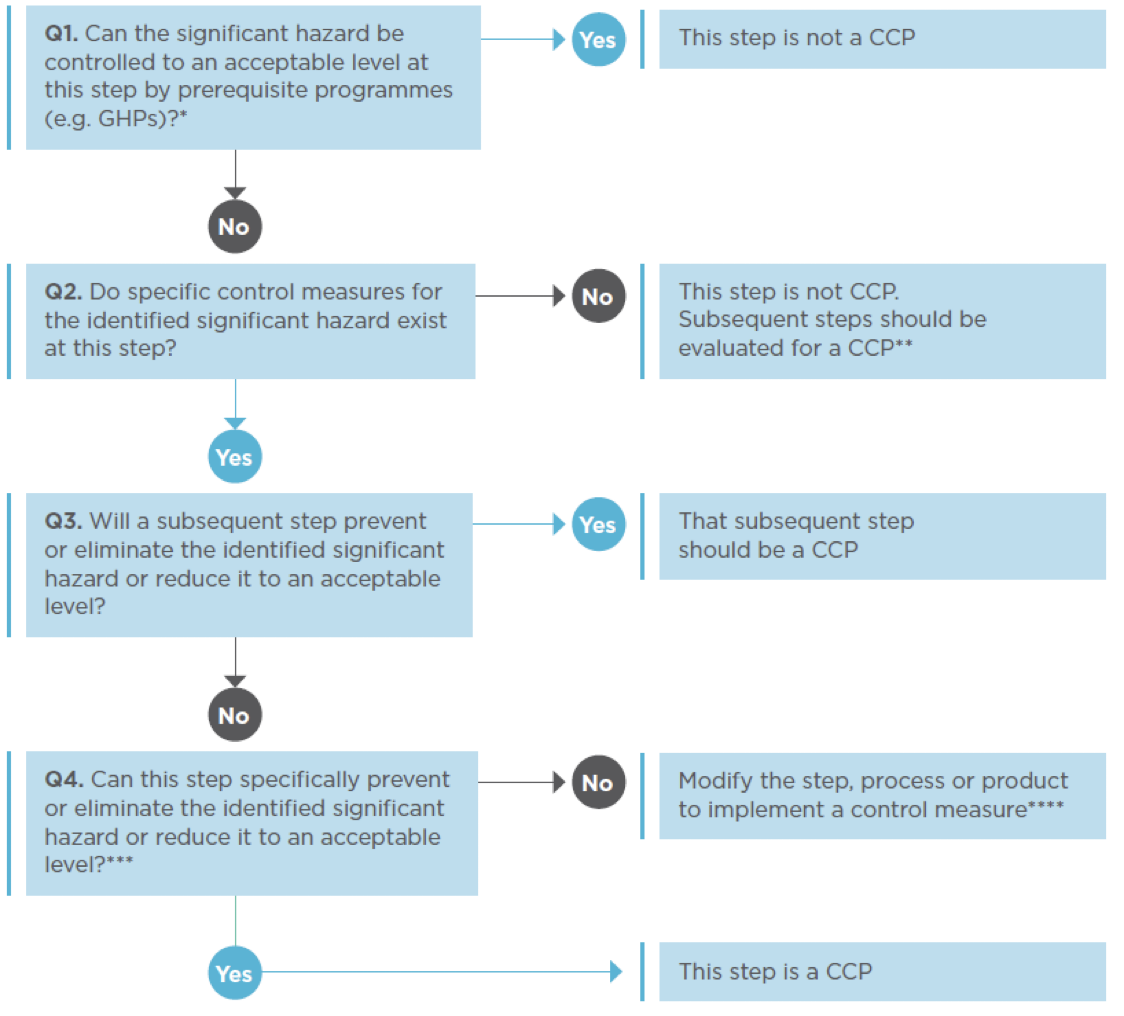
Principle 2 (step 7) - Determine the critical control points (CCPs) for the hazards identified during production
CCP = a step at which a control measure, essential to the control of a significant hazard, is applied in an HACCP system
Identification of a CCP should be done asking yourself the questions seen in the flow chart
Describe what is done during principle 3 of your HACCP?
Principle 3 (step 8) - Establish critical LIMITS
Critical limits separate acceptable (likely safe) from unacceptable (likely unsafe) products
Must be objective, based on scientific evidence, and be MEASUREABLE or OBSERVABLE
Examples:
Milk pasteurisation (Reg. (EC) 853/2004):
a high temperature for a short time: at least 72 °C for 15 seconds
a low temperature for a long time: at least 63 °C for 30 minutes
Acidification of raw egg products (pH ≤ 4.2 for mayonnaise)
Describe what is done during principle 4 of your HACCP?
Principle 4 (step 9) - Establish a system or monitor control of CCPs
CCPs must be monitored by measurement or observation
Monitoring should enable TIME detection of deviations, and prompt corrective action
For each CCP, the HACCP plan should indicate:
What should be monitored
Who should perform the monitoring
When should CCPs be monitored
How should they be monitored
Describe what is done during principle 5 of your HACCP?
Principle 5 (step 10) - Establish corrective actions
When CCPs are breached, need to consider:
Safety of the product since last monitored (past)
How to re-establish control (present)
Root cause analysis to avoid a recurrence (future)
For each breach of CCP, the HACCP plan should indicate:
What corrective action should be implemented
Who is responsible for implementing corrective action
When should corrective action be implemented (usually immediately)
How corrective action should be implemented
Describe what is done during principle 6 of your HACCP?
Principle 6 (step 11) - Validate the HACCP plan and establish verification procedures
Validation → is BEFORE production
Definition: obtaining ecidence that a control measure, or combination of control measures, is capable of controlling the hazard for a specific outcome
Ex: experimental evidence that the process will eliminate the hazard
Verification → happens DURING production
Definition: the application of methods, procedures, tests, and other evaluations (in addition to monitoring) to determine whether a control measure has been operating as intended
Ex: regular laboratory tests on the end product indicating absence of the hazard
Describe what is done during principle 7 of your HACCP?
Principle 7 (step 12) - Establish documentation and record keeping
Documents and records that verify and demonstrate compliance with the HACCP plan:
HACCP team composition
Hazards analyses outcomes and justification
Justification for establishment of CCPs, control measures and critical limits
CCP monitoring activities
Corrective actions taken following identified deviations
Outcomes of verification procedures
Updates to the HACCP plan
What is the objective of a food safety management system audit? What are the key requirements for this audit?
To verify compliance with food safety and animal health / welfare standards
Key audit reqirements:
Risk-based assesment (in compliance with Commission Implementing Regulation (EU) 2019/627)
Informative to both FBO and Competent Authority
Consistent
Accurate
What are the 4 compliance ratings a facility could get in regards to their food management system?
Good
No issues of significance for public health, animal health or animal welfare
Generally satisfactory
No immediate issues of significance for public health, animal health or animal welfare identified on the day of the audit. Any NCs identified during the audit period corrected promptly
Improvement Necessary
Major NCs identified at audit and/or NCs during the audit period not always responded to and corrected promptly
Urgent improvement necessary
Multiple major NCs or critical NC identified during audit visit or interim audit period. Official intervention required to ensure public health safeguards.