Y9-Cs. Unit 1: Bases
 Call Kai
 Learn
 Practice Test
 Spaced Repetition
 Match
 Flashcards
 Knowt Play
1/26

There's no tags or description
Looks like no tags are added yet.
27 Terms
Bit
short for binary digit, this is the smallest unit of data in a computer. A bit can have the value 1 or 0, corresponding to on or off.
Byte
a group of eight bits
Hexadecimal
Number system in base 16 that can be easily converted into binary.
Leading Zeros
zeroes before the first digit of 1 in a binary number used to lengthen out the binary number to make it a specific length, e.g. 8 bits or 16 bits.
Logical Shift
a binary shift, either left or right, where the cleared positions are filled with only 0s.
Nibble
Half of a byte - a group of 4 bits
In the binary number 1010. What is the place value of the:
first 1
first 0
second 1
second 0
what does this align with?
8
4
2
1
the powers of 2 starting from 2^0
how to annotate the base of a number
using subscript
To convert binary binary to denary, add the place values where a _____ is present:
1
To convert denary to binary, create a table with the ___________(1) and use the steps below:
Find the __________(2) place value that is less than or equal to the ____________(3) number.
Subtract the ___________(4) found from the above step from the ____________(5).
Then find the largest place value that is less than or equal to ___________(6) Repeat until you have _______(7) left.
Complete the process by adding 0 to all the blanks in the table.
binary place values
largest
denary
largest binary place value
denary number
the result from the above step
nothing
a logical shift is where a pattern of (1) is moved (2) or (3) by a (4) of (5).
the empty (5 again) are filled with (6).
bits
left
right
number
places
zeroes

this is an example of… where the zero is coming from the … side
logical shift left
right
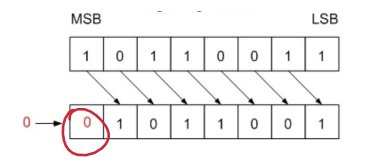
this is an example of… where the zero is coming from the … side
logical shift right
left
What does each logical shift left of one position do to the denary value of a number?
What does each logical shift right of one position do to the denary value of a number?
doubles the number
halves the number
a logical shift left of n multiples the number by… (a number in terms of n)
a logical shift right of n divides the number by… (a number in terms of n)
2n
2n
a logical shift left of n (1) the number by 2n
a logical shift right of n (2) the number by 2n
multiplies
divides
When a computer does a calculation, it (1) a space in (2) for the result. The size of this space is usually determined in advance. (3) takes place when the result is too (4) for the (5) of bits (6) to hold the (7).
This means (3 - again) is defined as a (7 - again) to an (8) in which a result is (9 - long answer)
reserves
memory
overflow
large
number
reserved
result
operation
too big to display within the allocated number of bits.
Overflow only occurs during (1) or logical shifts to the (2).
When there is overflow to the (3) also known as (4). This is a related issue but rather than overflow is called a (5) where the (6/7) cannot be represented.
multiplication
left
right
division
loss of precision
decimal points
What logical shift of 01101011 would cause an overflow error if 8 bits are reserved for the result?
Why?
LSL2, this is because 2 shifts is needed for some information (a 1) to be lost.
To convert binary numbers into hexadecimal you separate the binary number into a (1) and convert that (2) bit (1 again) into hexadecimal.
The first place value in a hexadecimal number is (3) which can also be shown as (4)
nibbles
4
1
160
List the following hexadecimal letters into denary then binary
A
B
C
D
E
F
10 - 1010
11 - 1011
12 - 1100
13 - 1101
14 - 1110
15 - 1111
Two ways to show a number is in hexadecimal format:
putting 0x in front of it
a subscript of 16
put these in order from smallest to largest, which one is the largest hexadecimal number that is possible in 2 digits?
0xAB, 0xCA, 0xFF, 0xBE, 0xCD, 0xAA, 0xF9, 0xA1
0xA1
0xAA
0xAB
0xBE
0xCA
0xCD
0xF9
0xFF (largest hexadecimal number possible in 2 digits)