Chapter 7: Genomes and Chromosomes
 Call Kai
 Learn
 Practice Test
 Spaced Repetition
 Match
 Flashcards
 Knowt Play
1/65

There's no tags or description
Looks like no tags are added yet.
Name | Mastery | Learn | Test | Matching | Spaced | Call with Kai | Chat |
|---|
No analytics yet
Send a link to your students to track their progress
66 Terms
What is a genome?
All the genetic information that defines an organism, encoded by DNA.
What is a gene?
a unit of heredity that is transferred from a parent to offspring; found on a single chromosome or distributed among multiple genetic elements
What is the primary function of DNA?
To serve as a stable, mutable, and replicable information storage molecule.
What is the human genome size?
Over 3,000,000 kilobase pairs.
What is the typical size range of bacterial and archaeal chromosomes?
From approximately 106 to 16,000 kilobase pairs.
How do bacterial and archaeal chromosomes differ from eukaryotic chromosomes?
Bacterial and archaeal chromosomes are mostly circular (single or multiple), while eukaryotic chromosomes are linear.
What percentage of the prokaryotic genome is noncoding content?
Less than 15%.
What percentage of the eukaryotic genome is noncoding content?
More than 90%.
What are plasmids?
Small, circular DNA molecules found in prokaryotes that can replicate independently of chromosomal DNA; carry genes NOT essential for basic functions
What does coding content consist of?
functional units called genes that code for proteins
What does noncoding content consist of?
regulatory sequences like promoters and enhancers, controlling the expression of coding genes
What are the two types of nucleotides in DNA?
Purines (adenine and guanine) and pyrimidines (cytosine and thymine).
What type of bond joins nucleotides in DNA via special covalent linkages between 5' phosphate and 3' OH?
Phosphodiester bonds (unidirectional)
What is the complementary hydrogen bond relationships?
A with T via 2 hydrogen bonds
G with C via 3 hydrogen bonds
What is the significance of the antiparallel structure of DNA?
The two strands run in opposite directions, which is essential for replication and function.

What happens to DNA at high temperatures (50-90 degrees)?
The hydrogen bonds break, causing the DNA to denature into single strands.
What are the two grooves in the DNA double helix?
A wide major groove and a narrower minor groove.

How are grooves formed?
by the angles at which the complementary bases meet each other
What is the main function of the major groove in DNA?
It provides access for DNA-binding proteins to the base sequences in the center of the molecule ex. DtxR repressor protein dimer in diptheriae
How does RNA differ from DNA?
RNA is usually single-stranded (with ability to fold back on itself), contains ribose sugar, and has uracil instead of thymine.

What does ribose sugar and uracil in RNA prevent?
DNA polymerases from acting on RNA and RNA nucleases (RNases) from degrading DNA
What is a nucleoid?
The region in bacteria where DNA is compacted into loops or domains; anchored by histone-like proteins
What is the role of DNA polymerase in DNA replication?
It catalyzes the synthesis of DNA by adding nucleotides to a growing chain.

Describe the semiconservative nature of DNA replication.
Each new double helix consists of one parental strand and one newly synthesized strand.
What drives (creates energy) the DNA polymerization reaction?
1. hydrolysis of a high-energy phosphate bond in the incoming nucleoside triphosphate
2. hydrolysis of release pyrophosphate into 2 molecules of inorganic phosphate

What is the process of DNA replication divided into?
Three phases: initiation, elongation, and termination.
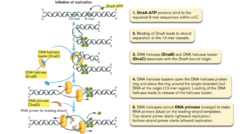
What initiates DNA replication in bacteria?
A defined DNA sequence called the origin (oriC).
What is the E. coli replication origin called?
oriC
What are the two key sequence regions in the oriC? What are they rich in?
9-base pair (9-mer) and 13-base pair (13-mer) sequences; AT rich
What is the relationship between genome size and organism complexity?
Generally, the simpler the organism, the smaller its genome.
What are Okazaki fragments?
Short DNA fragments formed on the discontinuously synthesized strand during replication.

What is the typical structure of eukaryotic genomes?
Composed of linear chromosomes.
What is the size of Okazaki fragments in E. coli?
Approximately 10,000 base pairs.
What is a replication bubble?
A structure formed during DNA replication that contains two replication forks.

What is the role of regulatory sequences in the genome?
They control the expression of coding genes.
What is the significance of the GC/AT ratio in DNA?
It influences the stability of the DNA molecule and its denaturation temperature.
What initiator protein is involved in E. coli replication? What does it do?
DnaA; binds to the origin and melts DNA, assembles replisome
What complex does DnaA form to initiate replication?
DnaA-ATP complex
What role does DnaB play in DNA replication?
helicase that unwinds the DNA helix.

What is the function of DnaG in DNA replication?
primase that synthesizes RNA primers against each template strand
What enzyme is primarily responsible for DNA synthesis during replication?
DNA polymerase III (DNA pol III)
What is the role of DNA pol I in replication?
Replacement of RNA primers with DNA
How are RNA primers removed during DNA replication?
By RNase H or the exonuclease activity of DNA polymerase I.
What enzyme repairs the phosphodiester nick after RNA primer removal using energy from NAD (bacts) or ATP (euks)?
DNA ligase

How many terminator sequences does E. coli chromosome have?
10
What is the role of Tus protein in E. coli replication? What does it stand for?
Tus binds to termination sequences to prevent polymerase complexes from escaping and continue replicating DNA; terminus utilization substance
What structure do the two daughter DNA molecules form after replication?
Catenane (pair of linked rings)

What is the function of topoisomerase IV in DNA replication?
It separates sister chromosomes by cutting and re-joining DNA strands.
What is the typical structure of plasmids?
extrachromosomal DNA elements that replicate autonomously; circular and supercoiled, smaller than chromosomes

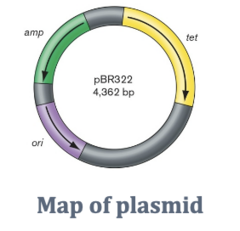
What does map of plasmid pBR322 contain?
an origin of replication (ori) and genes encoding resistance to ampicillin and tetracycline
What are the 4 critical roles plasmids play?
1. resistance to antibiotics (carry drug resistance genes)
2. provide resistance to toxic metals
3. encode toxins that aid pathogenesis
4. encode proteins that enable symbiosis (Rhizobium)
What is the significance of antibiotic resistance genes in plasmids?
They confer resistance to antibiotics and can be shared among bacteria.
What is conjugation in the context of plasmid transmission?
Transfer of plasmids from a donor to a recipient cell via direct cell-to-cell contact.
What is transformation in bacterial genetics, specifically plasmids?
Acquisition of plasmids from dead cells in the environment.
What is transduction in the context of plasmids?
Transmission via a replicating bacteriophage (virus) by accidentally being packed into bacteriophage head coats
What are the two types of replication mechanisms for plasmids?
Bidirectional replication (single origin; 2 directions simultaneously) and rolling-circle replication (unidirectional)

What is the role of RepA in rolling-circle replication?
initiator protein that binds to the origin and nicks one strand; holds onto 5' PO4 end, recruits helices to unwind DNA

What does 3' OH end of RepA serve as?
primer and host DNA polymerase to replicate complementary stands

What are iterons in plasmid replication regulation?
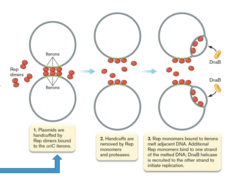
Direct repeats of 17-22 base pairs that bind Rep proteins; vary from 2-7 copies in plasmids
How do Rep proteins regulate plasmid replication?
Monomers initiate replication, while dimers prevents it through "handcuffing"
What is 'handcuffing' during replication?
forming an inactive bridge between the interns of two plasmids to control the rate of replication and ensure plasmid does not overload host cell with excess copies

What is a secondary chromosome in bacteria?
A smaller chromosome that evolved from plasmids via a series of gene transfer events; carries essential genes.

How do archaeal chromosomes differ from bacterial chromosomes?
circular and not found in a nucleus, similar to bacteria

What are the key differences of eukaryotic microbes from bacterial microbes?
-linear and nucleus-contained; DNA packed by histone proteins
-replication via mitosis
-replicate semiconservatively and bidirectionally
-larger than bacteria; big portions of non-coding DNA
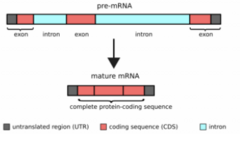
What are introns in eukaryotic genomes?
Intervening sequences that do not code for proteins and are spliced out of mRNA prior to transition
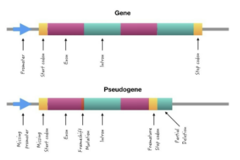
What is a pseudogene in eukaryotic genomes?
A segment of DNA that structurally resembles a gene but cannot code for a protein; derived from genes losing protein-coding ability due to accumulation of mutations