ANSC 360 Respiration
 Call Kai
 Learn
 Practice Test
 Spaced Repetition
 Match
 Flashcards
 Knowt Play
1/94

There's no tags or description
Looks like no tags are added yet.
95 Terms
Why does an animal’s breathing rate increase with exercise even if the lungs are healthy
Respiration is a coordinated system that supplies oxygen. eliminates CO2, and helps maintain homeostasis
Mouth/nostril use
Filter, warm, and humidify incoming air
Turbinates use
Increase surface area for air conditioning and filtration
Pharynx use
Shared passageway for air and food
Larynx use
Protects airway and vocalization
Trachea use
Conducts air, cartilage helps prevent collapse
Upper airway
Conditioning, protection, conducting air
Lower airway
Conducting air and gas exchange
Upper airway structures
Mouth/nostrils
Turbinates
Pharynx
Larynx
Trachea
Lower airway structures
Bronchi
Bronchioles
Alveoli
Bronchi use
Distributes air to lungs
Bronchioles use
Regulate air flow via smooth muscle
Alveoli use
Primary sit of gas exchange - large surface area for gas exchange
Alveolar type I cell
Thin cells that form most gas-exchange surface
Alveolar cells type II cells
Produce surfactant, reducing surface tension and preventing collapse
What happens as air moves deeper in lungs
Cartilage less important but smooth muscle is more important
Airways get smaller and increase in branching
Why would alveoli need to be extremely thin
Short diffusion distance for O2 and CO2
Why is pleural fluid important
Reduces friction while allowing lungs to move with the thoracic wall
Visceral pleura
Covers the lungsP
Parietal pleura
Lines the thoracic cavity
Thoracic cavity
Enclosed by the ribs, intercostal muscles, and diaphagm
Pleural fluid
Lubricates and keeps 2 pleural surfaces coupled during breathing
Inspiration
Inhalation
What happens during inspiration
Diaphragm contraction and flattening
External intercostal muscles help elevate ribs
Thoracic cavity volume increases
Intrapleural pressure becomes more negative
Alveolar pressure decreases below atmospheric pressure
Air flows into lunga
Important reminder for inhalation
Air moves down its pressure gradient
Expiration steps
Diaphragm relaxes
Elastic lung tissue recoils
Thoracic volume decreases
Alveolar pressure increases above atmospheric pressure
Air flows out
Expiration
Exhalation
Important reminder for expiration
During exercise or respiratory disease, expiration may require additional muscle activity
Inspiration vs expiration
Usually active vs usually passive at rest
Diaphragm contracts vs diaphragm relaxes
Thoracic volume increases vs throacic volume decreases
Air moves inward vs. air moves outward
Factors affecting airway resistance
Airway radius
Airway length
Gas viscosity
Most important factor in airway resistance
Airway radius
What causes heaves in equines
Airway narrowing and increase in airway resistance
Bronchoconstriction
Smooth muscle contracts
Airway diameter decreases
Resistance increases
Airflow becomes more difficult
Bronchodilation
Smooth muscle relaxes
Airway diameter increases
Resistance decreases
Airflow improves
What normally keeps the lung expanded against the thoracic wall
Negative pressure within pleural cavity and surface tension of pleural fluidW
What happens when air enters the pleural cavity
Pleural layers lose coupling and pressure relationship is disrupted
Why does the lung collapse in trauma
Recoils inward when missing negative intrapleural pressure
What treatment is required for collapsed lung
Removal of air (thoracentesis), oxygen therapy, place chest tube, treat underlying cause
Gas exchange movement
Moves from higher partial pressure to lower partial pressure
How do O2 and CO2 move comparatively
Independently
O2 and CO2 each have their own gradient affected by the other (they both move down)
What drives gas exchange
Diffusion
Gas exchange is driven by partial pressure gradient, NOT total pressure
Alveoli to pulmonary blood
O2 moves from alveoli to blood
CO2 moves from blood to alveoli
Blood to tissues
O2 moves from blood to tissues
CO2 moves from tissues into blood
Blood to alveoli
CO2 is unloaded and exhaled
O2 is replenished
Atmospheric air PO2 and PCO2 (mmHg)
159 (PO2) and 0.2 (PCO2)
Alveolar air PO2 and PCO2 (mmHg)
100 (PO2) and 40 (PCO2)
Arterial blood PO2 and PCO2 (mmHg)
95-100 (PO2) and 40 (PCO2)
Tissues PO2 and PCO2 (mmHg)
40 (PO2) and 46 (PCO2)
Venous blood PO2 and PCO2 (mmHg)
40 (PO2) and 46 (PCO2)
Partial pressures in body
Inspired air has higher PO2 than alveolar air
Alveolar PO2 is higher than blood arriving in lungs
Blood arriving in lungs has higher PO2 than aveolar air
How are gradients created for exchange
Tissues consume O2 and produce CO2
Hypoxia
Insufficient oxygen avilable to tissues
Hypoxia causes
Poor ventilation
Impaired gas exchange
Poor circulation or perfusion
Reduced oxygen carrying capacity (anemia)
Hypercapnia
Excessive carbon dioxide in blood
Hypercapnia causes
Hypoventilation
Airway obstruction
Respiratory muscle dysfunction
Impaired ventilation
Important reminder for hypoxia/hypercapnia
An animal can have hypoxia, hypercapnia, or both at once
Eupnea
Normal, quiet breathing
Dyspnea
Difficult or labored breathing
Apnea
Temporary cessation of breathing
Hyperpnea
Increased depth and/or rate of breathing to meet metabolic demand
Tachypnea
Increased respiratory rate
Polypnea
Used to described rapid breathing
Is oxygen soluble in plasma
Not really, which is why most oxygen is transported bound to hemoglobin within RBC
Hemoglobin strucutre
Four globulin subunits each with a heme group
Heme use
Contains an iron Fe+ molecule to bind to one oxygen molecule
Hemoglobin how much O2 can it carry
4 molecules (each on one heme group)
O2 amount bound to hemoglobin vs plasma
98% hemoglobin
2% plasma
Why does hemoglobin matter
Without hemoglobin, the blood could not carry enough O2 to meet metabolic demands
O2 content with hemoglobin
200 mL O2/L blood
O2 content with dissolution in plasma only
3 mL O2/L blood
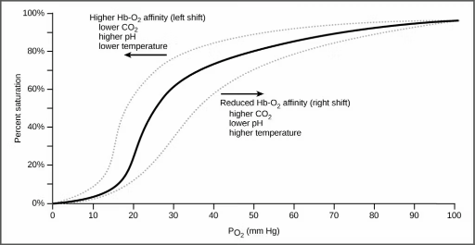
Name of curve
Oxyhemoglobin dissociation curve

Why is the curve shaped like an S
Hemoglobin exhibits cooperative binding. Binding of O2 at one site increases affinity of the remaining sites for O2

What is the advantage of this shape (lungs)
Plateau helps hemoglobin remain highly saturated even is PO2 decreases moderately

What is the advantage of this shape (tissues)
Steep portion allows substantial O2 unloading when tissue PO2 decreases
What causes right shifts on the curve
Hemoglobin gets lower affinity for O2 and releases more of it
Increased temp
Increased CO2
Decreased pH
More active tissues need the oxygen so the hemoglobin lets go easier
What causes left shifts on the curve
Hemoglobin has a higher affinity for O2 and holds onto O2 stronger
Decreased temp
Decreased CO2
Increased pH
Exercise and O2 unloading
During exercise, active muscles produce more heat, CO2, and H+ ions to help promote O2 unloading
3 forms of CO2 transport
Bicarbonate (70%)
Bound to hemoglobin - carbaminohemoglobin (23%)
Dissolved in plasma (7%)
Is O2 or CO2 easier to dissolve in plasma
CO2 - but most of it is transported as bicarbonate (HCO3-) regardless
Bicarbonate reactions inside RBC
Reacts with water
CO2 + H2O = H2CO3
Carbonic acid dissociation
H2CO3 = H+ + HCO3-
What helps regulate blood pH
Carbon dioxide transport
Bicarb formation - enzynes
Enzyme carbonic anhydrase accelerates the reaction
Bicarb formation steps
H+ is buffered largely by hemoglobin
HCO3- moves into plasma
Chloride enters the RBC to maintain electrical neutrality (chloride shift)
Reaction REVERSES in lungs
Bicarb with lungs
Bicarb converted back into CO2 and diffuses into alveoli and exhales
What controls breathing
Regulated via neural centers in brainstem
Body monitors - CO2/pH
Major driver of moment to moment ventilation
Increased CO2 increases H+ in cerebrospinal fluid
Chemoreceptors respond to changes in pH
Respiratory centers increase ventilation
Body monitors - O2
Peripheral chemoreceptors in the carotid and aortic bodies detect decreases in arterial oxygen
Strong respiratory response occurs when arterial PO2 becomes low
What happens when CO2 increases
CO2 rises
pH falls (more acidic)
Respiratory centers increase ventilation
More CO2 exhaled
CO2 decreases
pH goes back to normal levels
Increased ventilation purpose
Increase O2 intake and CO2 removal
Increased cardiac output purpose
Deliver more blood to tissues
Increased tissue blood flow purpose
Improve O2 delivery to active muscles
Increased O2 unloading purpose
Meet metabolic demand
Increased temperature and CO2 production
Help shift Hb curve rightward
Important reminder for entire respiratory system
Respiratory system cannot meet increased demand by ventilation alone. It must work with the cardiovascular system, blood, and tissues