Management of Wounds in Horses
 Call Kai
 Learn
Learn Practice Test
 Spaced Repetition
 Match
Match Flashcards
 Knowt Play
1/37

There's no tags or description
Looks like no tags are added yet.
Name | Mastery | Learn | Test | Matching | Spaced | Call with Kai | Chat |
|---|
No analytics yet
Send a link to your students to track their progress
38 Terms
What is healing?
What are the sequences of events in healing?
• Healing is an orderly biologic process of repair that restores continuity to injured tissue
• Sequence of events of healing progresses through overlapping phases-
Inflammatory
Debridement
Repair (proliferative)
Maturation phases (remodelling)
Goal of healing?
A functional and cosmetic repair with a rapid return to normal use
Why is wound repair or therapy an expensive process?
• Wound epithelialises at 1.2mm per day (Under best conditions)
• 10cm wound takes 3 months to close
• Bandage changes every 4-5 days
• Average hospitalised wound costs
£3000-£7000
**Important to consider welfare “cost” to the patient by treating the wound
What research changed the way we manage wounds today?
"epithelization is retarded by the dry scab which normally covers a superficial wound, and if the formation of the scab is prevented, the rate of epithelization is markedly increased."
In detail, describe the inflammatory phase of healing.
• Inflammatory phase
- Occurs during first 2 to 3 days
- First a transient vasconstriction followed by increased vascular permeability
- Wound fills with fibrin
• White blood cells move into wound
• Neutrophils appear first
• Neutrophils die & release enzymes that attack cellular debris
- White blood cells of horses produce lower concentrations of inflammatory mediators, which are essential for healing
i.e., less inflammation
What is different about the inflammatory phase in horses compared to other animals?
• Inflammatory phase
- Leukocytes of horses produce lower concs of inflammatory mediators, which are essential for healing
i.e., less inflammation
- Neutrophils disappear more rapidly in wounds of ponies than in wounds of horses
Worst place - lowest conc. of wound - distal limb, trunk
Is inflammation a good thing?
• Markers of the non healing wound
MMPs 2&9
Neutrophil elastase
• Allow us to determine if intervention actually works
• When the wound starts to heal the inflammatory markers appear
In detail, describe the debridement phase of healing.
- Occurs after 6 to 8 hrs
- Duration depends on amount of debris & contamination
- Monocyte is predominant leukocyte
• Become macrophages
Responsible for removal of debris
Inductive effect on fibroblasts
“Looks like a pizza”
In detail, describe the repair phase of healing.
Proceeds after wound is debrided
Also called fibroblastic or proliferative phase where granulation tissue begins to form (Around day 4) - start to see epithelial cells with white margin around day 10-14
Strength increases rapidly during this phase
Wound has no strength until this phase
Primary cell is the fibroblast
Fibroblasts appear by 3 days
Lay down collagen & other components of connective tissue
Capillaries appear
Granulation tissue forms
Complex of fibroblasts, capillaries, & macrophages in a matrix of collagen & fibrin
Granulation tissue is necessary for wound contraction & migration of epithelium
In detail, describe the maturation phase of healing.
- Also called remodeling phase
- Begins at about 2 wks & continues for 6 - 12 months
- Granulation tissue & collagen production decline
- Intra- & inter-molecular cross-linking of collagen fibers
- Scar is never as strong as tissue it replaced
Scar is NOT skin, fibrous patch, does not have hair or glands
Massaging of the wound can help reduce appearance and size of the scar
If scar is traumatized, it can fall apart and break up
What are some factors that MAY inhibit healing?

When examining a horse or patient with a wound, what should be your first step?
• Stand back and observe the horse
• Physical examination, shock, exhaustion, other trauma
What are the main methods of providing analgesia to horses for a wound?
Local or regional
- Regional is better than local
• Regional perineural anesthesia
• Regional perfusion
Suprisingly, skin wounds are not very painful and should not cause much lameness, if the horse is very lame, it is very likely there is damage to some underlying structure or infection within a tendon sheath or joint
Should you close all wounds?
When is it suitable and when is it not?
• The expectation of many clients is that the wound will be closed immediately, this is often NOT in the horse's best interests, particularly where there is a loss of tissue and a great deal of contamination
BUT
Primary wound closure
• Suitable for
-surgical wounds and injuries which are not grossly contaminated, infected or swollen
-wounds without excessive tension or soft tissue devitalisation
-nothing gained by attempting primary closure if you feel that breakdown is likely
Describe techniques used for methods of closure?
Monofilament nylon & polypropylene are preferred skin sutures (They have less drag on tissue and braiding which can hold bacteria)
- Capillary sutures in skin should be avoided
- For deeper layers, use synthetic, monofilament absorbable suture
- Staples are quick and easy to use - but not designed for horses, emergencies only
Is their use controversial?
What are the main criteria for wound closure?
- Must be vascular
- Must have minimal tension
- Must be clean
- Must be within golden period (i.e., not infected)
**Most wounds can be safely closed after 24 hoyurs
What is the golden period?
- Time between wounding & infection
• Usually said to be about 6 to 8 hrs
- Wound becomes infected when bacterial conc. exceeds humoral & cellular defense's ability to destroy bacteria
• For most types of bacteria, this conc is 105 organisms/g tissue (100,000/g)
Additionally, there is no fixed golden period in horses
Why is delayed skin closure preferred in some instances?
- the wound is not closed immediately but is closed after several days once the conditions are optimised to prevent wound breakdown. If we closed immediately, infection may have set in.
REASONS FOR DELAY
Severe contamination
Contusion or devitalised tissues
Swelling
Infection
What is second intention healing?
Nature’s method of healing

What is second intention vs. first intention healing?
Primary intention healing involves direct mechanical intervention to close the wound.
Secondary intention healing (also called healing by secondary intention or granulation) is a natural wound healing process where a wound is left open and allowed to heal from the bottom up without stitches, staples, or surgical closure.
• Definition: Primary intention (or primary closure) happens when clean, opposing wound edges—such as a surgical scalpel incision or a sterile cut—are brought directly together and held in place.
• Intervention: It requires active medical or mechanical intervention using tools like sutures (stitches), surgical staples, skin adhesives (glue), or Sterri-Strips to approximate the edges.
• Result: Because the gap is closed artificially and immediately, the body heals faster with minimal tissue loss and a smaller scar compared to secondary intention
What should be used to clean equine wounds?
Chemicals are not designed for cleaning the wound - good to clean around the wound, they kill cells, slow down healing.
Bring the horse to an area where it can be assessed. Then wash the wound with water to remove contamination. A running hose is the best way to do this, if the horse will tolerate it.
“Dilution is the solution to pollution”

By how much does early irrigation reduce infection risk?
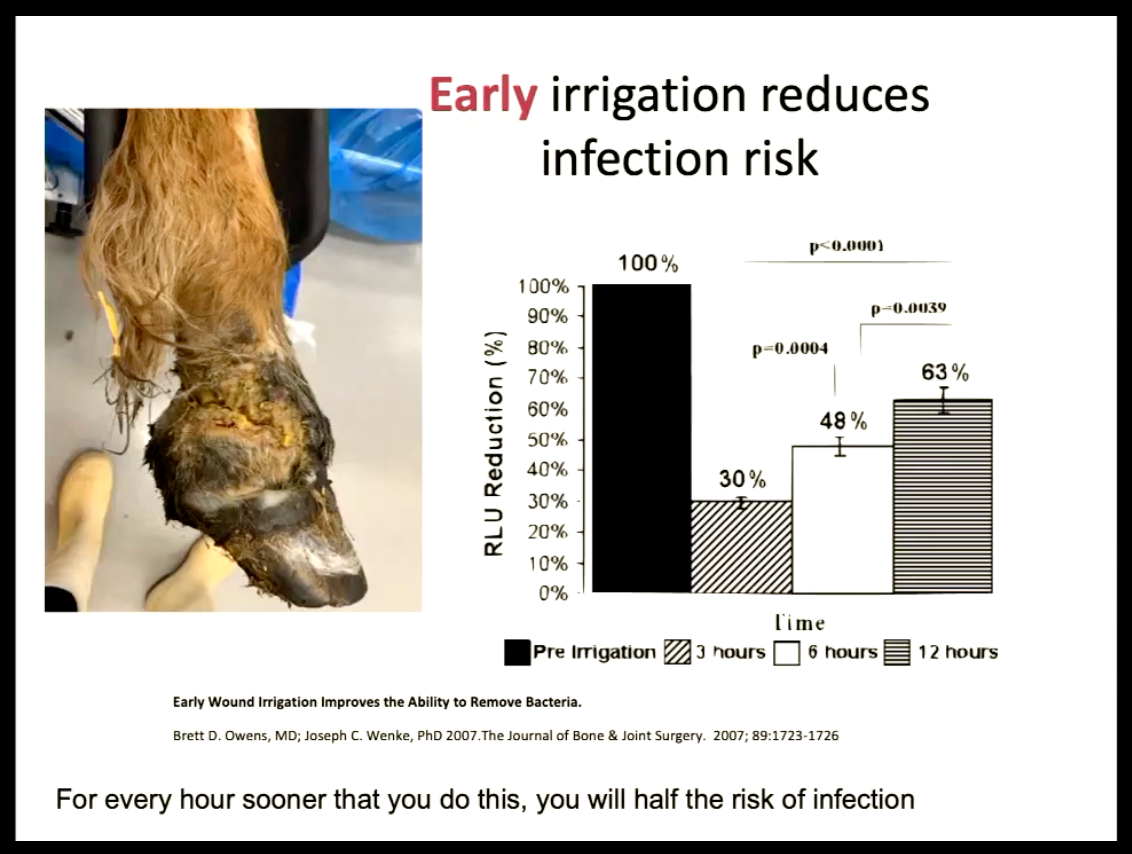
What is the versa-jet?
The VERSAJET (most commonly known as the VERSAJET Hydrosurgery System made by Smith+Nephew) is a specialized surgical tool used primarily for wound debridement.
How It Works
High-Velocity Saline Jet: The system shoots a very fine, high-pressure stream of sterile saline (or water) across an opening in a handheld tip.
Venturi Effect Vacuum: The rapid movement of the fluid creates a local vacuum (Venturi effect) that simultaneously cuts away tissue and suctions/aspirates debris, bacteria, and non-viable (dead) tissue into an evacuation tube.
**Can use a garden sprayer on wounds if not available!
What are the main principles of infection control regarding wounds?
• Principles
• Removal of foreign material and debris
• Removal of devitalised tissue
• Eliminating micro-organisms to below critical level required to maintain septic process
Topical Antibiotics
Intravenous Regional Perfusion of ABs
• Removal destructive radicals & enzymes
• Improve action of antibiotics
Restore pH to physiological levels
Remove purulent exudate
Should you apply anything topically to the wound?
Don't apply anything to the wound unless it has proven efficacy— resist the temptation to apply wound powder, purple spray or oily creams. (Detergent, antispetics, wound powder and many so called "wound creams" actually inhibit healing!)
Get owner to lavage the wound!!!! Stops them from putting these into the wounds.
How can you determine if a joint is involved in the wound?
Synovial Pressure Test - NO joint tap, put sterile fluid into joint, see if it leaks out
Don't forget that absence of obvious lameness does not rule out penetration of a joint or sheath.
How can you reduce movement or immobilize wounds to promote healing?
Movement
•Wounds over joints or bony prominences
•Soft tissue structures moving through a wound
i.e extensor tendon

What are the indications for casting a wound?

When should you remove flaps of tissue?
Living tissue that you can use and eliminate weeks of healing by using the flaps of tissue!

What are some methods you can use to relieve tension of a wound?
• Tension relieving sutures
• Stent bandages
• Drains
• Reliving incisions
What can occur if a wound has a foreign body?
Impairs or prevents healing
Include soil/clay/faeces etc
Lead to increased risk of infection
Inflammation
May be difficult to find
Sequestrum formation - section of bone dies and becomes a foreign body
Reminder** What should granulation tissue look like?
What is exuberant granulation tissue or proud flesh?
• The horse has a propensity to develop granulation tissue earlier in healing and in excessive amounts
• Granulation tissue in an open wound is beneficial
-migration of epithelial cells
-resistance to infection (inherent resistance to bacterial colonisation)
-process of contraction centred around its development
• BUT excess granulation is detrimental to healing - looks knobbly and tells you there is an impairment to healing

What factors may encourage development of exuberant granulation tissue?
Factors encouraging its development
-moisture
-warmth (low temperature decreases metabolic activity)
-low oxygen tension
-low pH
-irritation
-infection
-motion
How can you control or treat EGT?
• Counter pressure (bandages/casts)
• Immobilisation
• Surgical excision
• Infection control
• Topical agents?
• Cryosurgery
• Biological dressings
• Skin grafting
What are wound dressings used for?
What categories do they fit into?
1.) Provide moisture
Hydrogels
Hydrocolloids
2.) Absorption
Foam
Cotton, padding, wadding
3.) Donate
Donate something to wound, usually something which kills bugs, utilizing silver as an antimicrobial agent to reduce bacteria while cellular activity continues
Silver is effective against MRSA strains and over 150 other
bacteria known to be common wound pathogens.

When is honey useful for wound care and how?
Can you use just any honey?
It helps to debride through osmotic action essential in wound preparation, is antimicrobial and anti- inflammatory
A good alternative to hydrogels where infection is an issue.
Antibacterial properties attributed to:
• Acidity
• Hydrogen Peroxide (H202)
•Osmotic Effect
•Phytochemical Components
Contributes to:
• control inflammation
• microbial control
• promoting angiogenesis, fibroblast proliferation and cytokine production - increase wound healing?
Must use medical grade honey?
You cannot use regular grocery store or pantry honey for wound care because it is not sterile and can introduce harmful bacteria, spores, and contaminants to broken skin.
What is the purpose of negative pressure therapy?
• Removes exudate and other wound fluid
• Reduces wound expansion
• Poorly understood effect on rate of contraction
Describe how maggot therapy or biofoam dressing is used to remove necrotic tissue?
Apertures in the dressing mesh are just the right size to allow the larvae to feed on necrotic and sloughy tissue while keeping them contained in the dressing.
The dressing contains foam chips to absorb exudate produced and maintains a moist environment for the larvae to survive.