shock
 Call Kai
 Learn
 Practice Test
 Spaced Repetition
 Match
 Flashcards
 Knowt Play
1/93

There's no tags or description
Looks like no tags are added yet.
94 Terms
what is shock in term of hemodynamic?
shock is lack of oxygen to the tissues, resulting in abnormal cellular metabolism
more anaerobic metabolism compared to aerobic metabolism
which one is there more of during shock? aerobic metabolism or anaerobic metabolism?
anaerobic metabolism
what are the different type of shocks and give a quick description of what they are…
hypovolemic - low circulating volume
cardiogenic - there is something wrong with the heart pump
obstructive - something is blocking the flow of blood
distributive - something is wrong with the distribution of blood (e.g., pooling of blood) - divided into three subtypes: septic, anaphylactic, and neurogenic
alterations in at least one of what four components can lead to shock?
blood volume
myocardial contractility
blood flow
vascular resistance
what is the normal MAP on the floor and in the ICU?
floor: 70-100 mmHg
ICU: 65 or higher
review the equation for MAP…
MAP = (2 x DBP + SBP) / 3
what drop in MAP triggers the baroreceptor response in a healthy person?
5-10 mmHg from baseline or if the MAP is less than 65 mmHg
where are the arterial baroreceptor located?
carotid sinuses and the aortic arch
which cranial nerve carries the signal from the carotid sinus baroreceptors to the brain?
CN IX (glossopharyngeal), via the carotid sinus nerve
which cranial nerve carries the signal from the aortic arch baroreceptor to the brain?
CN X (vagus)
when MAP falls and the baroreceptor reflex kicks in, what is the sympathetic response?
vasoconstriction and increased heart rate/contractility
a patient is bleeding and the baroreceptor reflex is working … what do you expect to see first: a drop in BP or a rise in heart rate?
rising heart rate and cool, clammy skin with BP still near normal
the reflex holds MAP near normal by raising heart rate and constricting vessels; early shock shows up as tachycardia, cool skin, and delayed capillary refill while BP still look fine; the time MAP drops is when the compensatory mechanism is already exhausted
a hypotensive patient is on a beta-blocker and has a heart rate of 70 … why is that heart rate not reassuring?
the beta-blocker blunts the tachycardia response, so the epxected compensation is missing which we will then need to relies on other measurement like lactate, urine output, mentation, and trend to see what is going on.
why might a patient in neurogenic shock or under deep sedation failed to compensate for hypotension?
sympathetic outflow is disrupted or blunted so vasoconstriction and tachycardia don’t occur normally
the brain's compensatory signal travels through the sympathetic system → spinal cord injury interrupts it (neurogenic shock) and sedatives or anesthetics blunt it, so the expected vasoconstriction and tachycardia may be absent.
what is working against a hypotensive reflex in septic shock?
widespread vasodilation (vasopledgia) overwhelms the vasoconstrictor response which is why vasopressor is the first-line of medication for septic shock
ff the patient's reflex is already maxed out (tachycardic and vasoconstricted), what does that tell you as a nurse?
there is little compensatory reserve left, so further decline may be abrupt
the reflex buys time but is not unlimited. A patient who is already tachycardic and vasoconstricted has little left to give, so they may decompensated quickly. This is a reason to escalate early.
what is happening in stage 1 (initial stage) of shock?
compensatory mechanisms maintain blood flow to vital organs despite decreased cardiac output and hypoxia
vasoconstriction and increased HR
MAP is either unchained or drop less than 10 mmHg from baseline
there will be some anaerobic metabolism so expect a rise in lactate (normal: 0.5 - 2.2 mmol/L; abnormal and trigger an ICU admission: > 4 mmol/L)
reversible with little or no damage
what state of shock is considered to be reversible?
stage 1, 2, and 3
what is the normal and abnormal serum lactate?
normal: slides said less than 1 mmol/L but Ian said 0.5-2.2 mmol/L
abnormal: more than 4 mmol/L → will definitely trigger an ICU admission
what is happening in stage 2 (compensatory stage) of shock?
cardiovascular compensation is no longer adequate to keep MAP stable and you will typically see a drop in BP and increased HR now!
MAP drop 10-15 mmHg from baseline
renal system senses decreased MAP and attempts to compensate by retaining water and sodium
blood is prioritized to vital organs → hypoxia of non-vital organs (e.g., cyanotic skin, AKI of kidney due to decreased blood flow)
anaerobic metabolism raises lactic acid → acidosis
reversible if the cause of shock is controlled and supportive measure are initiated
why is prolonged compensation in shock harmful?
release drenaline (epi) and norepinephrine causes vasoconstriction which over time the skin will not receive adequate perfusion and so the skin is cold, clammy, and cyanotic (poor perfusion) → blood is also direct to vital organs whcih causes hypoxia of non-vital organ
ADH, aldosterone, cortisol release causes the body to holds onto water and sodium to increase pressure which over time it would causes edema, low serum osmolarity, high urine osmolarity, low urine output, and CONGESTION!!!!
fast, deep breathing (as the body’s attempt to increase oxygenation) that causes blows off of too much CO2, causing respiratory alkalosis, which constricts brain vessels and lowers cerebral blood flow (confusion)
what happens in stage 3 (progressive stage) of shock?
compensation fails, so the body’s own attempt to fixes the shock causes organ damage → this stage is threatening, so treatment is aggressive!
MAP drop more than 20 mmHg from baseline | HR is still high
worsening hypoxia of non-vital organs which causes increase in anaerobic metabolism causing lactic acidosis → organ began to mot and shows sign of organ failure
capillary leak syndrome: the high pressure pushes retained fluid out of vessels so intravascular volume drops and tissues swell → shows as ARDS in lung and swelling of the brain
ischemia hits organs (AKI for kidneys, pancreas release substances that weakens the heart, and liver can’t make clotting factors so bleeding risk)
stage 2 is more of the organ being stressed but stage 3, the organ is literally breaking!
what happens in stage 4 (refractory stage) of shock?
the body can no longer compensate, and the damage is irreversible even if the cause if corrected
massive cell death from tissue hypoperfusion as the cell have been starved too long, so even restoring flow can’t undo it
multiple organ dysfunction syndrome (MODS): damage to vital organs, with several failing at once)
observable symptoms: dusky skin, no palpable pulse, bradycardia, SpO2 that can’t be picked up even if oxygenation increased (poor perfusion causes the sensor to fail)
organ failure: AKI, ARDs, stress ulcers (gut hypotension damages the lining)
sepsis: the damaged gut lets bacteria escape and spread, “looking for other places to eat” so infection pules on top
how do early vs. late signs of shock differ?
early signs mean compensation is working while late signs mean it is failing!
blood pressure: normal → less than 90 systolic. The reflex holds BP until it can’t
pulse: fast → fast but weak; the heart gets tired, so the rate stays up but each beat is weaker
skin color: normal → pale → vasoconstriction pulls blood away from the skin
skin temp: cool and moist → cold; squeezing for longer means less flow, so it goes from clammy to cold
mental status: anxious → coma; the brain goes from “something’s wrong” (adrenaline, low O2) to starved of blood
breathing: fast and deep → fast and shallow; early on, the patient is trying to blow off acid and get O2. Later, the breathing muscles tire out
what is the general principles of shock management?
shock means oxygen supply is below demand, so every principle either raises supply (of oxygen), lowers demand, or fixes the cause
identify and reverse the underlying cause; if hypovolemic, start IV resuscitation
minimize oxygen consumption (lower demand)
maximize oxygen delivery to reverse tissue hypoxia (raise supply)
correct the circulatory component (the volume, pump, or vessels problem
how should the nurse restore intravascular volume in shock?
replace what is missing, aiming for a MAP of at least 65 mmHg, and watch for signs that the fluid is working
absolute vs. relative hypovolemic: absolute means fluid was actually lost (bleeding, vomiting) so fluid resuscitation might be indicated; relative means the fluid is still there but the vessels are dilated (sepsis, anaphylaxis) so passive leg raise can help
access: large-bore IV and/or CVC, so fluid can run in fast
fluids: view another flashcard
monitor urine ouput (Foley for strict I&O), level of consciousness, peripheral perfusion (check cap refill)
cardiogenic shock: large volumes ar generally not appropriate because the problem isn’t with the amount of fluid but the heart can’t pump that fluid effectively
what is the Belmont rapid infuser more?
allow rapid, massive fluid or blood infusion
need a large IV: 18-21 gauge
used for PRBCS and other warmed fluids
what should the nurse need to know about the different type of fluids that can be used for shock?
crystalloids can help replace fluid fast but they also leak out of blood vessels, so blood products replace what crystalloids can’t: oxygen carrying and clotthing
3 mL of crystalloid replaces 1 mL of blood loss: crystalloids spread across the whole extracellular space, so only about a third stays in the vessels
recognize hemodilution: lots of crystalloid dilutes red cells (less oxygen carried) and clotting factors (more bleeding), so give blood products
LR is not preferred: it resembles plasma, but it contains lactate and can worsen lactic acidosis
crystalloids restore volume, blood restores oxygen carrying and clotting
why might a shock patient need a ventillator, and why sedate them?
when shock happen, the tissues are not able to receive adequate oxygen
mechanical ventilation can take over the work of breathing, so O2 consumption drops and sedation lowers it further because less movement = less demand for oxygen
why monitor ABGs, and why does the patient need an A-line?
ABGs are the fastest check on whether the oxygenation is working, so in an unstable patient, the nurse will need to draw them regularly per doctor’s order
a full panel gives oxygenation and acid-base status plus H/H, electrolytes, and lactates, with results in minutes
an A-line lets the nurse draw blood without repeated sticks and shows BP beat by beat
which lab should the nurse check when the patient is in shock, and what does each one tell them about the clinical status of the patient?
serum lactate: are the tissues getting enough oxygen? (rises when cells go anaerobic)
CBC with differential: low H/H suggests blood loss, and high WBC suggest infection
serum chemistry: electrolytes and kidney function, since the kidney are one of the first organ to suffer due to reduced blood flow (AKI)
coagulation studies: is the patient at risk for bleeding or abnormal clotting (as septic shock reduce blood flow to the liver)
culture and sensitivity: which bacteria, and which antibiotic kills them
review the different type of medication that can help shock and its complications…
vasopressors: squeeze the pipes (vessels) to raise SVR and MAP
inotropes (dopamine, dobutamine): squeeze the pump harder (increase contractility)
insulin: stress hormones push blood sugar up, so hyperglycemia is common and needs control
antibiotics: treat the infection, especially in sepsis
corticosteroids: your slide doesn’t say why (see note below)
DVT prophylaxis: critically ill patients lie still and have sluggish blood flow, so clots form
stress ulcer prophylaxis: a poorly perfused gut lining loses its protection, so it ulcerates
why should hypothermia be avoided for patient in shock?
cold temperature slows the body’s chemistry which the heart muscle contracts more weakly, and the clotting cascade works poorly which mean lower contractility and coagulopathy
why should nutrition be start within 24-48 hours after the patient develop shock?
a gut that isn’t fed break down, and a broken gut lining let bacteria leak into the blood (bacterial translocation) → but a sick gut move slowly
start feeding early to protect the gut lining
monitor residuals and avoid overfeeding
why is skin a concern in shock, and what should the nurse do?
skin is a non-vital organ so it get less blood during a shock which pressure on skin that’s already starved of blood damages it quickly
strict turning schedule
specialized ICU beds
why are corticosteroid used in shock?
used for septic shock taht doesn’t respond to fluids and vasopressots (refractory)
severe illness can leave the body short on its own steroid response, and steroids help vessels respond to vasopressors again
why is hyperglycemia common in shock, and why does it matter?
stress hormones (catecholamines, cortisol) push the liver to release sugar, so blood glucose rises even in patients who aren’t diabetic
uncontrolled high glucose is linked to worse outcomes and infection risk in ICU patients, so insulin is used to control it
exact glucose targets vary by unit, so go with what your instructor or protocol teaches
what do alpha 1 and beta 1 receptors do?
alpha 1 = arteries: vasoconstriction, BP goes up
beta 1 = heart BEAT: HR and contractility go up (can cause tachyarrhythmias)
what do beta 2 receptors do?
they sit in the lungs and vasculature. They cause vasodilation, so BP goes down, with no effect on heart rate.
what do vasopressin receptor do?
vasoconstriction
increased blood pressure
what is the MOA, indications, contraindications, and adverse effects of dopamine (Intropin)?
positive inotrope (increase contractility), vasopressor (potent vasoconstriction)
MOA: binds to D1/D2 (kidney and gut vessels), plus beta 1 and alpha 1; effects depend on the dose
low (1-3 mcg/kg/min): D1/D2; more renal and abdominal blood blow
medium (3-10 mcg/kg/min): beta 1; stronger contractility
high (more than 10 mcg/kg/min): alpha 1: vasoconstriction so increased BP and HR
indications: hypotension, decreased cardiac output, and symptomatic bradycardia that doesn’t response to atropine or pacing
contraindications: V-tach or V-fib since the rate is already rapid
adverse effects: HTN, tachyarrythmias, HA, V, dyspnea, anxiety, piloerection (goosebump), azotemia (increase BUN/creatinine), peripheral vasconstriction, and tissue necrosis if infiltrated
why might a patient in shock with bradycardia get dopamine instead of norepinephrine?
dopamine stimulates beta 1, so it raises HR and BP while norepinephrine mostly stimulates alpha 1 which raises BP through vasoconstriction but it doesn’t speed up the heart
why is dopamine no longer a first-line vasopressor, and what is used instead?
first line vasopressor is norepinephrine (Levophed)
not dopamine because effects are dose-dependent, it causes more tachyarrythmias, no proven kidney protection, worse outcomes than norepinephrine in some shock state
it is still used for selected patient with bradycardia since it raises HR
what is the MOA, indications, contraindications, and adverse effects of epinephrine?
MOA: stimulates alpha 1 (vasoconstriction), beta 1 (increase contractility), beta 2 (vasodilation and open airway); acts both as an inotrope and a vasopressor
route: bolus dose, continuous infusion, or via endotracheal tube
indications: cardiac arrest, symptomatic bradycardia, severe hypotension, and anaphylaxis
contraindications: use with caution in tachyarrythmias and severe hypertension
adverse effects: tachycardia, tachyarrythmias, HTN, anxiety, tremor, HA, chest pain, or MI
since both epinephrine and dopamine raise HR and BP, when is each one preferred?
epinephrine: emergencies like cardiac arrest, anaphylaxis, severe hypotension because beta 2 open the airways, which dopamine can’t do
dopamine: symptomatic bradycardia, or hypotension with low CO that didn’t respond to atropine, when the patient is not at high risk for arrhythmia
what is the MOA, indications, interactions, and nursing considerations of norepinephrine (Levophed)?
vasopressor and cardiac stimulant
MOA: alpha 1 (vasoconstriction → SVR and BP up), beta 1 (contractility → HR, BP, CO up), beta 2 (mild vasodilation to protect blood flows to organ)
indications: hypotension (shock)
interactions: MAOIs (since it break down norepi), tricyclic antidepressants (block reuptake of norepi), oral hypoglycemic (norepi can raise blood sugar), halogenated anesthetics (sensitize the heart to catecholamines, which make norepi likely to trigger ventricular arrhtymias)
adverse effects: HTN, arrythmias, decreased perfusion, HA, anxiety, chest pain
what is the first-line medication for shock?
norepinephrine (Levophed)
what is the nursing consideration for administering norepinephrine?
extravasation can cause tissue necrosis so make sure the IV flush and have blood return
peripheral vasoconstriction cause reduced organ/tissue perfusion
HTN if over-titrated
tachycardia or arrythmias
hyperglycemia
epi and norepi have similar MOA so why is epi preferred in cardiac arrest and anaphylaxis, while norepi is first line for shock
epi: strong alpha 1 + beta 1 + beta 2 → works as a quick bolus to restart the heart, boost coronary and brain blood flow, and open airways.
norepi: mostly alpha 1, with less beta → a steady infusion that raises BP with fewer arrhythmias.
what is the MOA, indications, interactions, and nursing considerations of phenylephrine?
MOA: pure alpha 1 agonist (vasoconstriction), BP, SVR, and after load go up; has no beta stimulation, so it doesn’t speed up the heart (HR often stays the same or drops)
indications: hypotensive for patient where you want to raise BP without affecting HR (e.g., patient with a tachyarrythmias)
contraindications: use caution with bradycardia, severe HTN, and HF or low CO
adverse effects: bradycardia (reflex), coronary artery vasoconstriction, increased after load, HTN, reduced perfusion
what is the nursing considerations for neosynephrine (Phenylephrine)?
titration: 5 mcg every 15 minutes
give through a central line
check for extravasation
watch HR, BP, and extremities perfusion
what is the MOA, indications, interactions, and nursing considerations of vasopressin (Pitressin)?
antidiuretic hormone
MOA: vasopressin 1 agonist; vasopressin or ADH; causes smooth muscle constriction, but vasodilate cerebral vasculature; help retains sodium and water
indications: vasodilatory shock, diabetes insipidus, heart failure (may be better for patient with a failing heart, since it doesn’t act on beta receptors)
contraindications: dysrhythmia, hypertensive crisis, AKI, pulmonary edema
adverse effects: increased platelet aggregation, reduced perfusion to the gut, skin, and limbs, tissue necrosis if extravasates, and arrythmias
why would vasopressin be used over, or in addition to, other vasopressors?
vasopressin tend to be used as an adjunct to Levophed when only the constriction from Levophed isn’t enough to raise blood pressure
vasopressin doesn’t raise heart rate like other vasopressors (e.g., levophed, epi, dopamine)
sometime it is used as an adjunct to reduce the amount of other vasopresor that would otherwise be needed (e.g., less norepi mean less tachycardia and less harsh vasoconstriction)
there is no need for titration unlike other vasopressors
true or false: phenylphrine have no effects on the heart in term of its mechanism BUT as a side effect it can cause reflex bradycardia
TRUE!
what is the MOA, indications, contraindications, interactions, and nursing considerations of clevidipine (Cleviprex)?
MOA: ultrashort-acting calcium channel blocker (CCB) - blocks calcium arterial smooth muscle, so arteries relax, SVR drop, and BP falls; extremely rapid onset with a half life of 1 minutes
indications: hypertensive crisis
contraindications: soy or egg allergies as the medication is lipid based
interactions: other BP-lowering drugs
nursing consideration: lipid-based so make sure the pt don’t have allergies, 50 mL vial last 4-6 hours and 100 mL last 8-12 hours, consider low-dosing when fluid overload is a concern (since it is an emulsion so it add volume), monitor BP continuously, check triglycerides!
why must the nurse check triglyceride for patient receiving clevidipine?
because it is lipid-based
do the nurse have to check blood glucose levels for patient on levophed?
yes! because norepinephrine stimulates the breakdown of glycogen into glucose in the liver
why might clevidipine (Cleviprex) be preferred as a medication for post-cardiac surgical patient?
for patient who have just received cardiac surgery, we need to bring their BP down to protect surgical suture lines form bleeding and since the medication have a short hal life and a rapid onset, it can help fix the BP, and if BP were to drops too low, stopping the medications will stop the drop almost right away
what is the MOA, indications, contraindications, adverse effects, and nursing considerations of nipride (nitroprusside)
MOA: arterial and venous vasodilator so SVR drops, BP falls and CO increases (the reasoning is that the heart pumps against less resistance); no change in pulse
indications: severe left ventricle heart failure, hypertension after CABG, hypertensive crisis, and dissecting aneurysm
contraindications: compensatory HTN, liver or kidney failure (due to cyanide byproduct)
adverse effects: cyanide toxicity (can turn into cyanide if expose to light), edema, hypotension, headache, and increased ICP
nursing considerations: IV only and the patient must have a central line, protect from light at all times (keep it in the bag!), can turn into cyanide in the body so watch for toxicity, monitor BP continuously
what is the MOA, indications, contraindications, adverse effects, and nursing consideration of nicardipine (Cardene)?
MOA: IV CCB; causes arterial vasodilation in the peripheral and coronary vasculature, so SVR drops and BP falls; short acting (2-4 hours)
indications: HTN emergencies, ICH/stroke, postop HTN, acute aortic dissection, and pre-eclampsia
contraindications: advance aortic stenosis because the med can drop BP too far and reduce coronary blood flow
adverse effects: headache, flushing, dizziness, tachycardia, hypotension, nausea, and swelling
nursing consideration: can be given peripherally no central line required, monitor BP closely, watch for hypotension and reflex tachycardia, check IV sites often!
when is nicardipine preferred over clevidipine, and when is clevidipine preferred?
nicardipine: soy/egg allergy, pancreatitis or lipid problems, or when BP needs steady control over hours → simpler to run, with no lipid base.
clevidipine: needs fast, tight titration (1-minute half-life), such as post cardiac surgery.
what is MOA, indications, contraindications, adverse effects, and nursing consideration of nitroglycerin?
MOA: a nitrate vasodilator; relaxes vascular smooth muscle, mostly the veins (and arteries at higher dose) → vein dilates, so less blood returns to the heart (lower preload), and the heart works less and needs less oxygen; potent vasodilator in the brain
indications: angina pectoris, HTN, and HF
contraindications: PDE-5 inhibitor (e.g., sildenafil/Viagra) since it can cause severe hypotension when used together, hypovolemia, RV infarct, increased ICP
adverse effects: intense headache, hypotension, dizziness, flushing, and reflex tachycardia
Almost done
how is nitroglycerin different from nipride, clevidipine, and nicardipine?
nitro: mostly dilates the veins (only dilate arteries at high doses!), which lower preload; used for angina, HF, and pulmonary edema; wok fast in IV or sublingual form; BUT tolerance develops with continuous use
nipride, clevidipine, nicardipine: dilate arteries, which lowers afterload, used to bring down BP in HTN emergencies
what is the MOA, indications, contraindications, adverse effects, and nursing consideration of cardizem (diltiazem)?
MOA: a CCB antiarrythmic; it slows AV and SA node conduction, so HR drops; negative inotropic effects (weaker contraction), antiplatelet and anti-ischemic effects
indications: angina, HTN, SVT, afib without RVR (afib w/ RVR can be converted into another tachyarrythmia, so it isn’t used when the rate is already rapid and unstable)
contraindications: HFrEF, heart blocks, sick sinus syndrome, severe hypotension, WPW with afib
adverse effects: low BP, swelling, headache
nursing considerations: dosing (5-15 mg/hour), route (IVP, continuous infusion, or PO), monitor BP, HR, and ECG continuously, and hold and notify the provider for marked bradycardia or hypotension, watch for signs of heart failure
how do you decide between diltiazem, nicardipine, and clevidipine?
diltiazem: the heart rate/rhythm drug (afib, SVT). Slows the nodes.
nicardipine: the BP drug for steady control over hours.
clevidipine: the BP drug for fast, tight control (1-minute half-life).
what is the MOA, indications, contraindications, adverse effects, and nursing consideration of amiodarone (Cordarone)?
MOA: an antiarrythmic - stabilizes the heart’s electrical activity
indications: pulseless VT, VF, and AFib/flutter
contraindications: bradycardia (meant to correct tachyarrythmias not bradyarrythmias), heart blocks, and severe hypotension
adverse effects: N, V, W/L, bradycardia, pulmonary fibrosis (the medication builds up inside lung cell and damage which causes scar tissues formation), optic neuropathy (the medication can accumulate in the optic nerve tissues and cause swelling which then causes damage), and peripheral neuropathy (the medication can build up in the nerve tissues and causes damage
nursing consideration: have to calculate based on the patient’s weight, give IV push, orally, or continuous infusion, have long half-life so no infusion longer than 24 hours, monitor HR/BP/ECG continuously, with long-term use watch the lungs and eyes
what is the MOA, indications, contraindications, adverse effects, and nursing considerations of milrinone?
MOA: a phosphodiesterase (PDE) inhibitor (like Viagra/sildenafil) which raises intracellular cAMP, which raises intracellular calcium and causes stronger contraction (positive inotropy), HR rise (positive chronotropy), peripheral vasodilation
indications: low cardiac output states, especially cardiogenic shock and end-stage heart failure. It can also be an add-on in septic shock with low CO.
contraindications: Not on your slide. From your diagram: severe aortic or pulmonic valve disease.
adverse effects: hypotension
nursing considerations: long half-life (hard to titrate and effects linger even after stopping), cleared by kidney so watch out in kidney failure, monitor BP closely, watch for hypotension
what is the MOA, indications, contraindications, adverse effects, and nursing considerations of esmolol?
MOA: a short-acting, selective beta-1 blocker. It blocks beta-1 receptors in the heart, so HR drops (negative chronotropy), contraction weakens (negative inotropy), and AV conduction slows. BP falls and the heart needs less oxygen. It’s the opposite of milrinone: milrinone pushes the heart harder, and esmolol puts the brakes on.
indications: post-op hypertension and tachyarrhythmias (per your slide)
contraindications: cardiogenic shock and heart block (per your slide). The “why” is that these patients already have a pump that’s failing or a signal that’s blocked, and esmolol weakens and slows the heart even more
adverse effects: your slide leaves this blank. Expect hypotension and bradycardia, which are just the drug’s effects taken too far
nursing considerations: its big advantage is a very short half-life, so effects wear off quickly after you stop the infusion. That makes it easy to titrate and safer when you’re unsure how a patient will respond. Monitor HR and BP continuously, and hold or call the provider for bradycardia or hypotension
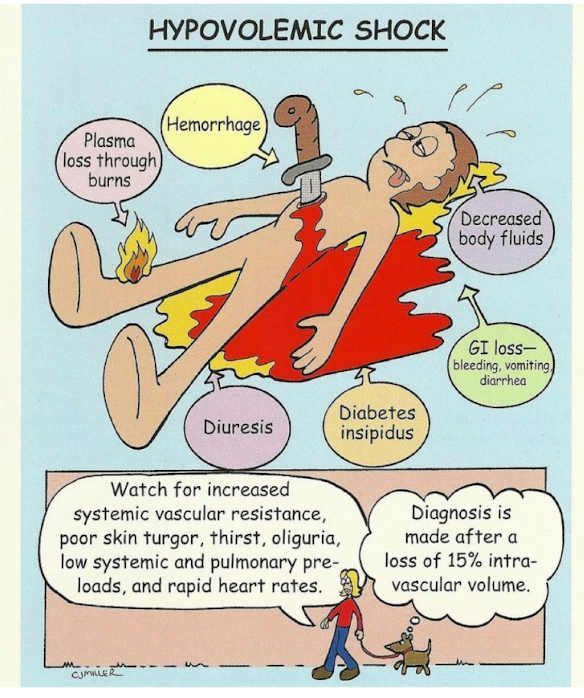
what is hypovolemic shock and what causes it?
the tank is too empty and there isn’t enough volume in the vessels for the heart to pump, so perfusion fails
external loss of blood: GI bleed, trauma, surgery
external loss of fluid: vomiting, diarrhea, diuretics, diabetes insipidus, hyperglycemia, burns, hyperglycemia (sugars pulls the water into the urine)
internal loss of blood of fluid: retroperitoneal hemorrhage, ascites, hemothorax, dissecting aneurysm, bowel obstruction
what would oyu see in a hypovolemic shock patient, and why?
lack of circulating fluid so the body is trying hard to compensate
increased SVR: vessel clamp down to hold pressure (the baroreceptor reflex)
rapid heart rate: the heart tries to make up for low volume by beating faster
low preload (systemic and pulmonary): less volume returning to the heart
oliguria: the kidneys get less blood and hold onto water
thirst and poor skin turgor: the body is dehydrated
diagnosis is made after a loss of about 15% of intravascular volume
how do you treat hypovolemic shock, and why isotonic crystalloids?
fix the leak, then replace the fluid!
treat the cause: stop the bleeding or the fluid loss, otherwise you would be filling a leaking bucket
replace volume: blood (replaces oxygen-carrying red cells, which matters most in hemorrhage) and isotonic crystalloids (the fluids stays in the body’s fluid compartment rather than shifting into the cell or shrinking the cell)
what is cardiogenic shock and what causes it?
the pump is broken, not the tank, the heart can’t push out enough blood, so cardiac output falls and the tissues are starved! → this will shows up as decreased cardiac output, hypotension, and unlike hypovolemic shock which result in LOW PRELOAD, cardiogenic shock result in INCREASED PRELOAD because the blood is not being pump properly → causes:
myocardial infarction (LV): the LV is the main pumping chamber so losing muscle there cuts output the most
dysrhythmias: a heart beating too fast or too irregularly can’t fill or eject well
cardiomyopathy (weakened heart muscle)
severe heart failure
congenital heart defect
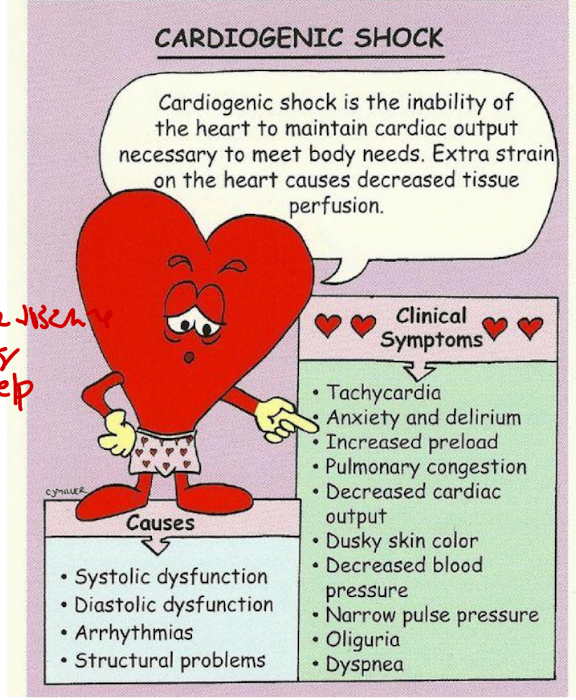
what would you see in cardiogenic shock, and why?
two things happen: blood doesn’t move forward (low output), and it piles up behind the heart (congestion).
backs up: increased preload, pulmonary congestion, dyspnea (fluid in the lungs)
doesn’t go forward: decreased cardiac output, decreased BP, oliguria, dusky skin color
body compensating: tachycardia, anxiety and delirium (the brain is low on blood)
narrow pulse pressure: each beat pushes out little blood, so systolic falls while vasoconstriction keeps diastolic up, and the gap between them shrinks
how do the treat cardiogenic shock?
improve contractility: positive inotropes (increase cardiac output)
decrease preload: diuretics and vasodilators (less volume to pump)
decrease afterload: arterial vasodilators (less resistance to push against)
what is obstructive shock and what causes it?
the pump and the volume are fine, but something blocks blood from getting in or out of the heart → imagine a kinked tube → heart and blood volume are normal but the problem outside is preventing blood from traveling → an obstruction causes shock because the heart can’t fill properly and it can’t empty properly (LOW PRELOAD AND CARDIAC OUTPUT) → causes:
cardiac tamponade (fluids builds up in the sac around the heart and squeezes it, so it can’t fill properly) → reduces diastolic filling
tension pneumothorax (trapped air in the chest pushes on the heart and great vessels, so blood can’t return) → decreased diastolic filling
pulmonary hypertension (a clot in the lungs blocks the right ventricle’s way out) → increase RV afterload