Chapter 10: Bacterial Growth
 Call Kai
 Learn
 Practice Test
 Spaced Repetition
 Match
 Flashcards
 Knowt Play
1/181

There's no tags or description
Looks like no tags are added yet.
182 Terms
Why is bacterial growth important (2)?
1. An increase in numbers is one of the requirements for infection
2. Understanding the requirements for growth will help in understanding the infectious process and how to prevent/inhibit infection
_____________________ vary between bacterial species; time interval between cell divisions
Generation times
What are generation times heavily influenced by?
Environmental pH, osmotic pressure, oxygen level, availability of nutrients, and temperature
What are examples of organisms that have the shortest generation (doubling) times?
E. coli, Salmonella, S. aureus (20 minutes)
What is an example of an organism that has the longest generation (doubling) times?
Mycobacterium (around 30 days); one month to go from one cell to two
What are usual bacterial generation times?
1-3 hours
doubling in bacteria
Binary Fission
How many generations (doublings) would it take for one cell to become a population of more than a million cells?
20 generations yield 1,048,576 bacteria (over a million)
If the bacteria has a generation time of 30 minutes, how long for one cell undergoing doubling to become a visible colony? (Rule of thumb: a visible colony of bacteria has a million or more bacteria in it)
Ten hours (20 generations of 30 minutes each); why streaking for isolation grows colonies in the plate overnight
what happens when you take loop with bacteria then put it in broth
Standard Growth Curve
What are the 5 phases on the Standard Growth Curve for bacteria?
1. Lag phase
2. Exponential log phase
3. Stationary phase
4. Death phase
5. Prolong/decline
bacteria are adjusting to their environment and may have to synthesize enzymes to utilize the nutrients available in the environment
Lag phase
Lag phase: What does how long this phase lasts vary depending on?
The organisms/bacterial species and the environment/culture conditions
Lag phase: How much binary fission occurs?
Little if any
What is the lag phase like for the cell?
No change in numbers, but an intense time
phase where the number of bacteria doubles exponentially
Exponential log phase
Log phase: There is a constant minimum __________________
generation time
How long does the log phase last/is sustained?
Only as long as suitable levels of nutrients is available and when environmental conditions remain favorable
Log phase: Conditions for this phase can be what?
Artificially maintained
device that permits the replacement of depleted medium with fresh, nutrient rich medium
Chemostat
Log phase: What are bacteria like during this phase?
Most metabolically active and therefore most sensitive to antibiotics (as well as radiation and and adverse environmental changes)
Log phase: Why are antibiotics that target peptidoglycan extremely effective during this period?
When bacteria divide, cell wall production is at its peak
Log phase: Why are treatments targeting the bacterial ribosome also highly effective?
Translation is also maximal during this phase
phase caused by a decreasing availability of nutrients; waste levels begin to rise
Stationary phase
Stationary phase: What is the number of cells dying equal to?
The number of cells being produced during cell division
Why is the stationary phase relatively short?
Since it depends on the availability of nutrients, which continue to disappear throughout this phase
phase in which there is a continuous decline in the number of dividing cells that is caused by the exhaustion of the nutrient supply and the collapse of the environment due to the build-up of toxic waste products
Death phase
What is the death phase AKA?
Logarithmic decline phase
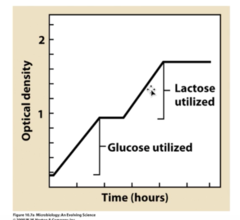
E. coli was incubated with aeration (shaking) in a nutrient medium containing 2 carbon sources, and the growth curve below was made from this culture.
a. Explain what happened at the time near the 2nd line
b. Which substrate provided better growth conditions for the bacteria? How can you tell?
a. Transition from log to stationary
b. Glucose: substrate (glucose) is used at first because it is a better carbon substrate as rise in log number of cells is faster than with lactose

Why did it switch from log to stationary the first time?
Glucose was exhausted
multiple log phases, medium contains more than one carbon source
Diauxic growth
What are the 2 major categories for bacterial growth?
Physical and chemical
What are the physical requirements for bacterial growth?
Temperature, pH, osmotic pressure
What are the chemical requirements for bacterial growth?
Sources of carbon, nitrogen, sulfur, phosphorus, organic growth factors, and trace elements
What is there an especially notable and diverse relationship among bacteria?
To oxygen (O2)- ranging from absolute requirement to lethal, toxic gas
temperature at which the highest rate of growth occurs
Optimum growth temperature
What are the 2 types of cold-loving bacteria?
Psychrophiles and psychotrophs
grow at cold temperatures; can grow at a few degrees below 0 if they are in the presence of salts of sugars that prevent ice
Psychrophiles
grow best between 20-30 C; can grow from 0 to 35
Psychotrophs
most human pathogens are this, most common types of bacteria; bacteria that grow best at moderate temperatures; 25-40 C
Mesophiles
heat-loving bacteria (2); only grow at temps above 40 C
Thermophiles and hyperthermophiles
grows best between 40 to 80 C
Thermophiles
those that grow above 70-80C; none of these bacteria are pathogenic to humans, the human body would be like a refrigerator to them
Extreme thermophiles AKA hyperthermophiles
Listeria grows in the fridge, why is this that significant?
Fridge works to keep food pathogens from growing as they are mostly mesophilic. Listeria is psychrophilic, so even properly stored food may support the growth of Listeria (cause of stillbirth pregnancy and life-threatening for AIDS, cancer, and transplant patients)
Who is at highest risk for Listeria?
Pregnant, 65 or older, or a weakened immune system
What foods are mostly contaminated with Listeria?
- Soft cheese
- Raw milk
- Deli meats
- Sprouts
lowest temperature at which the organism grows
Minimum growth temperature
highest temperature at which growth occurs
Maximum growth temperature
Why is temperature so important to the function of bacteria?
Importance of protein structure and function, once again; temperature denatures protein, destroying its ability to function
What are some examples of bacteria that prefer certain temps and show that in how they reside there?
Syphilis preferring the lips, tongue, etc; leprosy preferring the extremities of the body
Many human pathogens have optimal growth temperatures at 37 degrees Celsius. So what might one of your body's responses to an infection (fever) do for you?
Fever may raise body temperature above the optimum temperature for the pathogen, bumps organism off optimum growth rate
Why are Mycobacterium leprae infections limited to body surfaces and extremities?
Optimum growth temperature is less than 37 C; cannot grow at our body temperature of 37 C, so it grows on body surfaces and extremities that are cooler
Why are 9-banded armadillos used to culture M. leprae?
Zoonotic reservoir that has a body temperature less than ours, so it supports the growth of M. leprae
bacteria that grow in extremely low pH values
Acidophiles
Some bacteria, such as ____________, produce chemical buffers to protect against the pH changes in their environment
H. pylori
What can changes in pH do that can be lethal for bacteria?
Denature proteins
pressure exerted on a bacteria by the water inside and outside the cells; can affect bacterial growth and can be used to inhibit bacterial growth
Osmotic pressure
What is an example of how osmotic pressure can be used to inhibit bacterial growth?
Food being preserved in high salt concentrations creates a hypertonic environment and causes organisms that might spoil the food to undergo plasmolysis
bacteria that prefer to be in a high-salt (high-solute) environment
Halophiles
require high salt concentration for growth
Obligate halophiles
live with or without high salt concentrations
Facultative halophiles
can grow in the presence of very high levels of salt
Extreme halophiles
Chemical requirements for bacterial growth what?
Vary widely
Bacteria use growth factors such as what?
Vitamin B1, B2, and B6
What must bacteria do because they cannot synthesize growth factors?
Be obtained from the environment
What do bacteria also require as enzyme co-factors?
Potassium, magnesium, and calcium
Some bacteria also require trace elements such as what?
Iron, copper, and molybdenum
all living things require these atoms for the construction of biological molecules; required for cell structures
Carbon
required for making bacterial amino acids and nucleic acids; integral part of the structure of amino acids, involved in protein synthesis
Nitrogen
What is nitrogen a part of?
The structure of DNA and RNA molecules
How can nitrogen be obtained?
Through decomposition of existing proteins and from ammonium ions found in organic material or from atmospheric nitrogen through nitrogen fixation
required to make some bacterial amino acids (and vitamins)
Sulfur
How is sulfur primarily acquired?
By decomposing existing proteins in which one or more of the component amino acids contain sulfur
In what form is sulfur procured?
Sulfate ion form (SO4^2-)
required for making bacterial nucleic acids, membrane phospholipid bilayer, and ATP (as well as AMP and ADP)
Phosphorus
How is phosphorus obtained?
By cleaving ATP to ADP plus inorganic phosphate
In what form is phosphorus procured?
Ion form PO4^-3
required for functioning of certain bacterial enzymes
Potassium, magnesium, calcium
required for bacterial metabolism
Iron
certain vitamins; some cannot be synthesized and must be obtained from the environment; elements potassium magnesium, calcium to function as enzyme cofactors; trace elements such as iron, copper, molybdenum, and zinc
Organic growth factors
components of bacterial proteins
Amino acids
functions in electron transport in bacteria
Heme
electron carrier
NADH
precursor of bacterial NAD+ and NADP+
Niacin (nicotinic acid)
component of bacterial coenzyme A
Pantothenic acid
precursor of folic acid, which is involved in the bacterial metabolism of carbon compounds and in nucleic acid synthesis
para-Aminonezoic acid
components of bacterial nucleic acids
Purines, pyrimidines
used in the synthesis of bacterial amino acids
Pyroxidine (vitamin B6)
precursor of bacterial FAD
Riboflavin (vitamin B2)
used in some bacterial decarboxylation reactions
Thiamine (vitamin B1)
any bacterium that requires not 1 or 2, but a large number of growth factors; usually slow growing, in a lab, growth medium provides all essential growth factors
Fastidious bacteria
What is an example fastidious bacteria?
Heamophilus influenzae requires rich, complex media containing amino acids, sugars and cofactors, but also NADPH+ and heme (supplied in chocolate agar, containing cooked blood), elevated CO2 levels, and careful temp regulation
What is an example of a non-fastidious bacteria?
E. coli requires only glucose, NaCl, Ammonium phosphate, Mg-phosphate, and K-phosphate
Wild-type E. coli has no what?
Growth factor requirements, and metabolically it can transform glucose into all of the macromolecular components that make up the cell
Where does E. coli get essential trace elements such as iron, copper, molybdenum, and zinc?
E. coli is a very fastidious scavenger. It is difficult to prepare glassware, water, and purified chemicals without tiny amounts of essential trace elements it requires. Can use these trace elements
Heamophilus influenzae is what?
Not the cause of influenza (flu), causes otitis media
Many bacteria do not require ____________ for growth, but die in its presence
oxygen
What is the dark side during normal bacteria respiration?
Form free radicals that are unstable and steal electrons from other molecules, leading to the death of the bacterial cell
What are the 2 aspects to consider when thinking about a bacteria's relationship to oxygen?
Use and toxicity
bacteria are obligated to grow in the absence of O2; cannot survive in the presence of oxygen
Obligate anaerobe