Tissue Types
 Call Kai
 Learn
 Practice Test
 Spaced Repetition
 Match
 Flashcards
 Knowt Play
1/19

There's no tags or description
Looks like no tags are added yet.
20 Terms
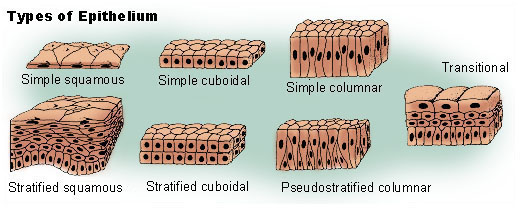
epithelial
function: covers body surfaces, lines internal cavities/organs, forms glands
key body locations: skin, gastrointestinal tract lining, trachea, kidney tubules
connective
function: binds, supports, protects, insulates, and transports materials
key body locations: bones, tendons, fat layers, cartilage, blood
muscle
function: contracts and shortens to produce body movement and heat
key body locations: skeletal muscles, heart wall, walls of hollow internal organs
nervous
function: transmits electrical signals for rapid internal communication
key body locations: brain, spinal cord, peripheral nerves

epithelial tissue
simple squamous epithelium
single layer of flattened cells designed for rapid diffusion and filtration
ex: lung, alveoli, blood capillary walls


epithelial tissue
simple cuboidal epithelium
single layer of cube-shaped cells functioning in secretion and absorption
ex: kidney tubules, small glands

epithelial tissue
pseudostratified ciliated columnar epithelium
single layer of tall cells with nuclei at varying heights that appears multilayered; contains goblet cells and apical cilia to trap and sweep debris
ex: tracheal lining


epithelial tissue
stratified squamous epithelium
multiple cell layers with flattened superficial cells; protects underlying tissue against mechanical abrasion
ex: skin, epidermis, oral cavity lining

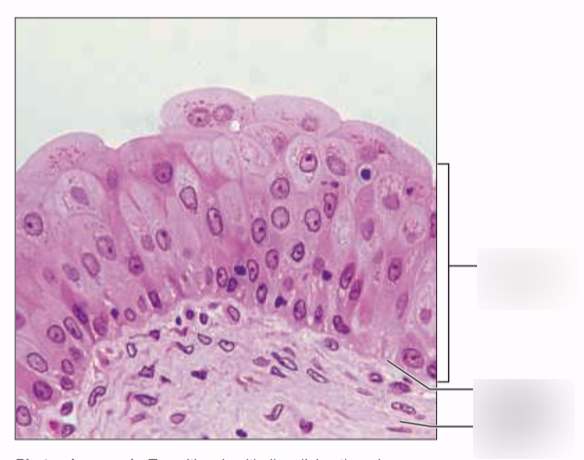
epithelial tissue
transitional epithelium
stratified tissue with cells of various shapes that stretch and flatten to accommodate shifting liquid volume
ex: urinary bladder

connective tissue
adipose
loose connective tissue filled with fat-storing adipocytes; insulates the body, stores energy, cushions internal organs

connective tissue
dense regular connective tissue
parallel bundles of collagen fibers secreted by fibroblasts; provides high tensile strength in one direction
ex: tendons, ligaments

connective tissue
dense irregular connective tissue
interwoven, multidirectional fibers; resists mechanical pull from multiple directions
ex: dermis of the skin

connective tissue
hyaline cartilage
smooth, glassy matrix containing chondrocytes within lacunae; reduces friction at joint surfaces and forms flexible structural frameworks
ex: articular joint covers, nose, costal cartilage

connective tissue
osseous (bone) tissue
hard, mineralized matrix containing calcium salts and collagen organized in concentric rings called osteons

connective tissue
blood tissue
fluid connective tissue composed of formed elements suspended in a liquid extracellular matrix called plasma

muscle tissue
skeletal muscle
voluntary control, striated, multinucleated cells; fibers are long, unbranched, and cylindrical with nuclei pushed to the outer periphery

muscle tissue
cardiac muscle
involuntary control, striated, single central nucleus per cell; branched fibers joined end-to-end by intercalated discs

muscle tissue
smooth muscle
involuntary control, non-striated, single central nucleus, spindle shaped cells with pointed ends found in the walls of hollow organs
ex: stomach, intestines, blood vessels

nervous tissue
neurons
signal-conducting cells consisting of a cell body, receptive dendrites, and an impulse-transmitting axon

nervous tissue
neuroglia
non-conducting support cells that nourish, protect, and insulate neurons