B&C Psych attention and action
 Call Kai
 Learn
 Practice Test
 Spaced Repetition
 Match
 Flashcards
 Knowt Play
1/13

There's no tags or description
Looks like no tags are added yet.
14 Terms
How do attention, perception and action interact during goal-directed behaviour?
Attention, perception and action are interconnected processes that enable us to interact effectively with our environment.
Example — Picking up a cup:
Attention: Selects the cup from other objects in the environment.
Perception: Identifies the cup and processes its shape and location.
Action preparation: Plans how to reach for and grasp the cup.
Action execution: Performs the movement, changing the body's position and incoming sensory information.
Why are these processes interconnected?
Perceptual information guides the planning and execution of actions.
Actions change the sensory information available for perception.
Brain regions involved in perception and motor control interact with one another.
Key principle: Attention selects relevant information, perception interprets it, and action uses it to interact with the environment.
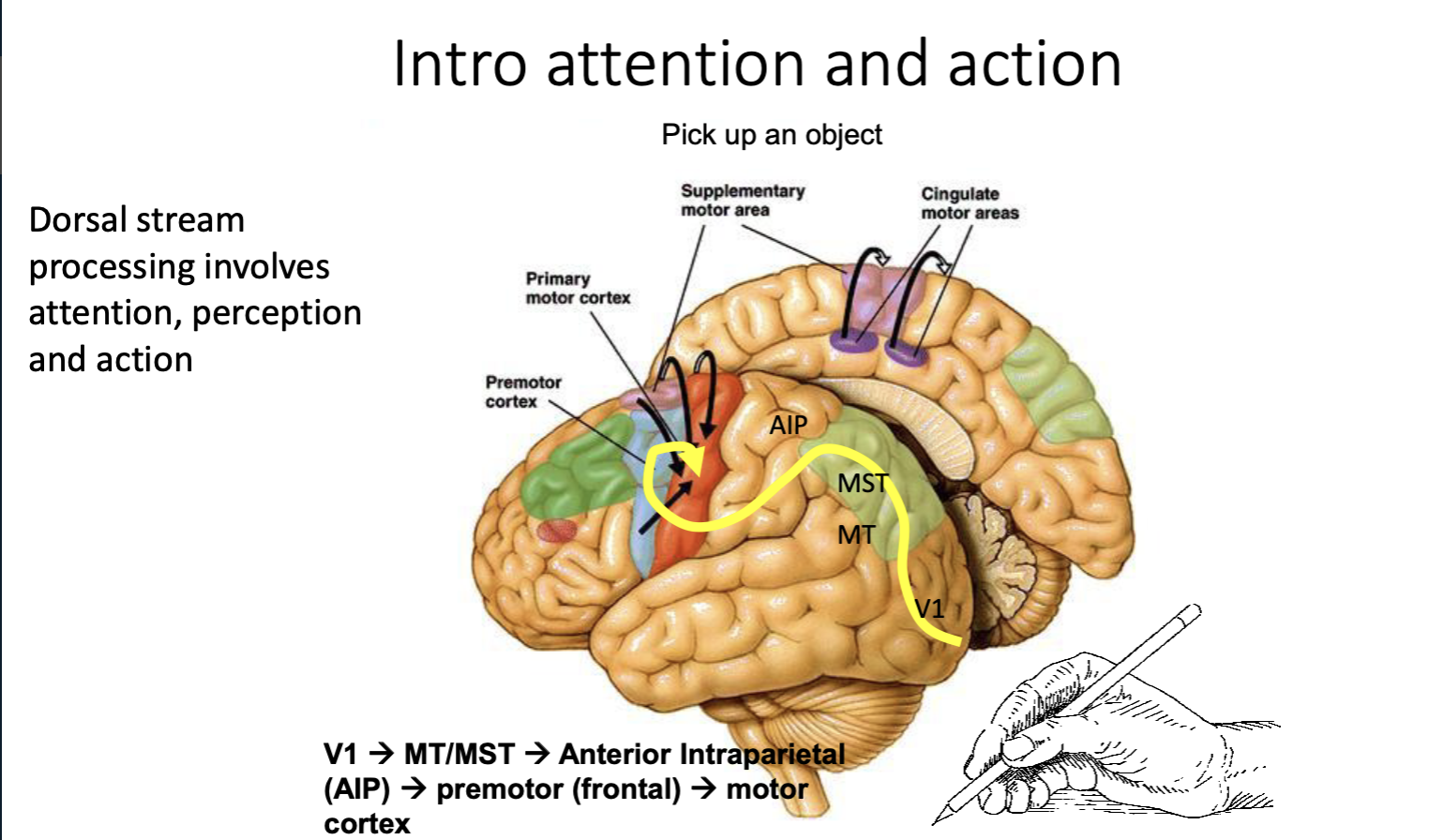
How does the dorsal visual stream contribute to visually guided actions, and which brain regions are involved?
The dorsal visual stream is the where/how pathway, which processes visual information relevant to guiding actions.
Example pathway from the lecture:
1. V1 — Primary visual cortex
Processes incoming visual information.
2. MT/MST
Contribute to motion processing.
3. AIP — Anterior intraparietal area
Contributes to visual processing relevant to grasping and object manipulation.
4. Premotor cortex
Contributes to action preparation.
5. Motor cortex
Contributes to movement execution.
Functional significance:
Different regions specialise in different aspects of visually guided behaviour.
Their interactions help transform visual information into appropriate motor activity.
Key principle: The dorsal stream links visual perception with the preparation and execution of actions.
What does functional specialisation within the dorsal visual stream mean, and how does it support different types of actions?
The dorsal visual stream contains specialised cortical regions, or modules, which contribute to different aspects of visually guided actions.
Examples:
MT/MST: Process information about visual motion.
AIP: Processes information relevant to grasping and manipulating objects.
Premotor regions: Use action-relevant sensory information to prepare movements.
Why is this important?
Different actions require different types of visual information.
Specialised regions process the information relevant to their particular functions.
These regions interact to support coordinated motor behaviour.
Connection to the ventral stream:
The ventral stream also contains functionally specialised regions, including areas associated with faces and places.
The dorsal stream is particularly concerned with visual information used to guide actions.
Key principle: Visually guided behaviour depends on specialised but interacting cortical regions rather than a single general-purpose visual-processing area.

What was the research question and experimental procedure of Simon's (1969) study, and how were congruent and incongruent trials created?
Research question: Does the spatial location of a stimulus influence response speed even when location is irrelevant to the task?
Experimental procedure:
Participants viewed a square or triangle presented on the left or right side of a display.
They responded based on stimulus identity, not spatial location.
Response rules:
Square → Left key.
Triangle → Right key.
Two trial types:
Condition | Example | Required response |
|---|---|---|
Congruent | Square on left | Left key |
Congruent | Triangle on right | Right key |
Incongruent | Square on right | Left key |
Incongruent | Triangle on left | Right key |
Key distinction:
Congruent: Stimulus location matches the required response side.
Incongruent: Stimulus location conflicts with the required response side.

What were the results of the Simon effect, and why are reaction times faster on congruent trials than on incongruent trials?
Main finding: Reaction times are shorter on congruent trials than on incongruent trials.
Why? The spatial location of a stimulus automatically activates the response associated with that location, even when location is irrelevant.
Congruent trial:
A square appears on the left.
Its location automatically activates a left-hand response.
The correct response is also the left hand.
The responses match → Faster reaction time.
Incongruent trial:
A square appears on the right.
Its location automatically activates a right-hand response.
The correct response is the left hand.
The automatic response conflicts with the required response.
The conflict must be overcome → Slower reaction time.
Key principle: Stimulus location can automatically influence response preparation, even when spatial information is irrelevant to the task.
How does the Simon effect differ from the Posner cueing paradigm in its experimental design and explanation of reaction-time differences?