15: Oxidative Phosphorylation
 Call Kai
 Learn
 Practice Test
 Spaced Repetition
 Match
 Flashcards
 Knowt Play
1/94

There's no tags or description
Looks like no tags are added yet.
95 Terms
Oxidative phosphorylation represents the___ phase of
the ____
final
catabolism of metabolic fuels and the major source of the cell's ATP.
electrons flow from ___ to ___
reduced cofactors to O2
free energy of redox reactions is ____ in the formation of ___
conserved
transmembrane gradient of protons
reduced cofactors:
reoxidized by:
NADH and QH2
molecular oxygen
every acetyl unit that enters the citric acid cycle can generate
how much for NADH/QH2
a total of 10 ATP equivalents
1 NADH: 2.5 ATP
1 QH2: 1.5 ATP
The early stages of oxidation of metabolic fuels such as glucose, fatty acids, and amino acids, as well as the oxidation of acetyl carbons to CO2 via the citric acid cycle, yield the reduced cofactors
NADH and ubiquinol (QH2)
NADH and ubiquinol (QH2) are forms of energy currency because
their reoxidation—ultimately by molecular oxygen in aerobic organisms—is an exergonic process.
free energy from NADH and QH2 reoxidation is harvested
to synthesize ATP, a phenomenon called oxidative phosphorylation
oxidant and reductant in oxidation-reduction reactions
oxidant is reduced as it gains electrons
reductant is oxidized as it gives up electrons
OIL RIG, what is O
oxidation is losing electrons. Reductant loses electrons!
O is for OXIDATION, not oxidant
The affinity of a substance such as ubiquinone for electrons is
its standard reduction potential (ε°′), which has units of volts.
AKA tendency of a substance to accept electrons (to become reduced) or to donate electrons (become oxidized) can be quantified
Reduction potential indicates
a substance’s tendency to accept electrons.
the actual reduction potential depends on
he actual concentrations of the oxidized and
reduced species.
how is actual reduction protential related to standard reduction protential
by Nernst equation
at 25C/298K, Nernst equation reduces to

Nernst equation (not reduced)

When the two half-reactions are added, their reduction potentials
their reduction potentials are also added, yielding a Δε°′ value.
the larger the difference in ε values (the greater the Δε value)….relates to electrons flowing bw substance and change in free energy
the greater the tendency of electrons to flow from one substance to the other, and the greater the change in free energy of the system
an ox-red reaction with a large positive deltaE value delta G?
large negative value of deltaG
cellular respiration in aerobic organisms is when
NADH and ubiquinol produced by glycolysis, the citric acid cycle, fatty acid oxidation, and other metabolic pathways are ultimately reoxidized by molecular oxygen,
how does O2’s oxidizing agent properties compare to other compounds? why?
O2 is a more effective oxidizing agent than any other biological compound. oxidation of NADH by O2 would release a large amount of free energy
Electrons are shuttled from NADH to O2 in what kind of process with what characteristics?
a multistep process that offers several opportunities to conserve the free energy of oxidation.
where does oxidative phophorylation occur, including prosthetic groups of large integral membrane proteins of?
in mitochondria
mitochondrial outer membrane characteristic, why
relatively porous due to the presence of porin-like proteins
inner mitochondrial membrane architecture, names, characterisitcs?
The inner membrane has a convoluted architecture that encloses a space called the mitochondrial matrix. prevents the transmembrane movements of ions and small molecules
ionic composition of intermembrane space of mitochondria is considered equivalent to that of the
cytosol
mitochondria are customarily shown as ____? including inner mitochondrial membrane forming system of___?
kidney-shaped organelles
baffles called cristae
a cell may contain hundreds to thousands of ___, or a single ____
discrete bacteria shaped mitochondria, or a single tubular organelle may take the form of an extended network
mitochondrial genome encodes how many proteins, of how many proteins required for mito function?
13; about 1500
much of a cell’s NADH and QH2 generated by
citric acid cycle inside mito
other type of reaction besides citric acid cycle, oxidative phos inside mito?
fatty acid oxidation
NADH produced by glycolysis and other oxidative processes in the cytosol cannot directly___. instead….
reach the respiratory chain.
“reducing equivalents” are imported into the matrix by the chemical reactions of systems such as the malate–aspartate shuttle system
malate-aspartate shuttle system net result
transfer of “reducing equivalents” from the cytosol to the matrix.
what does ATP translocase protein do
imports ADP and export ATP
what do symport proteins allow
simultaneous movement of Pi and H+
orientation of the protein complexes that carry out electron transport and ATP synthesis
in the inner mitochondrial membrane; complexes I, III, and IV form a ‘supercomplex’
complex 1 is also known as, what it does
ADH:ubiquinone oxidoreductase or NADH dehydrogenase, catalyzes the transfer of a pair of e- from NADH to ubiquinone
complex I relative size, where electron transport takes place, includes what?
largest electron transport protein
electron transport takes place in peripheral arm, which includes severeal prosthetic groups
all of these groups = redox centers
all the redox centers in complex 1 have reduction potentials approx between reduction protential of NAD+ and ubiquinone, which allows…
them to form a chain where the electrons travel a path of increasing reduction potential.

redox centers shown in …
red (flavin mononucleotide (FMN)) and orange ( Fe — S clusters)
the 2 electrons donated by NADH first picked up by_____ then transferred to ____
flavin mononucleotide (FMN)
second type of redox center, an iron–sulfur (Fe–S) cluster
electrons travel between several Fe-S clusters before reaching
ubiquinone
Electron travel path in complex I:
NADH- FMN- (Fe-S)8-10-ubiquinone
there is the presence of ___ in the membrane-embedded arm of complex I
four protein-translocating ‘channels’
in complex 1, protons pass from one side of the membrane to the other via a
proton wire
proton wire
a series of hydrogen- bonded protein groups plus water molecules that form a chain through which a proton can be rapidly relayed
other oxidation reactions contributing to ubiquinol pool
catalyzation by succinate dehydrogenase AKA complex II
membrane-bound acyl-CoA dehydrogenase
mitochondriol glycerol-3-phosphate dehydrogenase
what is cmplex III/what does it do
Complex III, also called ubiquinol:cytochrome c oxidoreductase or cytochrome bc1, transfers electrons to the peripheral membrane protein cytochrome c from ubiquinol
what are cytochromes
proteins with heme prosthetic groups
the net reaction for complex III includes
2 cytochrome c proteins
complex III itself contains ______ that are____
two cytochromes (cytochrome b and cytochrome c1)
integral membrane proteins
two cytochromes (cytochrome b and cytochrome c1), along with ____ form functional core of Complex III
iron-sulfur protein (AKA Rieske protein)
The circuitous route of electrons from ubiquinol to cytochrome c is described by the
two-round Q cycle
net result of the Q cycle
2 electrons from QH2 reduce 2 molecules of cytochrome c
what does cytochrome c do
ferries electrons between complexes III and IV
complex IV AKA
cytochrome c oxidase
each electron travels from cytochrome c to…
then to …
CuA redox center
binuclear center consisting of the iron atom of heme a3 and a copper ion CuB
Cytochrome c oxidase also relays____ from where to where? this protein complex harbors what?
four additional protons from the matrix to the intermembrane space, protein complex appears to harbor 2 protein wires
when reduced cofactors NADH and ubiquinol become oxidized (by delivering e- to electron transport chain), what happens to the cofactors?
rejoin the pool of oxidized cofactors in the cell
how do NAD+ and ubiquinone function as shuttles?
by accepting electrons (becoming reduced) then giving them up (becoming oxidized) over and over
chemiosmotic theory
The proton-translocating activity of the electron transport complexes in the inner mitochondrial membrane generates a proton gradient across the membrane
protonmotive force
imbalance of protons from proton gradient across membrance since protons can’t diffuse back into the matrix; can drive the activity of an ATP synthase
how many components of free energy of proton gradient? reflects what?
two, reflects difference in concentration of the chemical species and difference in electrical charge of the positively charged protons
free energy change for generating chemical imbalance of protons

free energy change for generating the electrical imbalance of protons

overall free energy change for transporting protons from the matrix (int) to intermembrane space (out)

The protein that taps the electrochemical proton gradient to phosphorylate ADP is known as
F-ATP synthase (or Complex V)
one part of the F-ATP synthase (or Complex V) protein is F0, function?
functions as a transmembrane channel (allows H+ to flow back into matrix)
one part of the F-ATP synthase (or Complex V) protein is F1, function?
F1 component catalyzes the reaction ADP + Pi → ATP + H2O
complex V general setup/looks like

ATP synthase F1 component structure
three α
and three β subunits surrounding a central shaft.
ATP synthase F0 compoennt structure
membrane-embedded portion, an a subunit, two b subunits, and a ring of c subunits
proton transport through ATP synthase involves what movements/how it works?
Involves rotation of c ring past stationary a subunit. When properly positioned at the a subunit, a c subunit can take up a proton from the intermembrane space. A slight rotation of the c ring brings another c subunit into position so that it can release its bound proton into the matrix.
gamma subunit attached to the c ring consists of
two long α helices arranged as a bent coiled coil that protrudes into the center of the globular F1 structure
F1 has 3 alpha and 3 beta subunits arranged around gamma unit - characteristics of these subunits?
only the beta subunits have catalytic activity
alpha-beta hexamer itself doesn’t rotate (help in place by peripheral arm anchored to a subunit)
does ATP synthase catalyze ender or exergonic synthase?
highly endergonic
how does ATP synthase enzyme operate (considered unusual)
using mechanical energy (rotation) to form a chemical bond (the attachment of a phosphoryl group to ADP). In other words, the enzyme converts mechanical energy to the chemical energy of ATP.
rotation-driven conformational changes alter the affinity of ____ for ____
each catalytic β subunit for anadenine nucleotide
ways catalytic sites’ conformations/binding affinities are referred to
open, loose, or tight state
ATP synthesis steps
The substrates ADP and Pi bind to a β subunit in the loose state.
The substrates are converted to ATP as rotation of the γ subunit causes the β subunit to shift to the tight conformation.
The product ATP is released after the next rotation, when the β subunit shifts to the open conformation
the three β subunits of ATP synthase act cooperatively, how does this impact their conformational changes?
they all change their conformations simultaneously as the γ subunit turns.
how is proton gradient dissipation related to ATP synthesis?
dissipation of the proton gradient is tightly coupled to ATP synthesis with near 100% efficiency.
what happens in the absence of a proton gradient
no ATP is synthesized because there is no free energy to drive the rotation of the γ subunit
what is an uncoupler
Agents that dissipate the proton gradient can therefore “uncouple” ATP synthesis from electron transport, the source of the proton gradient.
how many ATP molecules synthesized for every complete c-ring rotation?
3
how many c subunits in mammalian ATP synthase?
8
stoichiometry for mammalian ATP synthase
8 H+/3 ATP → 2.7 H+ per ATP
how is relationship between respiration (activity of electron transport complexes) and ATP synthesis traditionally expressed?
P:O ratio → number of phosphorylation of ADP relative to number of oxygen atoms reduced
oxidation of ____ by O2 is carried out by sequential activities of _______ translocates ____ protons into the intermembrane space
NADH
complexes I, III, IV
10
movement of 10 protons back into matrix via F0 in oxidation of NADH would theoretically drive the synthesis of how many ATP, why?
about 3.7 ATP, since 1 ATP can be made for every 2.7 protons translocated
equation for how many ATP can be made

for an electron pair originating as ____, only ___ protons would be translocated by the activities of complexes ___
QH2
6 protons
complexes III and IV
equation for ATP made from QH2
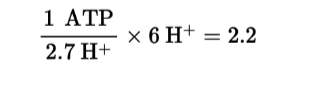
how do in vivo P:O ratios compare to theoretical
they are actually a bit lower
main regulatory mechanisms of oxidative phosphorylation rate
1) primarily by availability of reduced cofactors NADH and QH2
2) availability of substrates ADP & Pi
3) evidence of regulatory protein that binds to ATP synthase in mitochondria