BIOC 303 Space (Dr. Duong)
 Call Kai
 Learn
 Practice Test
 Spaced Repetition
 Match
 Flashcards
 Knowt Play
1/85

There's no tags or description
Looks like no tags are added yet.
86 Terms

What does this structure show?
A glycerolphospholipid (Note: Saturated tail at SN1 position, unsaturated tail at SN2 position, and phosphate at SN3 position)
What are the three main glycerolphospholipids?
Phosphatidyl-Ethanolamine (PE), Phosphatidyl-Serine (PS), Phosphatidyl-Choline (PC)
PE and PC are zwitterionic so neutral charge, only PS is negatively charged

How do lipid micelles form?
From “single-tailed” amphiphiles with the hydrophilic head group larger than the hydrophobic chain creating a curvature with a hydrophobic core

How do lipid bilayers form?
From “two-tailed” phospholipids with the hydrophilic head group the same size as the hydrophobic chains creating a flat bilayer

Why do bilayers spontaneously form into vesicles?
Because it is energetically favourable; the hydrophobic chains at the edges of the bilayer are exposed to the aqueous environment


Why is the melting curve not the most realistic?
Biological membranes may not have a single sharp transition point as they are mixtures
True or False: Membranes are usually in the gel state
False. They must be fluid for proper functioning
True or False: Cholesterol can move itself between leaflets
True. Through “Flip-Flop” movement
What interpretation can we make from a FRAP experiment (2 things)?
Lateral movement of lipids and protein
“Flip-Flop” of cholesterol occuring or not
(Review) What are the two ways to increase the Tm of a membrane?
Lengthen the hydrophobic chains
Increase saturation of the chains (cis worse than trans)
Both pack the hydrophobic chains tightly together and thus increase van der Waal interactions

How do bacteria do this?
C)
As T increases, they increase amount of saturated fatty acids while decreasing amount of unsaturated ones
As T decreases, they increase amount of unsaturated fatty acids while decreasing amount of saturated ones

(Review) How does cholesterol act as a buffer for membrane fluidity in animal cells?
At high T (Ld), the steroid nucleus takes over to enhance van der Waal interactions
At low T (Lo), the akyl side chains take over to disrupt van der Waal interactions
Note: Increases phase transition width

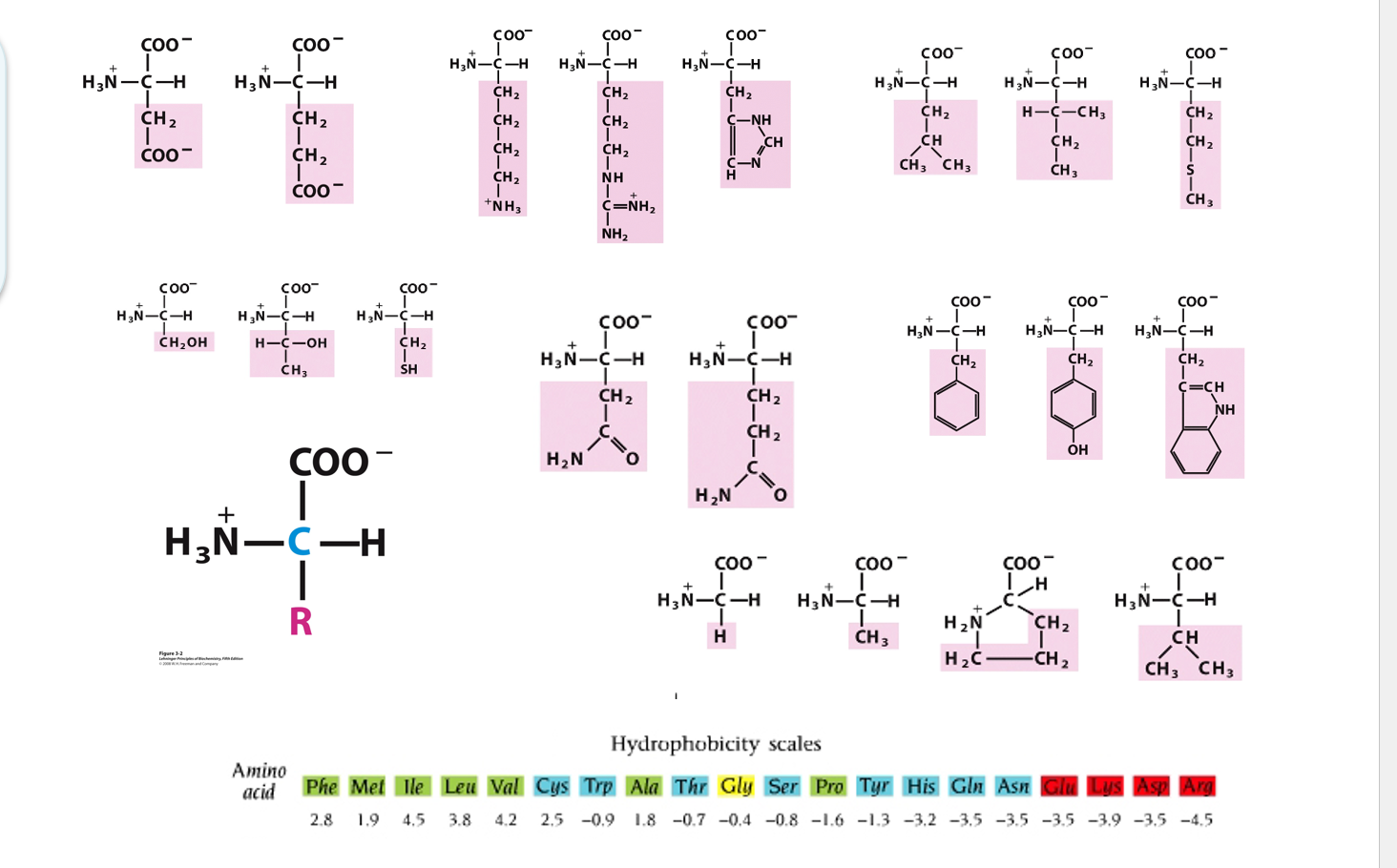
If you know your amino acids, then you know your…?
Membrane because of R groups!
Why are peptide bonds planar?
Because of the partial double bond character due to resonance
True or False: Rotations are possible across all bonds in a primary sequence
False. Rotations are only possible around the phi φ bond (N-Cα) and psi ψ bond (Cα-carbonyl C), not between the N-carbonyl carbon aka peptide bond

The α-helix has ___ residues per turn, pitch = ____ Å per turn, and a rise = ___ Å per residue
3.6
5.4
1.5

How is the α-helix stabilized in the membrane?
By intrachain hydrogen bonding of the backbone between the carbonyl oxygen of residue i and the amide hydrogen of residue i + 4 (no water involved) so the hydrophobic residues interact with the lipid bilayer
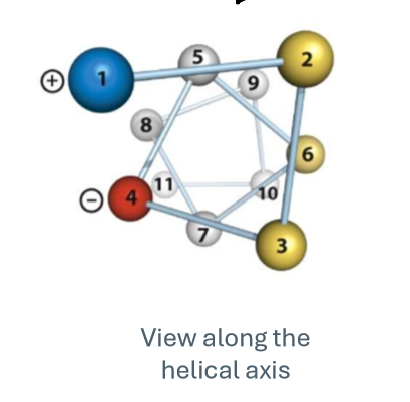
If the transmembrane domain is 30 Å, how long should the alpha helix be?
20 Å

What factors can change the estimate for how long the alpha helix should be (3 things)?
Bilayer thickness
Helix tilt
Interfacial residues (the a.a. of one protein come into contact with another molecule, usually another protein)
Surprise Q! What is the function of glycophorin (Hint: Look at its name)?
A protein that carries sugar

If you see this on a hydropathy plot, what prediction could you make?
There is a single transmembrane α-helix
True or False: You can determine the orientation of the N and C-termini across a membrane based on a hydropathy plot?
False
What is the “positive-inside” rule?
Positively charged amino acids are usually found on the cytosolic side of integral membrane proteins

Because it forms a β-barrel with alternating hydrophobic and hydrophilic residues that average out to near 0

What do gram-negative bacteria have that gram-positive don’t have?
Two membranes.
The inner (plasma membrane) regulates transport, cell energy, and metabolism
The outer membrane (both bacteria have this one) is a protective, semi-permeable barrier
What disadvantage do gram-negative bacteria face? How do they overcome this?
The periplasmic space between the two membranes contains a thin peptidoglycan layer, which makes nutrient uptake more difficult
Porins across the outer membrane to allow transport of selected hydrophlic molecules


What is Maltoporin (LamB)?
A specialized porin that is a trimer of beta-barrel channels across the outer membrane
How does LamB carry out its function?
Inside, its aromatic residues interact with the hydrophobic sugar rings to guide the sugar through
What is special about phosphatidylinositol lipids (PIPs)?
They can be phosphorylated at different positions to act as spatial signals for recruitment of proteins (5 in total)

What lipid types are common to all membranes (5)?
PS, PE, PC, PI, and Sterol

It’s different backbone gives it different properties + contribute to tight packing


What happens to the membrane properties as we go from ER —→ Golgi —→ Plasma membrane? What about in terms of electrostatics?
From less tightly packed, more membrane deformity, and less cholesterol to more tightly packed, less membrane deformity, and more cholesterol
It increases
How are red blood cell types determined?
By the head group of the sphingolipids

Why do sphingolipids and cholesterol have favourable interactions with each other?
Because sphingolipids contain long (+2 carbon), saturated hydrophobic chains that promote tight packing, which cholesterol loves
What effect does the sphingomyelin and cholesterol interactions have on the membrane?
Influences lateral membrane organization and form lipid rafts in the outer leaflet


Why is there lipid composition asymmetry between the two leaflets?
(Ex. More PE, PS, and PI on the inner leaflet but more PC and SM on the outer leaflet)
Because of signalling and membrane functioning
What does flippases do? What does scramblases do?
Maintain asymmetry (ATP-dependent); disrupt asymmetry (ATP-independent)
Why is the asymmetry of PS especially important?
Being on the outer leaflet sends out an apotosis signal to macrophages
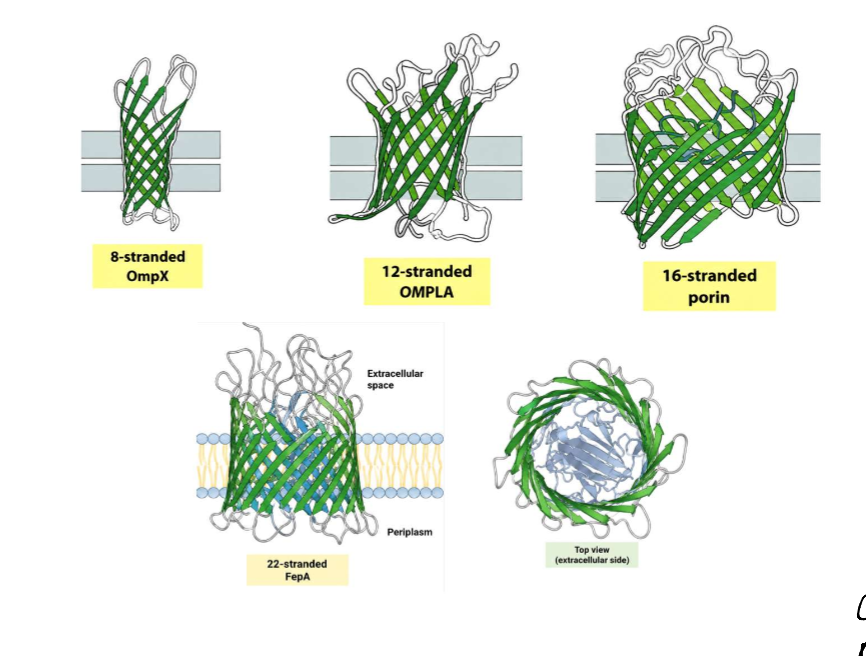
True or False: More strands in a beta-barrel makes the barrel opening wider
False. While the diameter thickness of the barrel does increase, the opening might have an internal plug domain to restrict passage (bacterial adaptation)
How does Prostaglandin H2 Synthase associate with the membrane without spanning it?
Its ampiaphatic a-helix has hydrophobic residues on one side just below the outer leaflet and hydrophilic residues on the other side towards the aqeous environment

True or False: Amphiapatic a-helices cause the membrane to curve at the site while transmembrane proteins can deform the membrane
True. Examples of how proteins contribute to shaping the membrane
How do lipid contribute to membrane shape?
Based on the head group to hydrophobic chain size relationship

True or False: Every a-helix has to traverse the entire membrane
False

How do proteins reach the ER?
An N-terminal signal sequence helps direct newly synthesized proteins to the ER that is cleaved by a signal peptidase enzyme (on the lumen side of the membrane) to produce a shorter, mature protein

What are the other names for the signal sequence (3)?
Signal peptide, leader sequence, and leader peptide (pattern)
How do proteins enter the ER?
The translocon membrane channel protein recognises the signal sequence to allow translocation (more on this later)

What is the significance of this?
Post-translational translocation does not work with ER microsomes (membranes)

What conditions are needed to get this band for protein translocation into the ER?
Ribosome Nascent Chain Complex (RNC) and Co-translational ER translocation

True or False: The RNC is a 100% efficient
False, it synthesises some proteins while not being attached to the ER microsomal membrane so no translocation

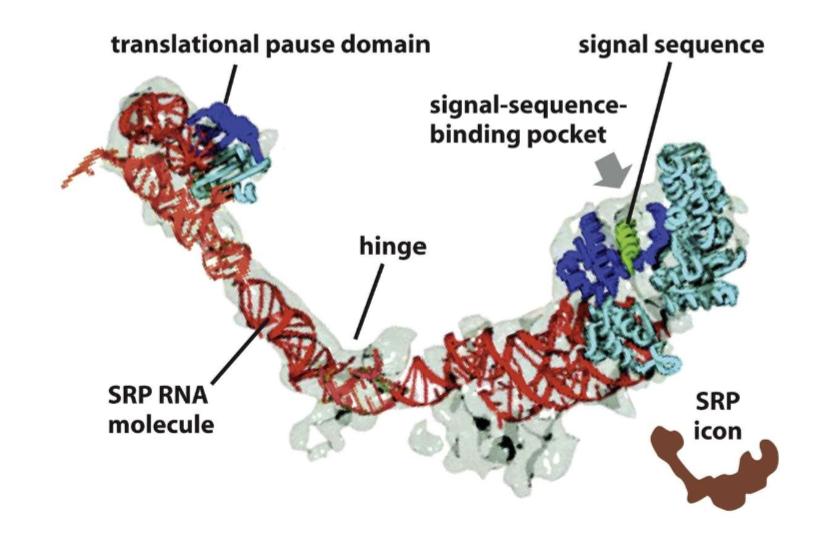
What does the Signal Recognition Particle (SRP) do?
It pauses translation until the ribosome reaches the ER membrane (spatial and temporal coordination)


What does the SRP RNA molecule do? Where does SRP bind to (2 sites)?
Acts as a scaffold to organize its protein subunits; at the ribosome nascent polypeptide exit channel and the emerging hydrophobic signal sequence
How can the signal sequence binding pocket of SRP recognise a wide variety of hydrophobic signal sequences with their different a.a’s?
It contains a hydrophobic pocket with methionine residues that have flexible side chains
Why might a protein with an ER signal sequence be unable to enter the ER?
Either there are no ribosomes to inject it into the ER or the protein has folded so much in the cytosol to be unable to enter the translocon
Why is the Sec61 translocon so important for eukaryotes?
Because the hydrophobic ER membrane will not accomodate the hydrophilic polypeptide passing through it
Why does the N-terminal sequence enter the translocon in a hairpin loop configuration?
Because it allows the polypeptide to grow in the ER lumen while it stays embedded in the transmembrane space for cleavage

What translocon complex do bacteria have?
SecY complex

In a translocon, what does the plug do? What about the pore ring?
A short a-helix that moves aside when proteins are translocating and seals the channel when it is inactive;
Hydrophobic residues (mainly isoleucine) that seals around the tranlocating polypeptide to minimize passage of ions and small molecules
Both maintain membrane permeability

What would be the consequence of there being no plug in the translocon?
There will be no H+ gradient as anything can just go through, so cell will die
How exactly does a hydrophobic a-helix move from the translocon to being embedded in the transmembrane space?
The lateral gates of TM2 and TM7 open to allow the hydrophobic a-helix to exit laterally into the transmembrane space

True or False:
Outside = the cytosol
Inside = the ER lumen
False.
Outside = the ER lumen/extracellular space
Inside = the cytosol/cell
“Whatever is in the cytosol stays in the cytosol”
What protein type is this?
N-terminus in lumen (signal sequence cleaved off), C-terminus in cytosol, and a single stop-transfer sequence embedded in the transmembrane space
Type 1


What protein type/(s) does this hydropathy plot show?
Type I
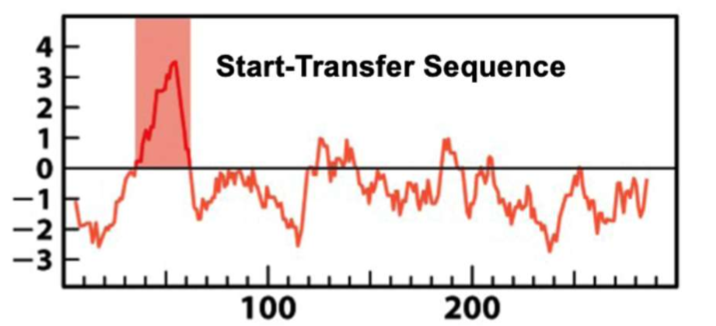
What protein type/(s) does this hydropathy plot show?
Type II and Type III
What makes Type II and III different than Type I proteins?
They don’t have a signal sequence, but rather an signal anchor called the start transfer sequence that is recognised by the SRP and brings the protein to the ER
True or False: For Type II and III proteins, the start transfer sequence is cleaved
False. It remains embedded in the membrane
What determines the orientation of Type II and Type III proteins?
The Positive-inside “rule” where arginine and lysine residues prefer to be on the cytosolic side
Type II: N-terminus in the cytosol; C-terminus in the ER lumen
Type III: N-terminus in the ER lumen; C-terminus in the cytosol

Notice the pattern?
N-terminus: Lumen, Cytosol, Lumen

What protein type/(s) does this hydropathy plot show?
Type IV aka multi-pass of alternating start and stop transfer sequences

What is an experimental way to determine membrane protein topology?
Alkaline phosphatase (PhoA), at the C-terminus, active only when in the periplasmic space, not the cytosol

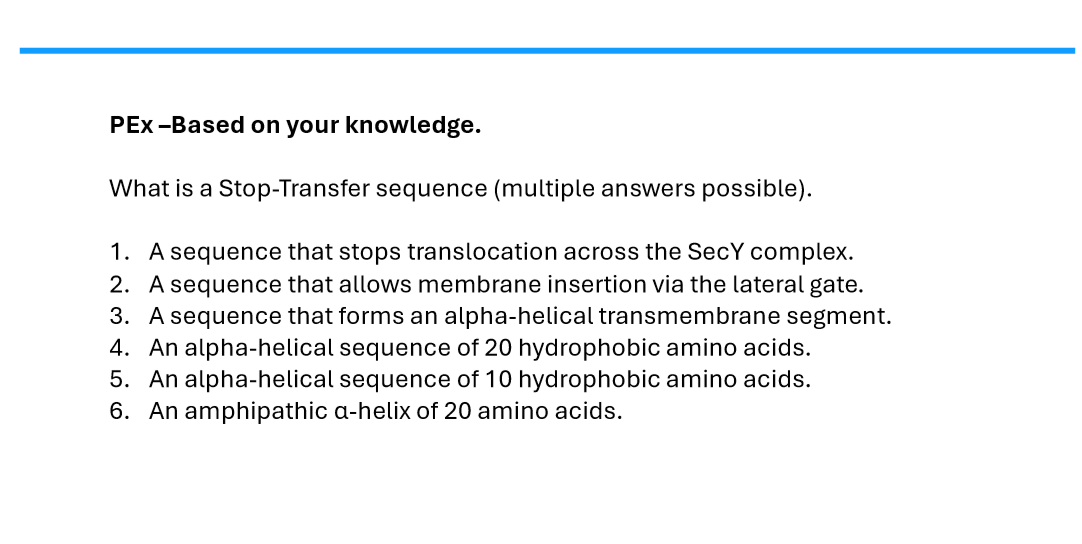
1, 2, 3, and 4
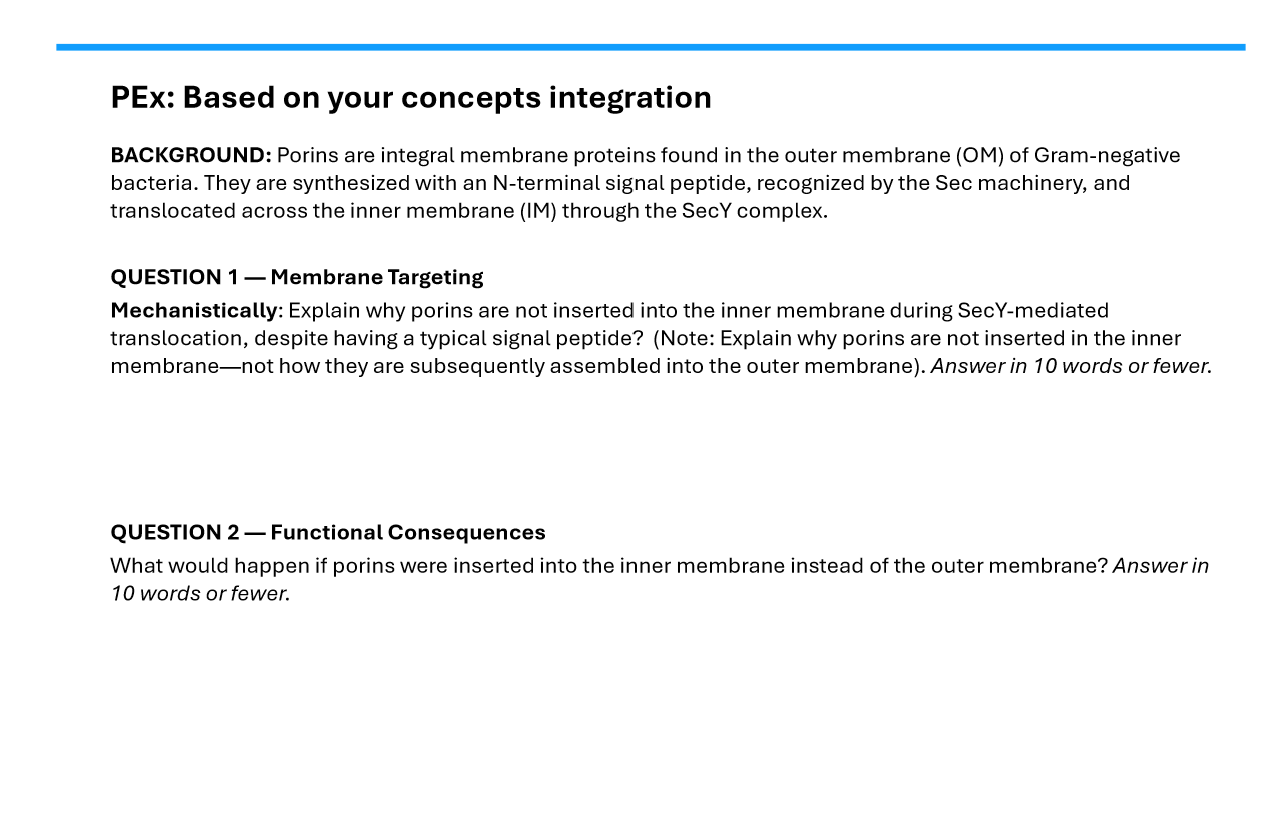
Porins are beta-barrels by the way
Beta-barrels lack a stop-transfer sequence to be released laterally from the SecY translocon to become TM segments
SecY translocases precursor porins through the IM that are assembled in the OM by the beta-barrel assembly machinery (BAM)
What is a nacent protein?
An immature protein that is being synthesized by ribosomes
What helps nacent proteins mature in the ER (3 things)?
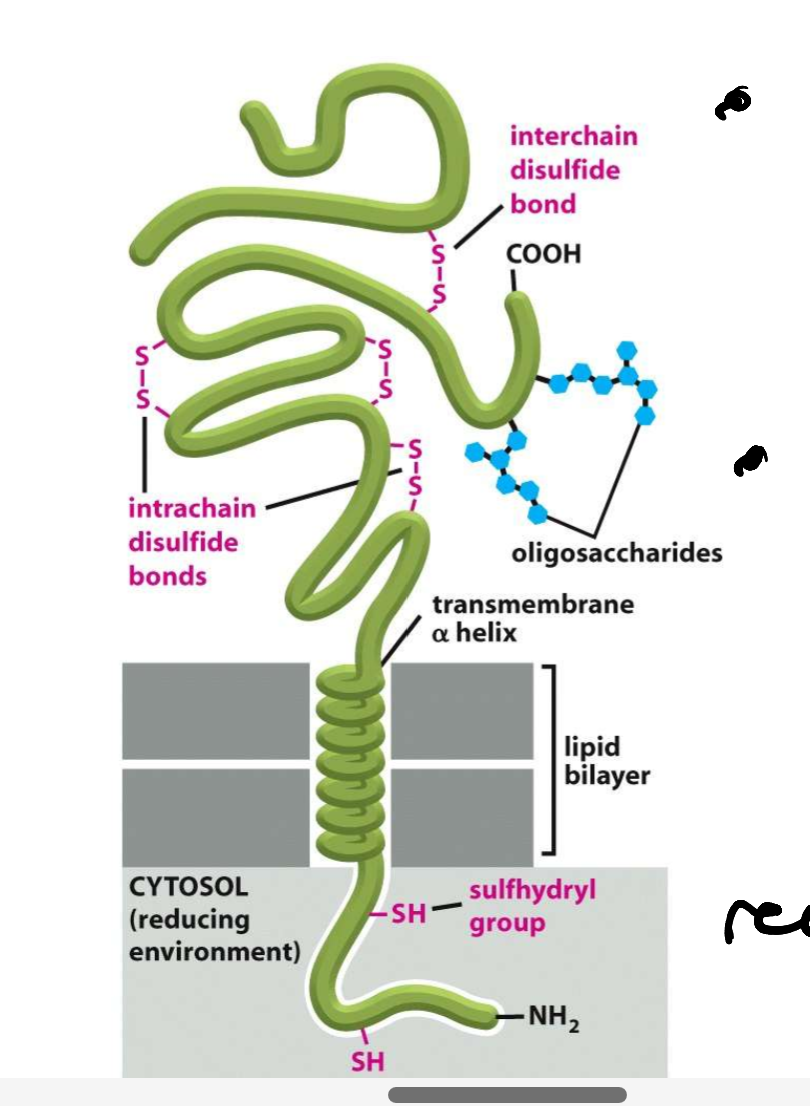
ER chaperone proteins, glycosylation, and protein disulphide isomerase (PDI) all ensure proper maturation
What does oligosaccharyl transferase (OST) do?
Transfers already built 14 sugar long oligosaccharides to asparagine (Asn) residues of nascent proteins in the ER at the consensus site (Asn - X - Ser/Thr; where X is not Pro)

True or False: Glycosylation can occur on both the cytosol and ER lumen side of integral membrane proteins
False. It only occurs on the ER lumen side (will become the extracellular side) of integral membrane proteins
What is N-linked glycosylation? What is O-linked glycosylation?
Sugars attached to the amide group of Asn residues (ER)
Sugars attached to the hydroxyl group or Ser/Thr residues (Golgi)
What does glycosylation contribute to the protein (Hint: F.F.S.T.)
Folding, Function, Stability, and Trafficking
What does glycosylation contribute to the cell?
The carbohydrate chains on the extracellular surface help with glycocalyx to protect the cell against chemical and mechanical damage and with cell recognition
What do chaperone calnexin and calreticulin do?
Recognize N-linked glycans on nascent proteins; help with proper folding and maturation in the ER
What does PDI do for proteins?
Rearrangement of disulphide bonds of cysteine residues within the same protein (intra) or between different proteins (inter) to help with correct strucutre

Why are disulphide bonds found on the non-cytosolic side of membranes (Ex. ER)
The ER lumen is a more oxidizing environment that favours disulphide formation compared to the cytosol that is a more reducing environment
What is a Glycosylphosphatidylinositol (GPI) Anchor? Advantages?
A specific ER modification that involves a hydrophobic stop-transfer sequence at the C-terminus, the C-terminu is then cleaved off by GPI transamidase before it attaches a pre-built GPI anchor there
Easier protein release from ER membrane and lateral movement within the plasma membrane of cell

What is the difference between a polypeptide and a protein?
Polypeptide: An unfolded sequence of amino acids
Protein: A folded sequence of amino acids that serves a function
Did you know: Yeast are actually eukaryotes, so they have an ER?
Woah
Post-Tranlational Challenge #1: Premature folding before reaching membrane (Bacteria and Yeast). What is the solution?
Cytosolic chaperones bind to newly synthesized polypeptides and prevent premature folding/aggregation

Post-Tranlational Challenge #2: Driving force of directional translocation (Bacteria and Yeast). What is the solution?
ATP-dependent machinery