OPM 3000 Forecasting CH 15
 Call Kai
 Learn
 Practice Test
 Spaced Repetition
 Match
 Flashcards
 Knowt Play
1/21

There's no tags or description
Looks like no tags are added yet.
22 Terms
Forecasting
A prediction or a guess on what’s going to happen next in the future
Qualitative Models
Subjective ideas, Anecdotive ideas.
Quantative Models
Involves math and data.
Jury of Executive Opinion
Involves a small group of experts on what they think will happen based on their experiences
Delphi Model
Getting opinions overtime will give you the right answer
Sales Force Compsite
People you can go to who interact with customers
Market Survey
Paying people to do your surveys
Time Series Model
They only look at the history of the thing you're forecasting. To forecast next month's sales, they use past monthly sales and nothing else. The underlying assumption is that past patterns like trend, seasonality and the general level will continue.
Associative Model
If you're using a different variable to explain it
Naive Approach
I don’t have enough information to do this certain action. Hence, you choose the more cost effective and basic approach.
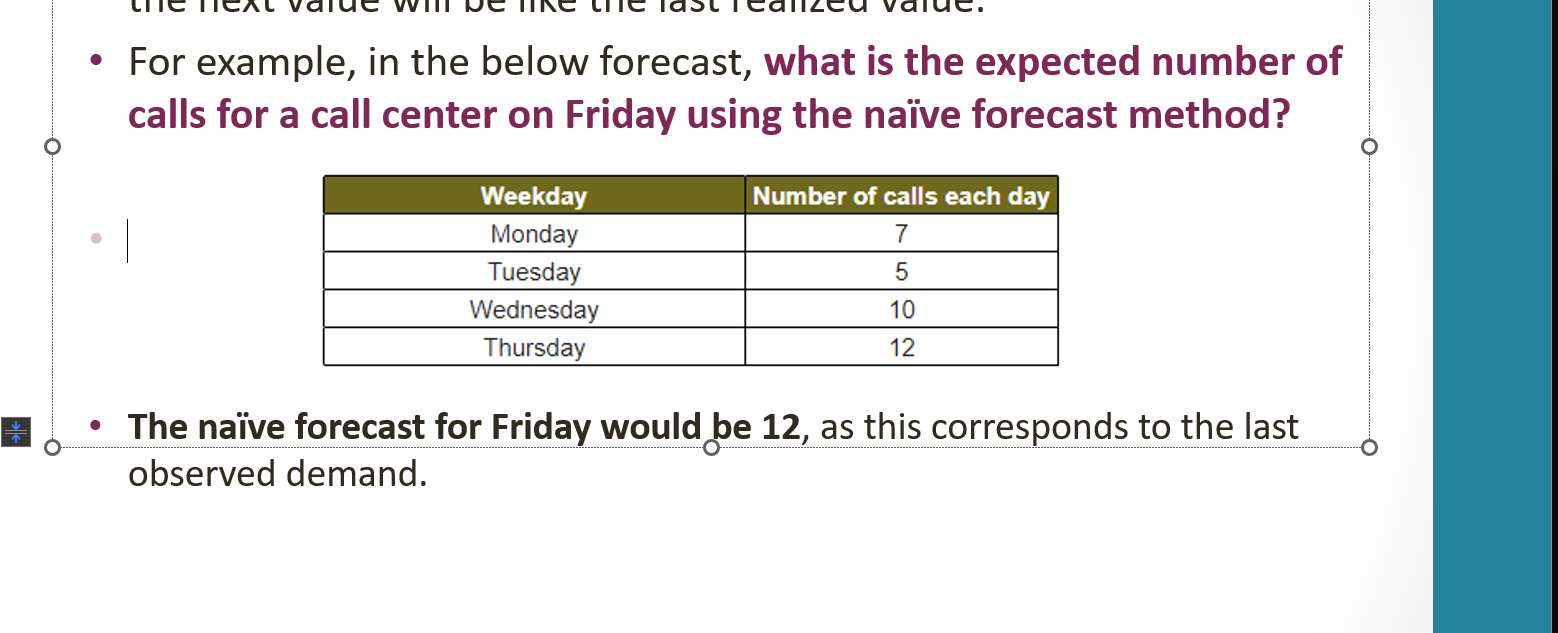
Naïve forecasting method
a forecasting method that predicts that the next value will be like the last realized value.
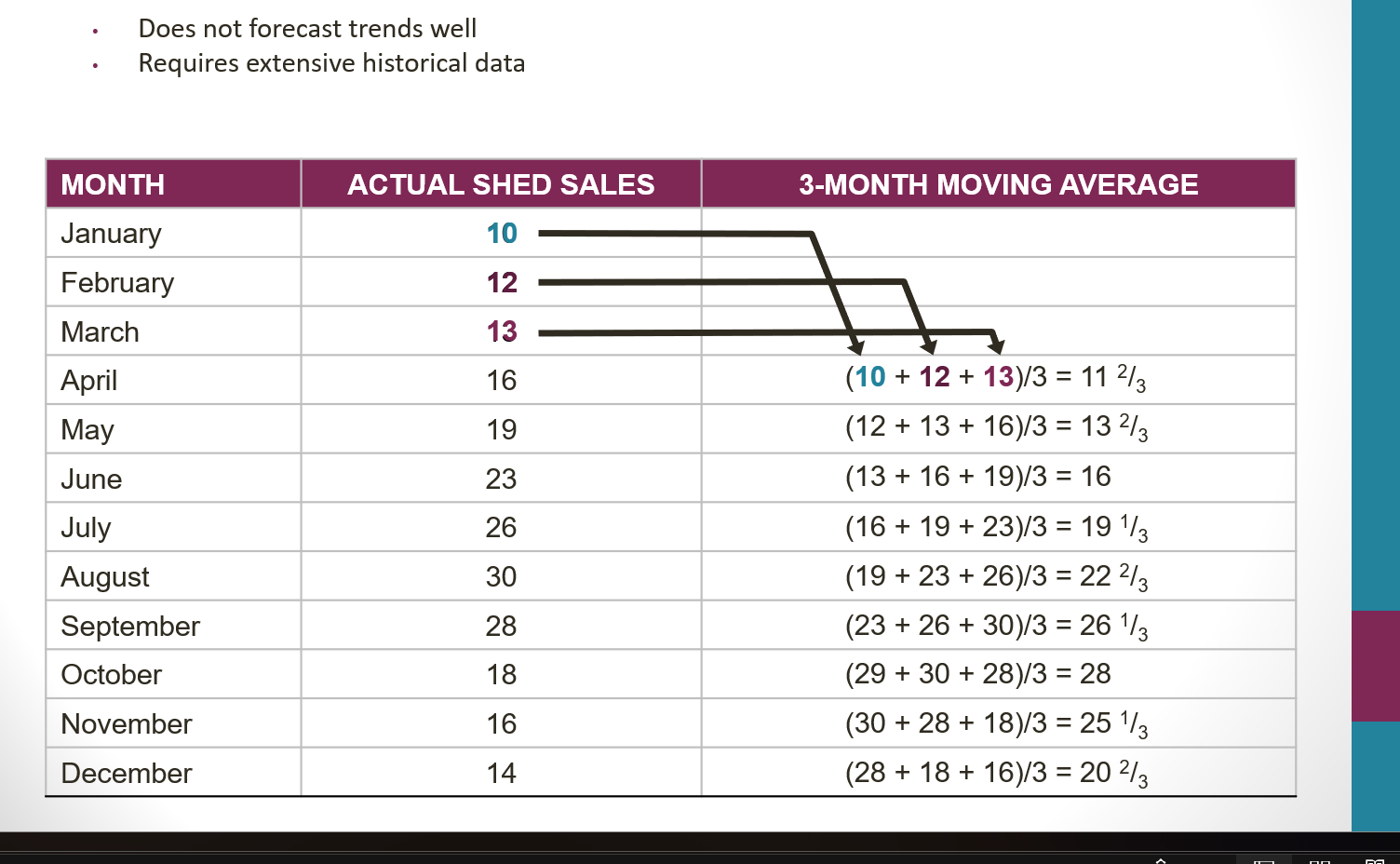
Moving average forecasting method
a forecasting method that predicts that the next value will be the average of the last realized values.

Weighted Moving Average
•Used when some trend might be present
•Older data usually less important
•Weights based on experience and intuition
What is the essential theme for forecasting?
The more sophiticated your forecasting, the more accurate the prediction may be
Forecast error
The difference between a forecasted value and the realized value.
Unbiased forecast
•a forecast that is correct on average, thus an average forecast error equal to zero.
Biased forecast
a forecast that is wrong on average, thus an average forecast error different from zero.
When should you use a naive forecast?
Use it when:
Demand is stable with no clear trend or seasonality, so last period is a fair guess.
You need it fast and cheap. It requires no math and only one data point.
You have very little data.
You need a benchmark. This is the big textbook point. Naive is the baseline you compare other methods against. If a fancier method can't beat naive on error (MAD/MSE), it isn't worth the effort.
When should you use the Moving average forecast?
Demand is fairly steady but noisy. Averaging smooths out random swings. It still lags when there's a trend.
When should you use the Weighted moving average / exponential smoothing?
you want recent data to count more, so the forecast responds faster to changes while still smoothing noise. A high α is more responsive and a low α is smoother.
When should you use trend projections?
the data clearly rises or falls steadily over time
When should you use linear regression (associative) approach?
demand is driven by another variable you can measure, like price, advertising or temperature.