unit 4 pics
 Call Kai
 Learn
Learn Practice Test
 Spaced Repetition
 Match
Match Flashcards
 Knowt Play
1/30

There's no tags or description
Looks like no tags are added yet.
Name | Mastery | Learn | Test | Matching | Spaced | Call with Kai | Chat |
|---|
No analytics yet
Send a link to your students to track their progress
31 Terms
Orbicularis oris
Action: movement of mouth and lips
Origin: arises indirectly from maxilla and mandible
Insertion: encircles mouth, inserts into muscle and skin at angles of mouth

Transverse Abdominis
A: compress abdominal contents
O: cartilages of the last 6 ribs
I: linea alba, pubic crest

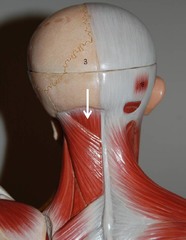
Sternocleidomastoid
A: rotate the head to the opposite side or obliquely rotate the head
O: sternum, clavical
I: mastoid process, superior nuchal line of occipital belly

Rectus abdominis
A: creates the 6 pack,bending the lumbar cavity
O: pubic crest, symphysis
I: xiphoid process, costal cartilages of ribs

Masseter
A: chewing, moving the jaw, elevates mandible
O: zygomatic arch, maxilla
I: angle and ramus if mandible

Orbicularis oculi
A: eyelid movement
O: frontal and maxillary bones, ligaments around orbit, frontal bone
I: tissue of eyelid around eye

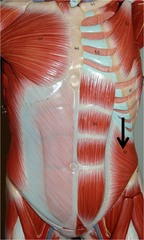
External oblique
A: pull the chest downwards, compress the abdonimal cavity
O: lower 8 ribs
I: most fibers insert anteriorly via a broad aponeurosis into linea alba, some into pubic crest and tubercle and iliac crest

Triceps brachii
A: primary extensor of elbow
O: long headm in fraglenoid tubercle of scapula, lateral head, posterior shaft of humerus, medial head, posterior shaft of humerus distal to radical groove
I: by common tendon into olecranon process

Biceps brachii
A: flexes elbow joint, supinates forearm
O: short head, coracoid process, long head, tubercle above and lip of glenoid cavity, tendon of long head runs within capsule and into intertubercle saleus of humerus
I: by common tendon into radial tuberosity, proximal radius

Brachioradialis
A: flexes elbow into forearm
O: humerous
I: radius (distal forearm base of styloid process of radius)

Trapezius
A: stabiizes, raises, retracts, and rotates scapula, can help extend head
O: occipital bone
I: continuous insertion along acromion and spine of scapula, lateral third of clavicle

External intercostals
A: pull ribs towards one another to elevate rib cage, aid in inspiration, synergist of diaphragm
O: inferior border of rib above
I: superior border of rib below

Latissimus dorsi
A: prime mover of arm extension, power arm adductor, medially rotates arm at shoulder, important role in bringing the arm down in power strokes
O: indirect attachment via lumbodorsal fascia into spines of lower 6 thoracic vertebrae lumnar vertebrae, lower 3-4 ribs and iliac crest
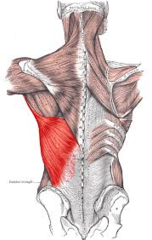
Serratus anterior
A: the pulling of the scapula forward and around the rib cage that occurs when someone throws a punch
O: by a series of muscle slips from ribs 1-8
I: entire surface of vertebral border of scapula

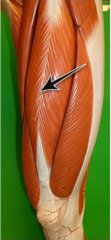
Quadriceps femoris
A: crucial in walking and running because it swings legs forward, plays important role in stabilizing patella
O: linea
I: patella
Gluteus maximus
A: major extensor of thigh, climbing stairs and running, responsible for movement in hip or thigh
O: dorsal ilium, sacrum, coccyx
I: gluteal tuberosity of femur, iliotibial bract, dorsal ilium, sacrum, coccyx

Biceps femoris
A: extends thigh and flexes knee, laterally rotates leg, especially when knee is flexed
O: ischial tuberosity, linea aspera and distal femur
I: common tendon passes downward and laterally to insert into head of fibula and lateral condyle of tibia

Epicranius
A: movemnet of forehead and eyebrows
O: cranial aponeurosis
I: skin of eyebrows

Pectoralis major
A: prime mover of arm flexion, rotates arm medially, adducts arm, aids in climbing, throwingm pushing and forced inspiration
O: sternal end of clavicle, sternum, cartilage of ribs 1-6, and aponeurosus of external oblique
I: fibers converge to insert by a short tendon into greater tubercle of humerus (proximal end of humerus)

Pterygoids
A: moving jaw left to right
O: sphenoid bone
I: mandible

Diaphragm
A: primary breathing muscle, seperates abdominal and thoracic
O: inferior internal surface or rib cage of sternum, costal cartilages of last 6 ribs and lumbar vertebrae, sternum
I: central tendon

Gastrocnemius
A: plantar flexes foot, running, jumping, most external calf muscle
O: by two heads from medial and lateral condyles of femur
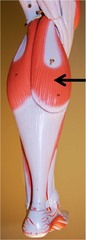
Soleus
A: aids in running. jumping, deep calf muscle
O: extensive origin from superior tibia, fibula, and interosseous membrane
I: posterior calcaneus via calcaneal tendon

TIbialis Anterior
A: shin muscle, dorsiflexes foot, brings foot towards you
O: upper 1/2 & Lateral Condyle of Tibia
I: medial cuneiform and first metatarsal bones of the foot

Extensor carpi muscles
A: extends and abducts wrist; acts synergystically with extensor carpi radialis longus to steady wrist during finger flexion
O: top of forearm
I: base of third metacarpal
(top of the arm)

Flexor carpi muscles
A: flexor of wrist, abducts hand, weak synergist of elbow flexion
O: medial epicondyle of humerus
I: base of second and third metacarpals, insertion tendon easily seen and provides guide to position of racial at wrist
(bottom of arm)

Deltoid
A: prime mover of arm abduction along the frontal plane
O: embraces insertion of the trapezius, lateral third of clavicle acromion and spine of scapula
I: deltoid tuberosity of humerous

Internal intercostals
A: draw rib cage together, and depress rib cage, aid in force expiration, antagonistic to external intercostals
O: superior border of rib below
I: inferior border (costal groove) of rib above

Platysma
A: Frowning and flexing your neck
O: Fascia of chest (over pectoral muscles and deltoid
I: lower margin of mandible, and skin muscle at corner of mouth

Internal oblique
A: pull the chest downward and compress the abdominal cavity
O: lumbar fascia, iliac crest, and inguinal ligament
I: linea alba, pubic crest, last three or four ribs, and costal margin
Semispinalis capitis
A: maintaining balance of the head on the neck
O: transverse process of C7-T12
I: occipital bone (capitis) and spinous processes of cervical vertebrae