SSP - Probability, random processes, random signals
 Call Kai
 Learn
 Practice Test
 Spaced Repetition
 Match
 Flashcards
 Knowt Play
1/33

Earn XP
Description and Tags
Part 1 of SSP curriculum
34 Terms
frequentist definiton of probability, also known as relative probability
the probability based on how often an event occurs

the three probability axioms
for any event A, it holds taht 0<=Pr[A]<=1
it holds that Pr[S]=1
for any countable collection of M disjoint events it holds taht Pr[A1 U A2 U … U Am] = Pr[A]+Pr[A2]+…+Pr[m]
consequences of the probability axioms
it holds that Pr[]=0
it holds that Pr[Ac]=1-Pr[A]
for any events A and B it holds that Pr[A U B]=Pr[A]+Pr[B]-Pr[A * B]
if A ←B it holds that Pr[A]=<Pr[B]
for any event A and event space {B1, B2, …, Bm} it holds that Pr[A]=sum(Pr[A * Bi]) = sum(Pr[ABi])
priori probability
probability og an avent A occurring without having made any observation (prior=before)
Pr[A]
posteriori probability
new probability after having obtained more information about the situation (post=after)
Pr[A|B]
Bayes’ theorem

if two events are independent, the following holds Pr[AB]=… and Pr[A|B]=.. and Pr[B|A]=…
=Pr[A]Pr[B]
=Pr[A]
=Pr[B]
random variables
processes that involve uncertainty and therefore have a random outcome
random variable versus a realization
random variable is a set possbile values of X(s)
x is a possible value of random variable X(s) = an observation
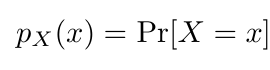
probability mass function (PMF) for discrete random variables
probability that a discrete random variable X takes on the value x
cumulative distribution funciton (CDF) for discrete random variables
cumulative probability of the discrete random variable X having a value lower than or equal to x
obtained from PMF by summing all values of the PMF

probability mass function (PDF) for continuous random variables
probability that a continuous random variable X takes on the value x

cumulative distribution funciton (CDF) for continuous random variables
cumulative probability of the continuous random variable X having a value lower than or equal to x
obtained from PMF by putting an interval all values of the PMF

cumulative distribtuion function (CDF) properties
0=<Px(x)=<1 for all x
Px(-inf)=0 and similarly Px()+inf=1
Pxx(x2)>=Px(x1) holds when x2>=x1
holds that Px(x2)-Px(x1)=Pr[x1<X<=x2] for x2>x1
probability density function (PDF) properties
it holds that px(x)>=0 for all x
by definition Px(x)=integral px(u)du
it holds that integralpx(x)dx=1
moments
quantities that summarizes random variables’ characteristics
sample moments
average over data samples
expectation operator orders
first order - expected value = mean
second order - variance (central moment = found by subtracting from the random variable their first order moment)
mth order normalized central moments - determied as the central moment divided by the mth order of the standard deviation
average=sample mean, median and mode
average - determined by summing over all values and dividng by the number of observations
median - value in the middle of the ordered data set
mode - observation with the highest number of occurences
joint random variables
multiple random variables that are all associated with an event
joint CDF
joint PDF
joint PMF
marginalization
When one of the conditions X ≤ x and Y ≤ y is always satisfied, the cumulative distribution does not depend on that variable anymore and therefore that variable can be removed from the equation, leaving a distribution that now depends on one single random variable.
covariance
a measure of the relationship between two random variables

correlation
a noncentralized version of the covariance

two random variables are called orthogonal…
…if the correlation between them equals 0

correlation coefficient
the relationship between two random variables independent of the variances

central limit therem
after averaging multiple realizations of a random variable generated from the same (arbi trary) distribution, the distribution of the averaged random variables converges to a Gaussian distribution
multivariate
= multiple variables are involved, X=[X1, X2, X3,…, XN]^T
multivariate joint CDF
multivariate joint PDF
multivariate joint PMF
A probability distribution depending on multiple random vectors can be regarded in…
…all aspects as a probability distribution depending on a single random vector (which is a concatenation of all different random variables)
statironary random process
if its statistical properties do not change over time

strict-sense stationary
When stationarity applies to the statistics of any order
Wide-sense stationarity (WSS)
weaker criterion than strict-sense stationarity. In stead of requiring that all N-th order statistics be constant, only the first- and second-order statistics (mean and variance) must be independent of the time shift
average signal power Ps
the average signal energy per sample and where a total of N samples are averaged over
If a random process is ergodic,…
the statistical properties of the entire random process can be inferred from any of its realizations and it has to be stationary
spectral factorization
states that most random processes with a continuous power spectral density (PSD) can be generated as the output of a causal filter driven by white noise, the so-called innovation representation of the random process
= the determination of a minimum-phase system from its magnitude response or from its autocorrelation function