AQA A level Bio 7.1 Inheritance
 Call Kai
 Learn
 Practice Test
 Spaced Repetition
 Match
 Flashcards
 Knowt Play
1/23

Earn XP
Description and Tags
24 Terms
Explain what is meant by the term phenotype (2)
Expression/appearance/characteristic due to genotype/alleles (1)
and the environment (1)

Tay-Sachs disease is a human inherited disorder. Sufferers of this disease often die
during childhood. The allele for Tay-Sachs disease t, is recessive to allele T, present in
unaffected individuals. The diagram shows the inheritance of Tay-Sachs in one family
Explain one piece of evidence from the diagram which proves that the allele for Tay-Sachs disease is recessive (2)
Unaffected 3 and 4 have affected offspring (1)
Both 3 and 4 are carriers (1)
Suggest two reasons why observed ratios are often not the same as expected ratios (2)
Fertilisation is random OR fusion of gametes is random (1)
Selective advantage (1)
Explain what is meant by codominant alleles (1)
Alleles that both contribute to phenotype in the heterozygous condition (1)

Human ABO blood groups are determined by the presence or absence of two antigens (A and B) on plasma membrane of the red blood cells. The plasma membrane of the red blood cells. The inheritance of these blood groups is controlled by three alleles.
IA – determines the production of antigen A
IB – determines the production of antigen B
Io – determines the production of no antigen
Alleles IA and IB are codominant. Allele Io is recessive to both. The pedigree shows the pattern of inheritance of these blood groups in a family over three generations.
How many antigen-determining alleles will be present in a white blood cell? Give reason for your answer (1)
2, inherited one from each parent(maternal and paternal) (1)

Human ABO blood groups are determined by the presence or absence of two antigens (A and B) on plasma membrane of the red blood cells. The plasma membrane of the red blood cells. The inheritance of these blood groups is controlled by three alleles.
IA – determines the production of antigen A
IB – determines the production of antigen B
Io – determines the production of no antigen
Alleles IA and IB are codominant. Allele Io is recessive to both. The pedigree shows the pattern of inheritance of these blood groups in a family over three generations.
If individuals 6 and 7 were to have another child, what is the probability that this child would be male and blood group A? explain your answer (3)
12.5 % (1)
parents IB Io and IAIo (1)
25% probability of blood group A and half will be male (1)
Explain what is meant by a dominant allele? (1)
Gene that is always expressed (1)
A woman comes from a family with a history of the sex-linked condition haemophilia. A test was carried out to discover the sex of one of the embryos produced by IVF.
Explain how observation of the chromosomes from an embryo cell could enable the sex to be determined (2)
XY male
XX female (1)
Y shorter/smaller than X (1)
A woman comes from a family with a history of the sex-linked condition haemophilia. A test was carried out to discover the sex of one of the embryos produced by IVF.
The mother is known to carry the haemophilia allele. The father does not have haemophilia. What is the probability of their first child having haemophilia? Explain your answer (3)
Haemophilia is a recessive allele (1)
Male 50% chance of haemophilia (1)
Female 0% of haemophilia (1)
The fruit fly is a useful organism for studying genetic crosses. Female fruit flies are approximately 2.5 mm long. Males are smaller and possess a distinct black patch on their bodies. Females lay up to 400 eggs which develop into adults in 7 to 14 days. Fruit flies will survive and breed in small flasks containing a simple nutrient medium consisting mainly of sugars.
Use this information to explain two reasons why the fruit fly is a useful organism for studying genetic crosses. (2)
Fast reproduction (therefore) results obtained quickly (1)
Size therefore easy identification of males and females (1)
Male fruit flies are more likely than female fruit flies to show a phenotype produced by a recessive allele carried on the X chromosome. Explain why (2)
Males have one allele (1)
Females need two recessive alleles (1)
In fruit flies, the genes for body colour and wing length are linked. Explain what this means (1)
(genes/loci) on same chromosome (1)

A scientist investigated linkage between the genes for body colour and wing length. He carried out crosses between fruit flies with grey bodies and long wings and fruit flies with black bodies and short wings.
Figure 1 shows his crosses and the results.
• G represents the dominant allele for grey body and g represents the recessive allele for black body.
• N represents the dominant allele for long wings and n represents the recessive allele for short wings.
Figure 1
Phenotype of parents: grey body, long wings x black body, short
Genotype of parents : GGNN x ggnn
Genotype of offspring : GgNn
Phenotype of offspring : all grey body, long wings
These offspring were crossed with flies homozygous for black body and short wings.
The scientist’s results are shown in Figure 2.
Use your knowledge to explain these results (4)
GN and gn are linked (1)
GgNn individual produces mainly GN and gn gametes (1)
Crossing over produces some/few Gn and gN gametes (1)
so fewer Ggnn and ggNn individual (1)
In genetic crosses, the observed phenotypic ratios obtained in the offspring are often not the same as the expected ratios
Suggest two reasons why (1)
Any two from :
Random fusion of gametes
Small sample size
Epistasis
lethal gamete (2)
The production of pigment in rabbit fur is controlled by two genes.
One gene controls whether any pigment is made. This gene has three alleles. Allele A codes for the production of one form of the enzyme tyrosinase, which converts tyrosine into a black pigment. Allele Ah codes for the production of a second form of the enzyme, which becomes inactive at temperatures close to a rabbit’s core body temperature, so only the face, ears, legs and tail are pigmented. A third allele, a, fails to code for a functional tyrosinase.
The other gene controls the density of pigment in the fur. This gene has two alleles. Allele B is dominant and results in the production of large amounts of pigment, making the fur black.
Allele b results in less pigment, so the fur appears brown.
How do multiple alleles of a gene arise? (2)
Mutations (1)
At different positions in the gene (1)
The table shows some genotypes and phenotypes.
Genotype | Phenotype |
A–B– | all fur black |
aaB– | all fur white (albino) |
Ahabb | white body fur with brown face, ears, legs and tail (Himalayan) |
What do the dashes represent in the genotype of the black rabbit? (1)
Either dominant or recessive allele (1)
The production of pigment in rabbit fur is controlled by two genes.
One gene controls whether any pigment is made. This gene has three alleles. Allele A codes for the production of one form of the enzyme tyrosinase, which converts tyrosine into a black pigment. Allele Ah codes for the production of a second form of the enzyme, which becomes inactive at temperatures close to a rabbit’s core body temperature, so only the face, ears, legs and tail are pigmented. A third allele, a, fails to code for a functional tyrosinase.
The other gene controls the density of pigment in the fur. This gene has two alleles. Allele B is dominant and results in the production of large amounts of pigment, making the fur black.
Allele b results in less pigment, so the fur appears brown. Suggest an explanation for the pigment being present only in the tail, ear, face and legs of a Himalayan rabbit (2)
temperature lower at extremities (1)
Coat colour in mice is controlled by two genes, each with two alleles. The genes are on different chromosomes.
One gene controls the pigment colour. The presence of allele A results in a yellow and black banding pattern on individual hairs, producing an overall grey appearance called agouti. Mice with the genotype aa do not make the yellow pigment and are, therefore, black.
The other gene determines whether any pigment is produced. The allele D is required for development of coat colour. Mice with the genotype dd produce no pigment and are called albino.
What type of gene interaction is occurring between the two genes? Explain your answer. (2)
Epistasis (1)
as one gene influences whether another is expressed (1)
Coat colour in mice is controlled by two genes, each with two alleles. The genes are on different chromosomes.
One gene controls the pigment colour. The presence of allele A results in a yellow and black banding pattern on individual hairs, producing an overall grey appearance called agouti. Mice with the genotype aa do not make the yellow pigment and are, therefore, black.
The other gene determines whether any pigment is produced. The allele D is required for development of coat colour. Mice with the genotype dd produce no pigment and are called albino.
Suggest how the actual genotype of albino parent could be determined (2)
Cross with black individual /genotype aaDd or aaDD (1)
genotype in Aadd if offspring is agouti (1)

A species of flowering plant can have white, red or purple flowers. The colour of the flowers is controlled by two genes. Each gene is found on a different chromosome, and is responsible for one step in a biosynthetic pathway. The biosynthetic pathway is
Gene 1 has the dominant allele A and the recessive allele a. Gene 2 has the dominant allele B and the recessive allele b. In both cases, the dominant allele needs to be present for the production of the associated enzyme.
Explain how the two genes are involved in producing white, red or purple flowers (6)
Allele A makes enzyme converting J to K (1)
Allele a produces no/non-functional enzyme (1)
Allele B makes enzyme converting K to L (1)
White flowers result from genotype aa (1)
Red flowers when A_bb (1)
Purple flowers when A_B_ (1)
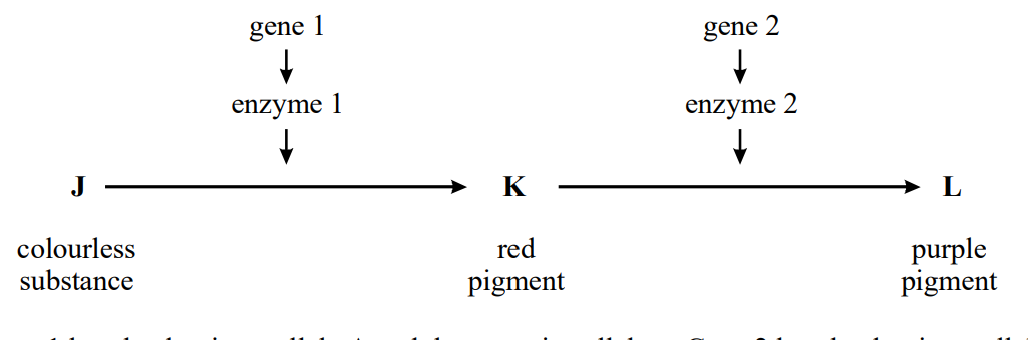
A species of flowering plant can have white, red or purple flowers. The colour of the flowers is controlled by two genes. Each gene is found on a different chromosome, and is responsible for one step in a biosynthetic pathway. The biosynthetic pathway is
Gene 1 has the dominant allele A and the recessive allele a. Gene 2 has the dominant allele B and the recessive allele b. In both cases, the dominant allele needs to be present for the production of the associated enzyme.
You have samples of fresh petals from the two homozygous types of white flowers, and a pur sample of the red pigment, K. Explain, in outline, how you might distinguish the two types of petal from each other (2)
(crush each type of white petal to make an extract, and) add some other (red) pigment/K to petal (1)
(extract becoming) purple is identified as aaBB (1)

In fruit flies, a gene for body colour has a dominant allele for grey body, G, and a recessive allele for black body, g.
A gene for eye colour has a dominant allele for red eyes, R, and a recessive
allele for white eyes, r, and is located on the X chromosome.
The diagram shows the phenotypes of fruit flies over four generations.
Give one piece of evidence from the diagram above to show that the allele for grey body colour is dominant. (1)
Grey parents produce black (fly) (1)
A large and growing number of disorders are now known to be due to types of mitochondrial disease (MD). MD often affects skeletal muscles, causing muscle weakness. We get our mitochondria from our mothers, via the fertilised egg cell. Fathers do not pass on mitochondria via their sperm. Some mitochondrial diseases are caused by mutations of mitochondrial genes inside the mitochondria. Most mitochondrial diseases are caused by mutations of genes in the cell nucleus that are involved in the functioning of mitochondria. These mutations of nuclear DNA produce recessive alleles. One form of mitochondrial disease is caused by a mutation of a mitochondrial gene that codes for a tRNA. The mutation involves substitution of guanine for adenine in the DNA base sequence. This changes the anticodon on the tRNA. This results in the formation of a non-functional protein in the mitochondrion. There are a number of ways to try to diagnose whether someone has a mitochondrial disease. One test involves measuring the concentration of lactate in a person’s blood after exercise. In someone with MD, the concentration is usually much higher than normal. If the lactate test suggests MD, a small amount of DNA can be extracted from mitochondria and DNA sequencing used to try to find a mutation.
Two couples, couple A and couple B, had one or more children affected by a mitochondrial disease. The type of mitochondrial disease was different for each couple.
None of the parents showed signs or symptoms of MD.
• Couple A had four children who were all affected by an MD.
• Couple B had four children and only one was affected by an MD
Use the information in lines 5–9 and your knowledge of inheritance to suggest why:
• all of couple A’s children had an MD
• only one of couple B’s children had an MD. (4)
Couple A
Mutation in mitochondrial DNA/DNA of mitochondrion affected (1)
All children got affected mitochondria from mother (1)
Couple B
DNA in nucleus affected (1)
Parents heterogyous (1)
A large and growing number of disorders are now known to be due to types of mitochondrial disease (MD). MD often affects skeletal muscles, causing muscle weakness. We get our mitochondria from our mothers, via the fertilised egg cell. Fathers do not pass on mitochondria via their sperm. Some mitochondrial diseases are caused by mutations of mitochondrial genes inside the mitochondria. Most mitochondrial diseases are caused by mutations of genes in the cell nucleus that are involved in the functioning of mitochondria. These mutations of nuclear DNA produce recessive alleles. One form of mitochondrial disease is caused by a mutation of a mitochondrial gene that codes for a tRNA. The mutation involves substitution of guanine for adenine in the DNA base sequence. This changes the anticodon on the tRNA. This results in the formation of a non-functional protein in the mitochondrion. There are a number of ways to try to diagnose whether someone has a mitochondrial disease. One test involves measuring the concentration of lactate in a person’s blood after exercise. In someone with MD, the concentration is usually much higher than normal. If the lactate test suggests MD, a small amount of DNA can be extracted from mitochondria and DNA sequencing used to try to find a mutation.
Suggest how the change in the anticodon of a tRNA leads to MD (lines 10–13). (3)
Change to tRNA leads to wrong amino acid being incorporated into protein (1)
Tertiary structure of protein changed (1)
Protein required for oxidative phosphorylation (1)