RNA interference and microRNAs
 Call Kai
 Learn
 Practice Test
 Spaced Repetition
 Match
 Flashcards
 Knowt Play
1/8

There's no tags or description
Looks like no tags are added yet.
9 Terms
notes
RNA interference (RNAI) has made a major emergence in the biomedical sciences only in the last decade or so
Research into RNA interference pathways eventually led to the characterisation of microRNAs now known to be fundamental players in cellular mRNA translation regulation
the small interfering RNA (siRNA) pathway
Thought to have evolved as a viral defence mechanism as early as in plants
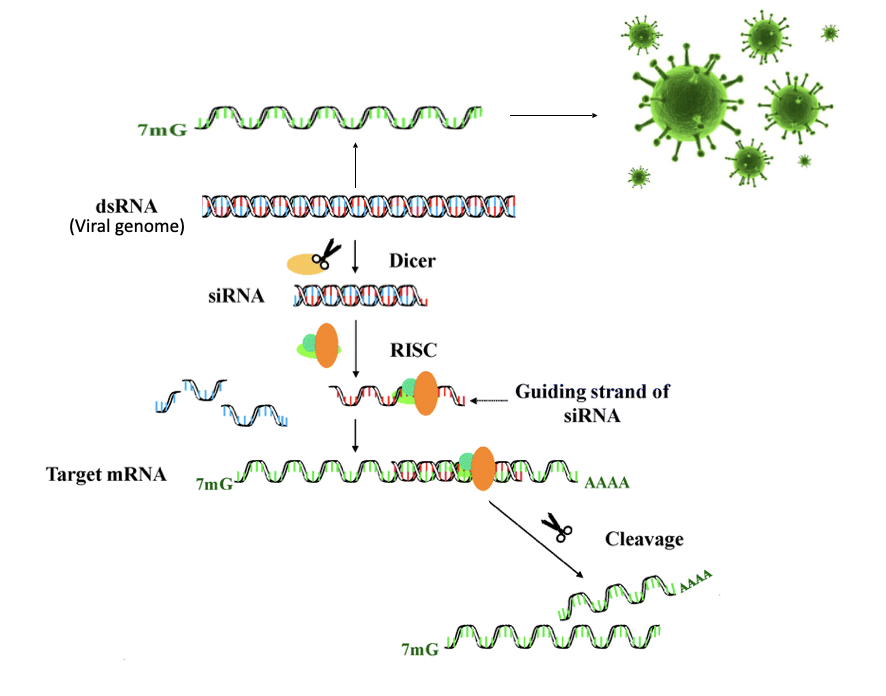
The pathway consists of machinery that can generate small double-stranded RNAs or siRNAs from viral genome and then use them to destroy viral mRNAs
Double stranded RNA genome (retrovirus)
DNA copy of RNA Is made
Gets incorporated into the plant genome
Genome is expressed (mRNA made)
Makes viral parts
Foreign genetic material is recognised
Some of the copies of double stranded RNA are degraded into small RNAs (sIRNA) by Dicer
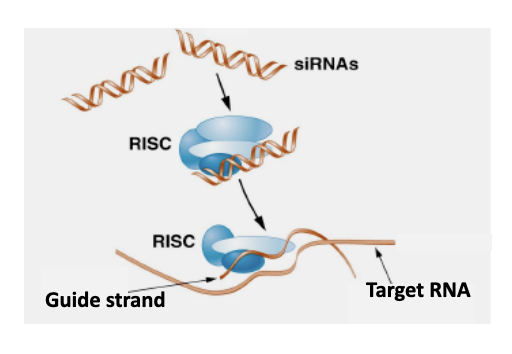
They interact with RISC complex (RNA induced silencing complex)
One strand is rejected
One strand (guide strand) is retained within the complex)
Protein RNA complex scans cell for any complimentary sequences (will only be viral sequences)
If there is a perfect matching of sequence
Enzymatic components of the RISC complex degrade target
Viral DNA degraded
Viral particles no longer produced
Dicer (enzyme)
Dicer generates the small double stranded siRNAs from the double-stranded viral RNA genome
The small siRNAs need to be in a very precise molecular configuration in order to be accepted by the RISC complex
22 nucleotides of RNA molecule
With 2 nucleotide 3' overhangs on each end
Dicer enzyme is composed of multiple domains
PAZ domain
Locks onto 3' end of RNA
Anchors the RNA
Ruler helix
Measures out 22 nucleotide length
RNA domain
Perform incision
Not perfectly aligned
One enzyme performs incision, other performs the incision 2 extra nucleotide away
Forms the other overhang
RISC
The RNA induced silencing complex mediates potent enzymatic destruction of the viral mRNA copies
Will only take up RNA generated by Dicer
Ago
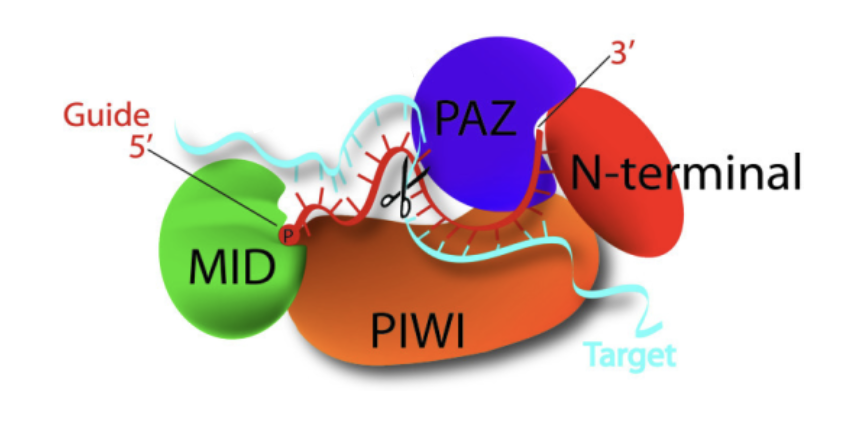
Argonuate (Ago/Ago2) is the major component of the RISC complex and carries out its critical function
Has multiple domains
MID
Binds to 5' end
PIWI
Contains enzymes
Responsible for mRNA cleavage
PAZ
Binds to 3' end of RNA
N-terminal
Unwinds RNA
Only once a perfect match has been found then will enzymatic components be reached
Released from where
Piwi domain
microRNAs
Higher organisms such as vertebrates have evolved alternative more effective and comprehensive means of viral defence
However we surprisingly find that the siRNA pathway machinery is still produced in vertebrate/mammalian cells
The pathway was hijacked by endogenously produced miRNAs expressed from vertebrate genomes
Several thousand miRNA genes have been identified in our genome
At least one for each protein coding gene
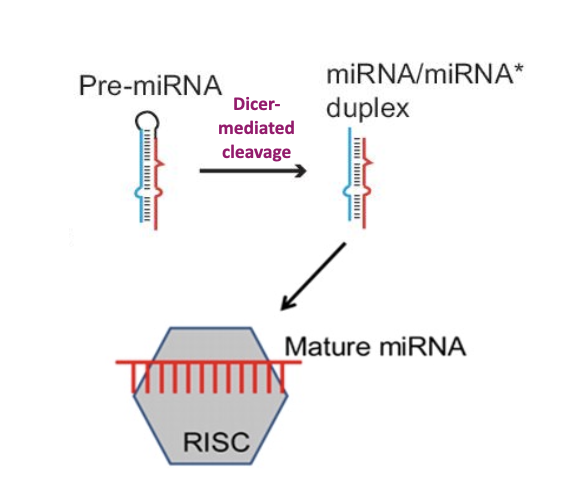
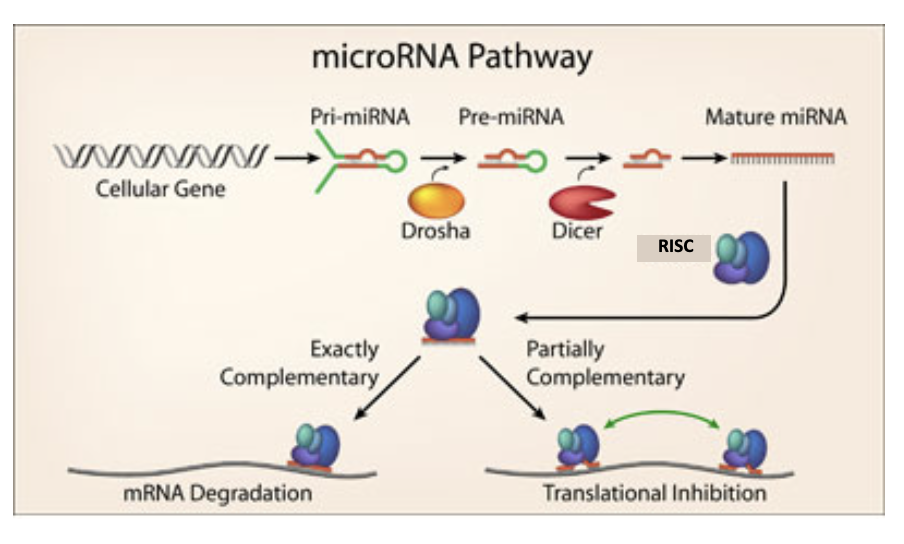
These genes encode lager miRNA-precursor RNAs which are then processed by cellular enzymes into the much shorter mature miRNAs
The mature roughly 22 nucleotide long miRNAs are used by the cell to exert control over mRNA translation
pre-miRNA
Pre-miRNA recognised by Dicer complex
How is hairpin portion cleaved off?
PAZ domain binds to 3' end
Cleaved near the base of the stem
Terminal/hairpin loop is cut off
22 nucleotides long as it is cleaved by dicer
Due to configuration, it will interact with RISC complex
One strand is retained in complex
Can scan cytoplasm for sequency complementarity
Matching of sequence of miRNA to mRNA is never perfect
Thus do not get degradation of mRNA
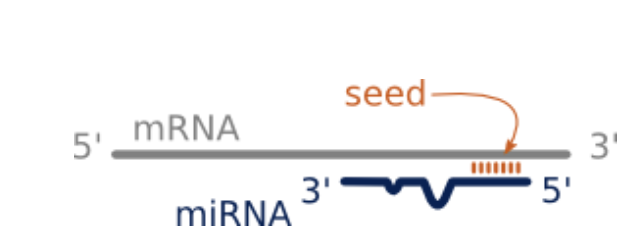
Seed sequence = perfect match in 5' end of miRNA
Pathway is to temporarily halt translation
Can inhibit elongation of ribosome
If cell wants to shut of translation permanently it can express mRNA exactly complementary to the miRNA
piRNAs
Piwi-interacting RNAs are expressed almost exclusively in germ line cells
In mammalian germ line cells, bursts of retrotransposon activity can be observed and piRNAs are employed to control/supress this activity
To promote genetic diversity
Can cause sections of genetic material to swap around
Eventually needs to be controlled (could become mutagenic)
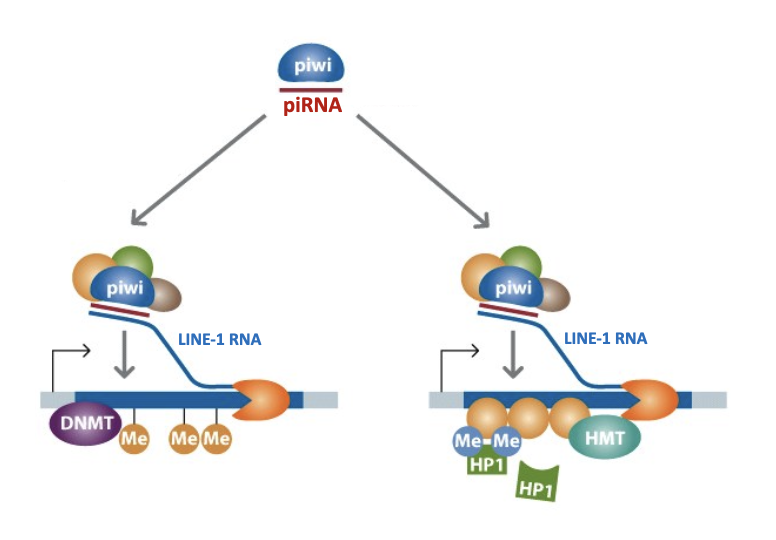
action of piRNAs
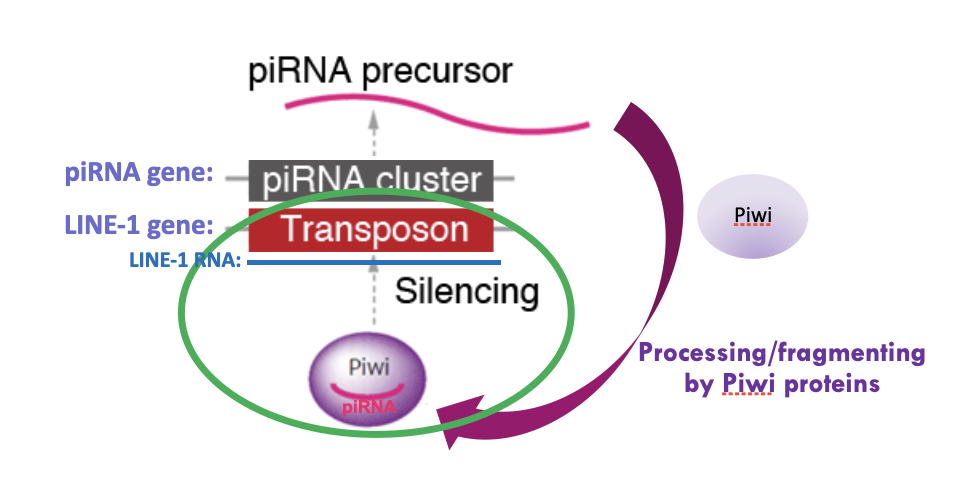
Line 1 gene expressed into line-1 RNA
piRNA cluster gene is located on opposite strand to line-1 gene
Complementary to line 1 gene
Also expressed into RNA
Piwi gets hold of piRNA precursor
Starts cutting it into smaller molecules
Retains smaller pieces as mature piRNA
As it is complementary to line-1 RNA it can form an interaction
Interaction occurs in nucleus
As line-1 emerges from polymerase
Newly synthesised
Piwi is recruited to gene
Recruits other proteins
DNA methyltransferases
Prevents binding of transcription factors
Histone methyltransferases
Adds methyl to histones
Reduces gene expression