L4 Forms of Business
 Call Kai
 Learn
 Practice Test
 Spaced Repetition
 Match
 Flashcards
 Knowt Play
1/15

There's no tags or description
Looks like no tags are added yet.
16 Terms
Sole Trader
challenging to obtain finance (banks may focus on individual credibility more than business which can lead to rejected finance)
no audit of accounts (no legal requirement)
minimum legalities and costs (just need to register business with HRMC)
unlimited liability
Partnership
access to greater skills and experience
can have sleeping partners who don’t intrude but are named as a partner
decision sharing: easier or harder
all liable
taxed as income tax
could be limited liability partnership:
tax would be corporate tax
need to register
need to file accounts
business is a separate entity from partnership (limited liability for losses)
Public/Private limited company
Private: shares owned by management, founders, and private investors (may include family and friends
Public: owned by shareholders, general investors and promoters (the founders/controlling shareholders)
limited liability
pay corporation tax
must comply with Companies Acts (UK)
face greater regulation
public can raise capital (finance) through shareholders
Community Interest Company
limited liability company created specifically for social enterprises who operate for community benefit over profits
their social objective is regulated so the organisation cannot deviate from its social missions
limited liability form of social enterprise
Industrial and provident society NOW co-operative and community benefit society
co-operative societies: owned and controlled by their members, aim to serve common needs of members, democratic basis so each member has equal power
community benefit societies: business done for the benefit of the broader community rather than just the members, assets and profits not distributed to members but distributed to community purpose, can be exempt charities regulated by FCA
register as ONE, cannot be both
what are social enterprises?
Paul Burns (2010) - its about putting the social objective first and utilising commercial skills to achieve it in an entrepreneurial way
businesses that trade to tackle social problems, improve communities, improve communities or the environment. They make money from selling goods but reinvest profits back into the local community or something the business provides
OVERALL: same as general business in terms of starting the business, business plan, needing financing etc. but stakeholders interest differ and objectives differ in terms of profit
e.g. TOMS for every pair of shoes sold they donate to those in need
Grameen Bank aided economic and social development through microcredit, allowing people who couldn’t ordinarily obtain a loan to get micro loans without a credit check (started by Dr Muhammad Yunus 1974 in Bangladesh)
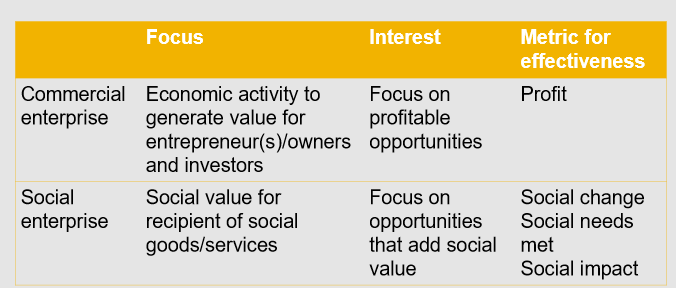
difference between commercial and social enterprise
focus: economic activity for value vs for social value
interest: profitable opportunities vs ones that add social value
metric of success: profit vs social change and impact
Why should we have/do we need social enterprises
Localism - create local jobs and solve local problems rather than globalism approach commercial firms may take
alternative to a globalised capital economy
neighbourhood economics: focuses on building wealth and well being in local areas rather than expecting top down improvement
How social enterprises measure success
Social return on investment = people (social good), profit, planet (environmental sustainability)
create and SUSTAIN social value
demonstrate value for companies, organisations and individuals: social housing, leisure for wellbeing
Challenges with measuring social return on investment
struggles to capture the individuality (heterogenity) of SEs) - they address different things so can’t be measured in the same way
can’t always be measured numerically e.g. well-being
fails to omit results that would have happened anyway
complex, time consuming and expensive
Social enterprises challenges
blamed/bad look if they fail despite many start-ups failing (extra pressure)
greater costs to be ethical = more challenging to create profit
perception e.g. no going back giving jobs to ex-offenders but do people want their house cleaned by ex-offenders
are they just charities dressed up
success is dependent on care from public
When is there potential for a franchise
scalable product/service that is easily replicable and can be delivered in the same way consistently
profitable product/service
suitable market potential (lack of competitors)
organisational sophistication
Franchising
an independent satellite enterprise linked to a host enterprise as a franchisor
master franchisor is authorised to establish, develop and manage the entire franchising network
in UK supported by British Franchise Association
franchisee adv and dis
adv:
business concept already given and hopefully proven to work
quick start up
training and support given as well as branding and promotion and R&D
fewer franchises fail leads to favoured lending from banks
shared skills and knowledge
dis:
not own creation, question of whether you can still be considered an entrepreneur
difficult to make changes - lack of independence/must report to franchisor
franchise at risk if something happens to brand image
franchisor adv and dis
adv:
can internationalise quickly with low investment
low effort once established
leverage franchisees knowledge
dis:
may be hard to maintain control over franchisees
limited control over abroad assets
risks creating a future competitor if franchisee then leaves
reputation dependent on these franchises
What factors influence what form of business someone may start
internal factors:
their purpose
if they are for profit or for benefits/value
finance available
risk appetite
skill set
external factors:
type of industry and industry norms
taxation
resource availability
legislation and regulations