Bio 4.1 Structure of Epidermis and Skin factors
 Call Kai
 Learn
Learn Practice Test
 Spaced Repetition
 Match
Match Flashcards
 Knowt Play
1/14

There's no tags or description
Looks like no tags are added yet.
Name | Mastery | Learn | Test | Matching | Spaced | Call with Kai | Chat |
|---|
No analytics yet
Send a link to your students to track their progress
15 Terms

Stratum Germinativum (Stratum Basale)
• Deepest layer of the epidermis.
• Contains basal cells, melanocytes, and Merkel cells.
• Produces new keratinocytes through cell division.
Epidermal Ridges
• Finger-like projections of the epidermis into the dermis.
• Help strengthen the connection between the epidermis and dermis.
• Form fingerprints on the hands and feet.
Basal Cells
• Cells found in the stratum basale.
• Continuously divide to produce new keratinocytes.
• New cells are pushed toward the surface as older cells are shed.
Merkel Cells
• Found in the stratum basale.
• Associated with sensory nerve endings.
• Detect light touch.

Stratum Spinosum
• Located above the stratum basale.
• Contains many keratinocytes connected by strong junctions.
• Provides strength and flexibility to the epidermis.
• Contains Langerhans cells.
Langerhans Cells
• Found mainly in the stratum spinosum.
• Help provide immune defense by detecting foreign substances.
Stratum Granulosum
• Located above the stratum spinosum.
• Keratinocytes produce keratin and waterproofing substances.
• Cells begin to die as they move toward the surface.
Stratum Lucidum
• Thin, clear layer found only in thick skin.
• Located between the stratum granulosum and stratum corneum.
• Found in the palms and soles.
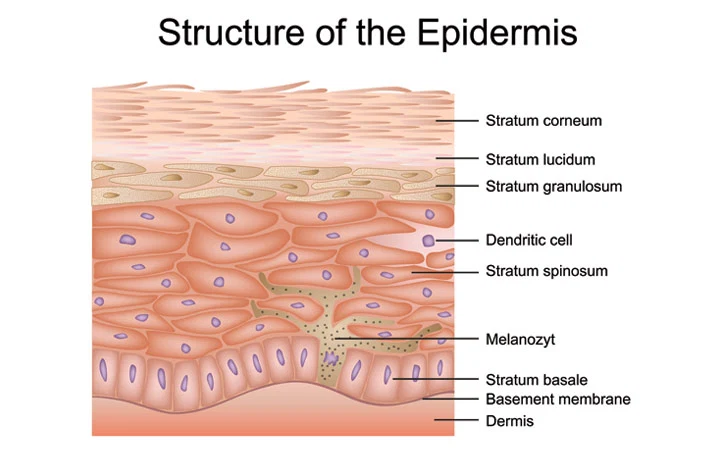
Stratum Corneum
• Outermost layer of the epidermis.
• Made mostly of dead, keratin-filled cells.
• Provides protection and helps prevent water loss.
• Cells are continuously shed and replaced.
Deep to Superificial
Stratum basale → Stratum spinosum → Stratum granulosum → Stratum lucidum → Stratum corneum*
Dermis
Layer of connective tissue located below the epidermis. Provides strength, support, and nourishment to the skin.
Papillary Layer
Superficial (upper) layer of the dermis.
• Made mainly of areolar connective tissue.
• Contains small blood vessels, nerves, and sensory receptors.
• Helps nourish the epidermis.
Dermal Papillae
• Finger-like projections of the papillary layer that extend into the epidermis.
• Increase contact between the dermis and epidermis.
• Contain blood vessels and sensory receptors.
• Help form fingerprints.
Reticular Layer
• Deeper and thicker layer of the dermis.
• Made mainly of dense irregular connective tissue.
• Contains collagen and elastic fibers.
• Provides the skin with strength and flexibility.
• Contains structures such as hair follicles, sweat glands, sebaceous glands, blood vessels, and nerves.
Hypodermis
• Structure: The hypodermis, also called the subcutaneous layer or superficial fascia, is located below the dermis. It is mainly made of areolar connective tissue and adipose tissue.
• Function: It anchors the skin to underlying tissues, provides insulation, cushioning/protection, and stores energy as fat.
• Important: The hypodermis is not technically part of the skin, but it lies directly underneath it.