LAB 6 ACETYLATION of FERROCENE:
 Call Kai
 Learn
 Practice Test
 Spaced Repetition
 Match
 Flashcards
 Knowt Play
1/23

There's no tags or description
Looks like no tags are added yet.
24 Terms
LAB 6 intro:
Ferrocene and column chromatography…
Electronic and steric effects that impac tthe mechanism of electrophilic aromatic substitution (EAS). THE EAS synthetic platform serves as an important stepping stone that transforms moleucles u find into pharmaceuticals..
IN THIS ACTIVITY: we explore the EAS REACTION and conduct a FRIEDEL = FRACTS ACYLATION on the first, highly characterized organometallic compound FERROCENE. (THIS IS LAB 6????).
ferrocene: superaromatic molecule.
10,000 more reactive toward electrophiles than benzene, makes it an excellent candidtate for friedel crafts acylations

DUE TO TRANSITION METAL CORE: GENERATES CHANGING COLORS THAT PROVIDE IMPORTANT VISUAL CLUE TO ADD IN A SEPERATION TECHNIQUE: COLUMN CHROMATOGRAPHY
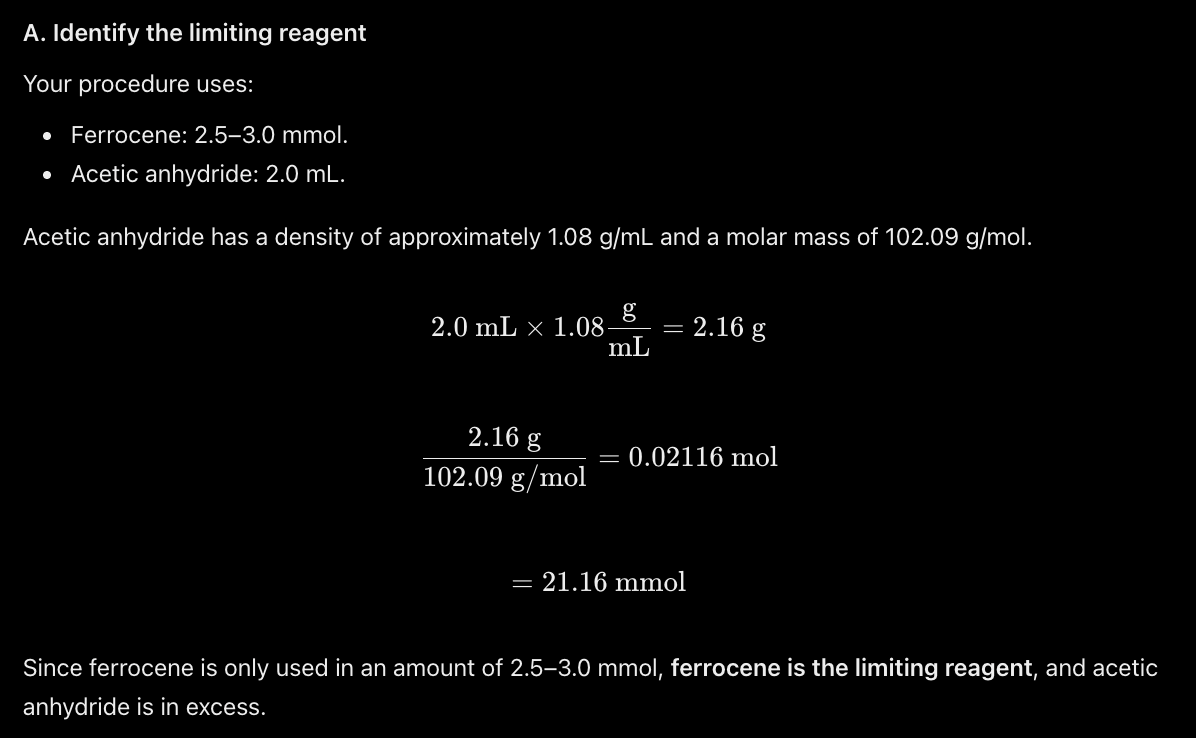
Identify and calculate the limiting reagent and determine the required masses of each reagent from a laboratory procedure.
Recognize where the most time-intensive steps are in an overall process to best plan the order and sequence of events in the lab.
Explain mechanistically how the acetylation of ferrocene is both an example of a Friedel-Crafts acylation and an Electrophilic Aromatic Substitution (EAS) reaction.
Compare the 1H NMR spectra of ferrocene and Benzene and explain why ferrocene is approximately 10,000 times more reactive than Benzene.
Demonstrate proper handling of moisture-sensitive reactions by maintaining dry glassware and preventing water contamination prior to neutralization.
Utilize TLC (visible and UV) and Rf values as a method for monitoring reaction progress and to determine if a multiproduct composition is formed (acetylferrocene and/or diacetylferrocene)
integrate the fundamental separation principles that apply to TLC (microscale) to column chromatography (macroscale).
).
Using safe laboratory practices, properly assemble, load, and perform a gradient elution (varying eluent compositions) with a chromatography column to macroscopically separate/purify a crude reaction mixture.
9/ Monitor compound separation using visual cues.
Confirm fraction purity and compound identity by analyzing eluent fractions using TLC (visible and UV) compared to known standards.
Combine known fractions to determine mass of isolated products, relative percentages, and overall reaction yields.
Confirm products by 1H NMR and melting points (when instructed
Electrophilic aromatic substitution (EAS) hinges on two core ideas:
aromatic ring acts as a nucleophile
substituants already on the ring influeen the rate and position of further substitution.
Columb chromotagraphy NEVER:
Once you have packed and introduced solvent into your column, never let the solvent level drop below the top of the stationary phase. This can happen easier than you think, and it is a sure-fire way of having to start all over.
Concept EAS:
hydrogen on ring is replaced by an electrophile!
principle: attack of the aromatic PI electrons on the electrophile in the RDS to form a resonance stabilized carbocation intermediate, (SIGMA COMPLEX AKA arenium ion) then a rapid loss of the proton to restore aromaticity

WHAT SPEEDS UP THESE RXNS: since the EAS is a cationic species, Electron donating groups tend to speed up these reactions since the activation energy barrier is lowered.
EDG: activating groups to EAS
CONVERSELY ELECTRON WITHDRAWING GROUPS: EWDS slow down these reactions as the aromatic ring initially more electron deficient. (DEACTIVATING GROUPS TO EAS).
-in EAS kinetic product usually prefered.
WHAT GROUPS ACTIVATE AND DE ACTIVATE EAS
Activate: EDG
Deactivate: EWD
(SPEED UP AND SLOW DOWN EAS RXN)
Where EAS electrophile will attach itself to the ring.
Arenium ion is not only a cationic intermediate but ALSO RESONANCE STABILIZED
ALlows functional groups that are already on the ring to influence the placement of the incoming electrophilic group.
ORTHO PARA DIRECTORS: For instance, groups that can inductively donate their sigma electrons (like alkyl groups) or their pi electrons via resonance, direct the electrophile to the ortho and para positions to lower the energy of the intermediate. These groups are categorized as ortho/para directors.
GROUPS that CANNOT participate in resonance donation, but can act as inductive and / or resonance withdrawes: direct the electrophile to the meta possition.. META DIRECTORS…

Note: This general scheme does not apply to halogens. Halogens are EWGs, but they are capable of donating pi electrons via resonace to the sigma complex. This makes them ortho/para directors.
CHAT:
1. Electron-donating groups (EDGs)
Ortho/para directors
EDGs donate electron density to the aromatic ring, making it more electron-rich and stabilizing the positively charged sigma complex.
They generally direct the incoming electrophile to:
- Ortho: adjacent to the existing group (1,2).
- Para: opposite the existing group (1,4).
Examples:
- –OH
- –OCH₃
- –NH₂
- –CH₃
2. Electron-withdrawing groups (EWGs)
Meta directors
EWGs pull electron density away from the aromatic ring, making it less reactive toward electrophiles.
They generally direct the incoming electrophile to:
- Meta: one carbon away from the adjacent position (1,3).
Examples:
- –NO₂
- –COOH
- –CHO
- –CN
- –SO₃H
3. The BIG exception: Halogens EWG but do the oppsoite and do ortho and para…
Halogens (F, Cl, Br, I) are:
- Electron-withdrawing → deactivate the ring.
- Ortho/para-directing → direct the incoming electrophile to ortho and para.
This is because they withdraw electron density inductively but can donate a lone pair through resonance.
Quick way to remember
Existing group Directing position
EDG, Ortho/para
EWG Meta
Halogens. Ortho/para (exception!)
One important distinction: Directing effects tell you WHERE the new group attaches. Activating/deactivating effects tell you HOW FAST the reaction occurs.
CONCEPT: Friedel -Crafts Acylation: (WILL KNOW FOR EXAM)
one of most important and widely used EAS reactions. may be considered one of the most historically important reactions that did not earn a Nobel Prize (Charles Friedel (France) was the principal investigator and died in 1899 - the first Nobel Prize in Chemistry was given in 1901).
IN THE REACTION an ACYL GROUP is introduced ONTO an aromatic ring, through the action of ACYLATING AGENT (usually using acid anhydride or acid chloride in the presnese of an acid cat).
An acyl group is a functional group in chemistry with the general formula R–C(=O)–, where a carbon atom is double-bonded to an oxygen atom (a carbonyl group) and single-bonded to an R group (such as an alkyl group, aryl group, or a hydrogen
IMPORTANT REACTION: allows u to place a carbonyl containing functional group DIRECTLY onto an aromatic system.. key synthetic stepping stone.
Traditionally friedel crafts acylation uses a strong lewis acid cat such as ALCL3 (alumninum chlroide) to create a highly reactive acylium ion electrophile from the acid anhydride or acid chloride. Lewis acid coordinates to the carbonyl oxygen, facilitating departure of the leaving group and formation of the resonance-stabilized acylium ion (R–C≡O⁺). This powerful electrophile is then attacked by the aromatic ring.
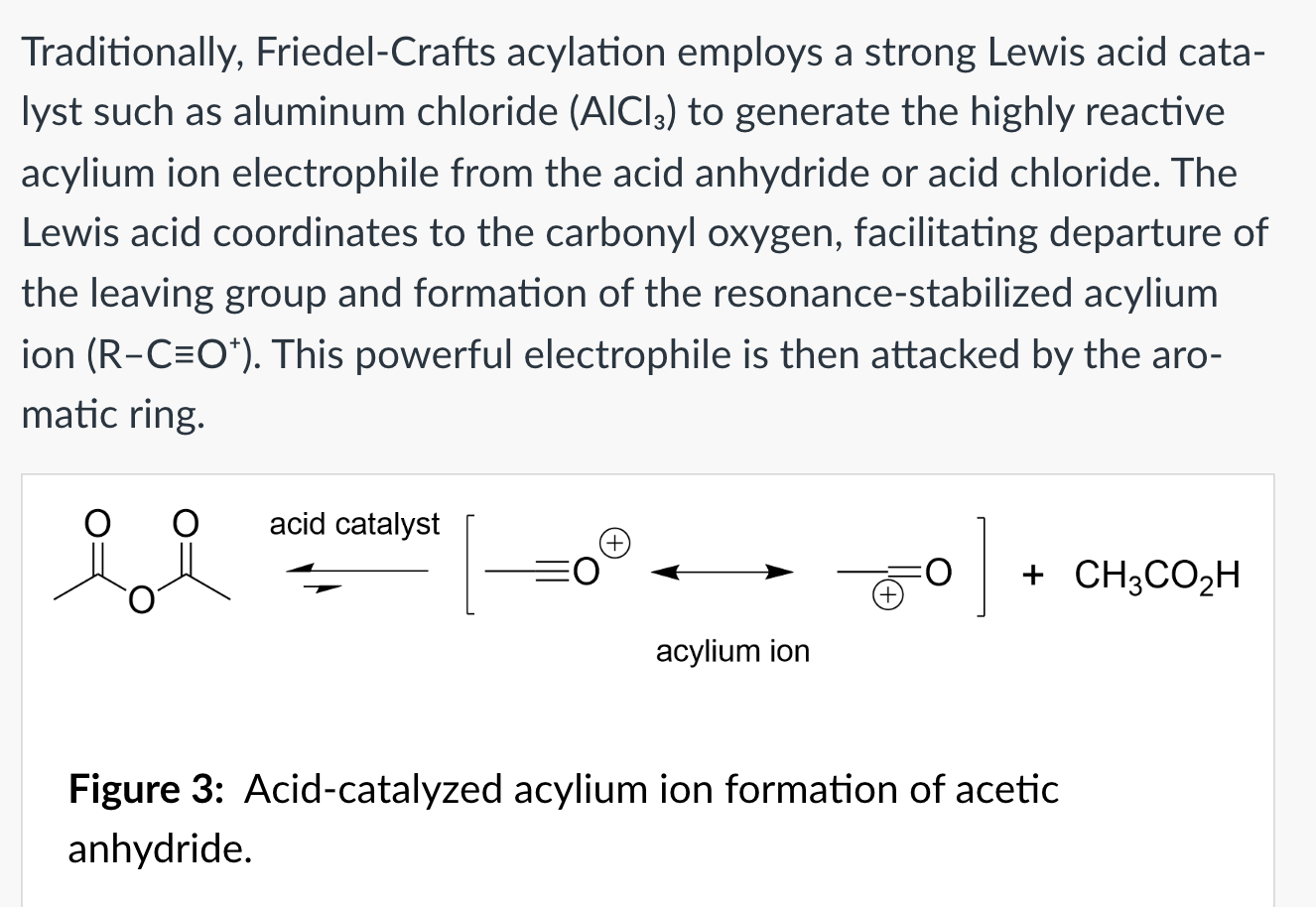
LEWIS ACID CAT DRAWBACKS IN LAB: hey are highly moisture-sensitive, generate large amounts of waste during workup, and can lead to side reactions and/or difficult purifications. In this activity, you will use a milder Brønsted acid catalyst—85% phosphoric acid (H₃PO₄) TO GEENERATE THE ACYLIUM ION FROM THE ACETIC ANHYDRIDE.
Phosphoric acid protonates the carbonyl oxygen of acetic anhydride, promoting loss of acetic acid and formation of the same acylium ion electrophile. You will need to describe this mechanism. This approach is safer, requires less stringent anhydrous conditions than AlCl₃, and produces easier-to-handle waste products.
CHAT:
main idea is to turn acetic anhydride in to a really reactive electrophile so that it can attach an acetyl group to ferrocene (electron rich molecule).
We are performing a Friedel-Crafts acylation, which is a type of electrophilic aromatic substitution (EAS).
Our goal is to attach an acetyl group (CH3CO-) to ferrocene.
acetic anhydride needs ot be activated b4 actning as electrophile effectivly. Activate NORMALLY through strong lewis acid called aluminum chloride, ALCL2 helps acetic anhydride beocme more reactive). AlCl₃ interacts with the oxygen of the carbonyl. This makes it easier for the leaving group to depart. An acylium ion forms. ACULIUM ION IS THE ELECTROPHILE…
use this instead of ALCL3 : Phosphoric acid is a Brønsted acid, meaning it donates a proton H+
Here's what happens:
1. Phosphoric acid donates H⁺ to the carbonyl oxygen of acetic anhydride.
2. Protonating the oxygen makes the anhydride more reactive.
3. Acetic acid leaves.
4. The acylium ion forms.
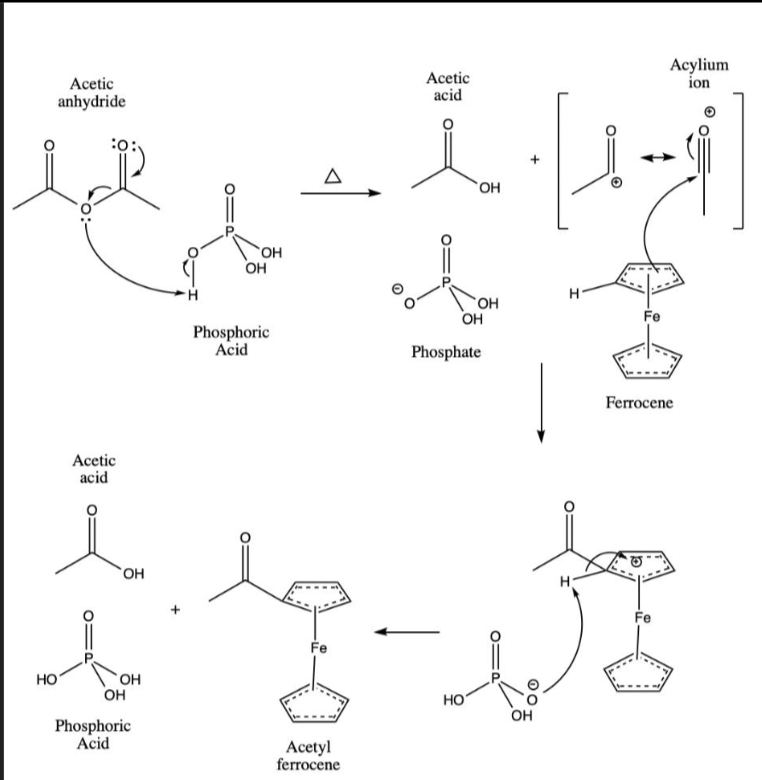
The important thing: Both AlCl₃ and phosphoric acid help generate the SAME electrophile: the acylium ion.
Now we have our electrophile!
Ferrocene is very electron-rich, so its aromatic rings can attack the positively charged acylium ion.
This starts the EAS mechanism:
1. Ferrocene's π electrons attack the acylium ion.
2. A sigma complex (arenium ion) forms.
3. A proton is removed.
4. Aromaticity is restored.
The result is acetylferrocene.

FERROCENE BACKGROUND:
accidental: isolation of a stable, light orang e crystalline solid. C10H10Fe. INTENSE COLOR AND REMARKABLE STABILITY TO AIR AND WATER.
FERROCENE IS A SANDWICH COMPLEX.
demonstrated that transition metals could form stable complexes with organic π-systems in ways previously unknown.

CONCEPT: column chromatography:
widely used purification tech: allows for the separation of individual components of a mixture based on differences in their polarity and interactions with the STATIONARY PHASE.
METHOD: solid absorbent such as silica gel or alumina packed into glass column, crude rxn mixture loaded on top. A soluble solvent (mobile phase) is then passed through the column, carrying the compounds downward at diff rates depending on how strongly they absorb to the stationary phase…
NOTE: less polar compounds travel faster and elute first, MORE POLAR COMPOUNDS are retained longer and elute later.
(macrocale verison of layer chromatography (TLC), just running in the opposite direction (gravity vs capillary action)
TLC: quick analysis and monitoring reaction progress.
Column chromatography: applies the same fundamental principles on a larger scale, enabling you to physically collect and isolate the separated compounds in pure form
good for purifying reaction products after a synthesis.
we used it to seperate yellow unreacted ferrocen, the orange monoacetylferrocene and red acetylferrocen prodced during the freidel crafts acylation.
By employing a gradient elution—starting with nonpolar hexane and gradually increasing the polarity with ethyl acetate—you take advantage of the same polarity differences you will observe when running a TLC plate
In industry, column chromatography (often called flash chromatography when automated) is essential for purifying pharmaceuticals, natural products, fine chemicals, and advanced materials on both research and production scales. Modern industrial versions use automated systems with UV detectors and larger columns, but the core principle remains identical to the manual technique you will perform - differential adsorption based on the polarity of a mobile phase.
CHAT GPT NOTE:
The silica gel is the stationary phase. It stays inside the column.
The solvents are the mobile phase. They travel down the column and carry the compounds with them.
Here's the key:
- Ferrocene is least polar, so it interacts weakly with silica and travels fastest.
- Acetylferrocene is more polar, so it interacts more strongly and travels slower.
- Diacetylferrocene is most polar, so it interacts most strongly and travels slowest.
why hexane first that ethyl acetate: we are changing the polarity of the solvent a the experiment progresses. HEXAN is non polar and ethyl aacetate is more polar. so hexan will move the least polar compound, ferrocene down first, then Increasing ethyl acetate makes the solvent better at competing with the compounds for interactions with silica.This helps move the more strongly retained compounds, acetylferrocene and diacetylferrocene, down the column.’
We start with a weak solvent to move the least polar compound first. Then we gradually use a stronger, more polar solvent to move the compounds that are sticking more strongly to the silica.
How does this PURIFY THE COMPOUNDS:
Let's say you put your crude mixture (EVERYTHING TOGETHER) into the column.
Initially, all three compounds are mixed together.
As the solvent moves down the column, they travel at different speeds. (due to their different polarities).
Eventually, they separate into distinct bands.
As each band exits the bottom of the column, you collect it in a separate container.
These collected portions are called fractions.
in this case:
deally, you end up with:
- Fraction 1: Ferrocene
- Fraction 2: Acetylferrocene
- Fraction 3: Diacetylferrocene
Instead of having all three compounds mixed together, you now have separate collections containing individual compounds.
THAT is purification! You're physically separating the compounds from one another.
TLC is an analytical technique not a purification technique.
In your Lab 6, you actually use BOTH!
1. Column chromatography separates the crude reaction mixture.
2. You collect the fractions.
3. TLC tests those fractions to determine whether they contain one compound or multiple compounds.
4. You can combine fractions that contain the same pure compound.
5. You determine the mass and calculate the yield.
TLC tests those fractions to determine whether they contain one compound or multiple compounds.
TLC does this by showing you how many separate spots appear on the TLC plate after you test a fraction.
Let's say you collect a fraction from your column and want to see whether it contains only acetylferrocene or is mixed with something else.
1. Put a tiny drop of that fraction onto the TLC plate.
2. Put the plate in a chamber containing the solvent (mobile phase).
3. The solvent travels up the plate, carrying the compounds with it.
4. Different compounds travel different distances because they interact differently with the polar silica.
How to interpret the result: If the fraction produces one spot, that suggests it contains one compound. If the fraction produces two or more spots, that indicates it contains multiple compounds.
Reaction scheme for lab 6

LAB 6 PROCEDURE:
NEVER:Caution
Never allow the volume of solvent in the column to go below the top of the adsorbent while packing the column. If the top of the adsorbent dries out, channels can form in the packing material that will result in poor separation.
As you gain more confidence with the apparatus you will want to speed up the process by “flashing the column”. This is where you will add air pressure to the top of the column. Fill a provided syringe (equipped with o-ring) with air and then place the tip inside the top of the column. Using your other hand, lightly grip near the center of the column with 3 fingers. Provide a slight upwards force on the column to match the downward force that you apply to the syringe. If you don’t balance the forces, the column could slip through the clamp. Just be careful. Slowly push a syringe full of air into the column. This should increase the rate of solvent flow.
CANNOT LET THE COLUMN GO DRY: We cannot let the column go dry because the silica gel can develop channels or cracks when it dries out.
Here's why that matters:
1. The silica gel needs to remain evenly packed and wet with solvent.
2. If the top of the silica dries, air pockets or channels can form in the silica bed.
3. When you add solvent again, it may flow through those channels instead of evenly through the silica.
4. This means your compounds won't interact consistently with the stationary phase, resulting in poor separation.
1. Perform the acetylation reaction
1. Make sure all glassware is dry.
- Why? Moisture can interfere with the reaction because acetic anhydride is moisture-sensitive.
2. Combine ferrocene, acetic anhydride, and phosphoric acid.
- Acetic anhydride supplies the acetyl group.
- Phosphoric acid activates the acetic anhydride and helps generate the electrophile needed for Friedel-Crafts acylation.
3. Heat the reaction in a hot water bath.
- Why? Heating helps the reaction proceed and allows the ferrocene to dissolve and react.
4. Cool the reaction in ice, then pour it over ice.
- Why? Cooling stops/slows the reaction and helps quench excess reactive material.
5. Neutralize the remaining acids with NaOH, checking with pH paper.
- Why? Neutralizes residual phosphoric acid and acetic acid.
6. Collect the crude product using vacuum filtration and rinse with cold water.
- Why? Vacuum filtration separates the solid product from the liquid. Cold water removes soluble acids and other water-soluble impurities while minimizing product loss.
7. Dry the product as much as possible, weigh the crude product, and cover it with parafilm.
- The crude product is the mixture before chromatographic purification.
2. Monitor the reaction using TLC
1. Dissolve a small amount of crude product in solvent.
why do we cover it in parafilm??
We cover the beaker with Parafilm to prevent contamination and minimize exposure to air and moisture while the crude product is being stored until the next lab session.
2. Prepare a TLC plate with three lanes:
- F: Ferrocene reference.
- P: Crude product.
- C: Co-spot (ferrocene reference + crude product).
3. Develop the plate using 4:1 hexane/ethyl acetate.
4. Visualize under visible light and UV, then calculate Rf values.
Why? TLC tells you whether unreacted ferrocene remains and whether the reaction produced multiple compounds, such as acetylferrocene and diacetylferrocene.
3. Prepare the column
1. Place a small cotton plug in a Pasteur pipette.
- Why? Prevents silica gel from escaping through the bottom.
2. Add silica gel and gently pack it evenly.
- Why? Silica is the polar stationary phase that separates the compounds based on their interactions with it.
3. Add hexane to wet the silica.
- Why? Prepares the column for separation and prevents the silica from drying out.
Important
Never let the silica gel dry or introduce water into the column. Drying can cause channels and poor separation.
4. Load the crude product and separate the compounds
1. Carefully load the crude product solution onto the top of the silica.
2. Rinse the pipette walls with hexane to transfer remaining sample onto the column.
3. Start with hexane and gradually change to more polar solvents.
Solvent Compound eluted Color
Pure hexane Ferrocene Yellow
70:30 hexane/ethyl acetate Acetylferrocene Orange
Pure ethyl acetate Diacetylferrocene Re
Why change the solvent?
Silica is polar. Less polar compounds interact less strongly with it and elute first. More polar compounds interact more strongly and require a more polar mobile phase to move through the column.
This is called gradient elution: gradually increasing the polarity of the mobile phase to elute compounds with different polarities.
5. Collect and check the fractions
Collect each colored fraction separately.
Use TLC to analyze all three fractions on one plate.
Compare the spots to determine whether each fraction contains one compound or multiple compounds.
Only combine fractions that contain the same compound and are sufficiently pure.
Why? The column separates the compounds, but TLC verifies whether the separation was successful.
6. Recover and characterize the products
Transfer the compound-containing fractions to watch glasses.
Allow the solvent to evaporate in the fume hood.
Record the isolated product masses.
Obtain melting points and IR/NMR spectra as instructed.
Why? These measurements help identify and characterize the isolated products and assess their purity.
EC: MECH

The acetylation of ferrocene is both a Friedel-Crafts acylation and an electrophilic aromatic substitution (EAS) reaction. Draw the complete mechanism for the formation of the acylium ion electrophile from acetic anhydride and phosphoric acid, and then show the step-by-step EAS mechanism leading to acetylferrocene (include all resonance structures of the sigma complex).
Ferrocene is approximately 10,000 times more reactive than benzene toward electrophilic aromatic substitution. Using 1H NMR chemical shift data or structural features, explain why the cyclopentadienyl rings in ferrocene are so much more electron-rich and therefore more reactive than the ring in benzene.
During column chromatography, you performed a gradient elution (pure hexane → 70:30 hexane/ethyl acetate → pure ethyl acetate). Explain, in terms of polarity, why ferrocene elutes first (yellow band), acetylferrocene second (orange band), and diacetylferrocene last (red band, if formed).
TLC analysis (visible and UV) was used both to monitor the crude reaction mixture and to check the purity of collected column fractions. What Rf values would you expect for ferrocene versus acetylferrocene in 4:1 hexane/ethyl acetate, and how does the presence/absence of multiple spots confirm successful (or unsuccessful) separation?
Soap formation is not an issue in this reaction, as was the case in the Biodiesel activity, but moisture contamination before neutralization can reduce yield. Explain what side reaction can occur if water enters the mixture prior to workup, and describe how the procedure minimizes this problem.
Calculate the percent yield of acetylferrocene (and diacetylferrocene if isolated) based on your actual masses obtained. Identify the limiting reagent and discuss one major source of product loss observed in your experiment.
hh
j
The solvent polarity increases throughout the experiment:
Pure hexane — nonpolar.
70:30 hexane/ethyl acetate — more polar.
Pure ethyl acetate — most polar of the three.
The compounds elute in order of increasing polarity: Exam takeaway: Less polar compounds elute first; more polar compounds are retained longer by polar silica and require a more polar solvent to elute.
1. Ferrocene — yellow
Least polar. Interacts weakly with polar silica, so it travels through the column first using nonpolar hexane.
Acetylferrocene | 1271-55-2 | TCI (Shanghai) Development Co., Ltd.
2. Acetylferrocene — orange
More polar because of its carbonyl group. Interacts more strongly with silica, so it requires the more polar 70:30 hexane/ethyl acetate mixture.
1,1'-Diacetylferrocene | 1273-94-5 | Tokyo Chemical Industry Co., Ltd.(JP)
3. Diacetylferrocene — red
Most polar because it has two carbonyl-containing acetyl groups. Interacts most strongly with silica, requiring pure ethyl acetate to elute
.
In a 4:1 hexane/ethyl acetate solvent system, ferrocene is expected to have a higher Rf value than acetylferrocene.
Ferrocene: Higher Rf because it is less polar and interacts weakly with the polar silica stationary phase, allowing it to travel farther up the TLC plate.
Acetylferrocene: Lower Rf because its carbonyl group makes it more polar, causing stronger interactions with silica and limiting how far it travels.
How TLC confirms separation:
One spot in a fraction: Suggests that the fraction contains one compound and is relatively pure.
Multiple spots in a fraction: Indicates that multiple compounds are present, meaning separation was incomplete.
Different fractions with distinct single spots: Suggest successful separation of the compounds.
Exam takeaway: Ferrocene travels farther and has a higher Rf than acetylferrocene. A single spot suggests purity, while multiple spots indicate a mixture.
Water can react with and hydrolyze acetic anhydride:
\[ \mathrm{(CH_3CO)_2O+H_2O\rightarrow 2CH_3COOH} \]
This is a problem because acetic anhydride is the reagent that supplies the acetyl group.
If water enters the reaction:
Some acetic anhydride is consumed by hydrolysis.
Less acetic anhydride remains available to generate the acylium ion.
Less electrophile may be available to react with ferrocene.
The amount of desired product can decrease, lowering the yield.
How does the procedure prevent this?
It requires dry glassware.
It warns against introducing water before neutralization.
Water is intentionally introduced only after the reaction has been completed and cooled, during the workup.
Exam takeaway: Water hydrolyzes acetic anhydride into acetic acid, consuming the acetylating reagent and potentially reducing product yield.
percent yield, limiting reagent, and product loss