BIO120 TEST #2 (9-15) UofT
 Call Kai
 Learn
 Practice Test
 Spaced Repetition
 Match
 Flashcards
 Knowt Play
1/88

There's no tags or description
Looks like no tags are added yet.
89 Terms
Vertebrate eyes are incredibly complex structures. For a vertebrate eye to function properly, there needs to be a lens, a retina, muscles, and many other interacting components. Which of the following does NOT provide evidence for how these complex structures were able to evolve?
a. Some animals have very simple colour and light receptors
b. These are analogous similarities between Octopus eyes and vertebrae eyes
c. The light sensitive protein Rhodopsin is present in some bacteria
d. Some invertebrate species have retinas but no lens
b. These are analogous similarities between Octopus eyes and vertebrae eyes
Which of the following pieces of evidence for evolution were not yet known by Darwin & Wallace, but support the theory of evolution?
a. Evidence of phenotypic changes occurring in response to artificial selection
b. Evidence of homology between structures of living species
c. Evidence of neutral changes in allele frequency due to genetic drift
d. Evidence of phenotypic changes occurring in response to artificial selection
c. Evidence of neutral change in allele frequency due to genetic drift
In eusocial bee colonies, the worker bees are not able to reproduce and therefore are not directly subject to natural selection because they do not pass on heritable variation. How could these specialized workers have evolved?
a. Adaptations that evolve in the reproductive individuals are transmitted via horizontal gene transfer to the workers
b. The worker genes are still passed on to the next generation because the workers are closely related to the queen
c. The workers are a result of some individuals in each generation developing mutations that reduce the reproductive ability
d. The worker is simply a result of phenotypic plasticity, with workers and queens frequently changing between non-reproductive and reproductive tasks
b. The worker genes are still passed on to the next generation because the workers are closely related to the queen
Which of the following statements about evolution is MOST accurate?
a. Evolution is non-directed, and can even lead to adaptations that are deferential in certain environments
b. Evolution does not explain why parasites are able to evolve even when they are dependent on their hosts
c. Evolution always proceeds from less complex to more complex adaptation
d. Evolution can explain all variation in human social behaviour
a. Evolution is non-directed, and can even lead to adaptations that are deferential in certain environments
Aging has many detrimental effects to the bodies of most multicellular organisms. How can aging persist when it decreases survival, knowing what we know about natural selection?
a. Aging persists because it provides a selective advantage for the group by reducing competition between individuals
b. By slowing down an animal's ability to disperse, aging persists by reducing the incidence of accidental death and new diseases entering a population
c. Aging persists because it prevents the overproduction of unfit offspring from any one individual in a population
d. Ageing persists because genetic variants that reduce fitness later in life are retained when there are also variants that increase reproductive ability earlier in life
d. Ageing persists because genetic variants that reduce fitness later in life are retained when there are also variants that increase reproductive ability earlier in life
Which of the following statements BEST describe the evolution of complex adaptations?
a. The evolution of complex adaptations is a result of small improvements in simpler adaptations over a long period of time
b. The evolution of complex adaptations suggests a directed design process in their formation
c. The evolution of complex adaptations is not compatible with our current understanding of evolutionary theory
d. Complex adaptations are not present in single-celled organisms such as bacteria
a. The evolution of complex adaptations is a result of small improvements on simpler adaptations over a long period of time
Recent shifts from salt marsh vegetation to mangrove dominance indicate that mangrove trees are limited by:
a. Competition
b. All of the above
c. Geographic barriers
d. Temperature
d. Temperature
If a transplant experiment shows that a species can live and reproduce beyond its current range, what is limiting the species' present distribution?
a. Pests
b Dispersal
c. Temperature
d. Competition
b. Dispersal
Which of the following statements best explains why some introduction experiments have had harmful results, but not others?
a. Some species do not have predators or competition in the introduced range
b. Many introduced species are agricultural crops or domesticated animals
c. Humans are unable to actively manage all introduced species
d. Most introductions involve too many individuals to be harmful
a. Some species do not have predators or competition in the introduced range
If the expression of a trait is a fitness trade-off, this is typically because:
a. The population size is too small
b. There is no genetic basis for the trait
c. The trait is not under selection
d. The trait is advantageous for some aspects of fitness but disadvantageous for another
d. The trait is advantageous for some aspect of fitness, but disadvantageous for another
Why do arid environments, such as deserts and grasslands, tend to occur on the leeward side of mountain ranges?
a. Mountain ranges force warm, moist, coastal air to rise and cool, causing most of the moisture in the air to have been lost to precipitation by the time the air mass crosses the range and descends on the leeward side
b. Moisture tends to evaporate from the windward side of the mountain and rise to the upper atmosphere, rendering it unavailable to regions on the leeward side
c. Most mountains are found around 59° latitude, and here they disrupt the movement of air from the tropics to temperate regions, causing dry air to descent from the upper atmosphere
d. Dry air masses travelling across continents towards mountain ranges absorb any available moisture from the ground
a. Mountain ranges force warm, moist, coastal air to rise and cool, causing most of the moisture in the air to have been lost to precipitation by the time the air mass crosses the range and descends on the leeward side
If you have watched the weather forecast on television, you may have noticed that storms spin as they travel. This is due to the Coriolis effect, which itself is caused by:
a. The combined effects of the gravitational forces exerted by the Moon and the Sun and the rotation of Earth
b. Differences in temperatures between the poles and the equator
c. Interactions between prevailing winds and ocean currents
d. Earth is spinning around on its own axis and spins faster around the equator compared to the poles
d. Earth is spinning around on its own axis and spins faster around the equator compared to the poles
Stockholm, Sweden and Whitehorse, Yukon, are located on almost exactly the same latitude (59° N compared to 60 ° N - for a comparison, Toronto is at 44° N, the same as Nice on the French Riviera). Yet, the mean temperature in January in Stockholm is 12° C warmer than Whitehorse. What is the main reason for this?
a. There is less precipitation in Stockholm
b. The Gulf Stream
c. Yukon has lower air pollution than Stockholm
d. Stockholm is at a higher elevation
b. The Gulf Stream
Which of the following observations is a consequence of the 23.5° tilt of Earth's axis?
a. The lack of major temperature fluctuations in coastal regions compared to continental interior regions
b. Trade winds blowing from northeast to southwest rather than north to south
c. The greater receipt of solar input in temperate regions than in the tropics
d. The occurrence of winter in the Northern hemisphere during the months of November through February
d. The occurrence of winter in the Northern hemisphere during the months of November through February
Pictured are four different species of the genus Lepus. Based on Allen's rule, which would you expect to live in the Arizona desert?
a.
b.
c.
d.
d.

Why are large organisms made up of many small cells rather than one single one?
a. Large cells would be too vulnerable to infectious diseases
b. Large cells would have too low of a surface area to volume ratio.
c. Single cell organisms can only live in water
d. If cells become very large, the genome would have to be bigger too, increasing the mutation load
b. Large cells would have too low of a surface area to volume ratio.
What are the Big Two factors limiting terrestrial species distributions?
a. Precipitation and salinity
b. Temperature and precipitation
c. pH and precipitation
d. Temperature and salinity
b. Temperature and precipitation
What is NOT an adaptation for desert plants?
a. Thick waxy cuticle covering the epidermis
b. Increased numbers of stomata
c. Reduced surface area of the leaves
d. CAM physiology
b. Increased numbers of stomata
You decide to monitor the core body temperature of your pet cat and your pet lizard several times daily over the course of the year. When you plot temperature against time, you expect to find that:
a. The average body temperature of your lizard is warmer than that of your cat
b. Your cat's body reaches a cooler temperature than does your lizard's body
c. The body temperature of your lizard fluctuates more than that of your cat
d. There is no major difference in the body temperature of your two pets
c. The body temperature of your lizard fluctuates more than that of your cat
Which environmental conditions are most favourable for ectothermy?
a. Low temperatures and high environmental stochasticity
b. Warm temperatures and low environmental stochasticity
c. Warm temperatures and high environmental stochasticity
d. Low temperatures and low environmental stochasticity
b. Warm temperatures and low environmental stochasticity
A(n) ______________ uses natural variation to investigate the association between one factor and another.
correlational study
You observe that a species of the plant seems to grow better in the shady part of your garden than in the sunny part. In spring, you grow some plants of this species in the shady part and the same number of plants in the sunny part. After 12 weeks, you measure the height of all the plants. What is your hypothesis?
a. There is no significant difference in plant height between plants grown in shade and plants grown in the sun
b. There is a significant difference in plant height between plants grown in the shade and plants grown in the sun
c. Plants grown in the shade are shorter than plants grown in the sun
d. Plants grown in the sun are taller than plants grown in the shade
b. There is a significant difference in plant height between plants grown in the shade and plants grown in the sun
The figure below shows two environments (A and B). Two genotypes (X1 and X2) were measured for height in different environments. Based on the figure below, what is causing variation in height? (Look at last graph in notebook)
a. There is no phenotypic variation (i.e., there is no variation in height)
b. Genetic variation
c. Interaction between genetic and environmental variation
d. Environmental variation
c. Interaction between genetic and environmental variation
Both male and female Phymata americana stridulate
a. True
b. False
a. True
You should always start at the ____________ objective lens when viewing a slide under a compound microscope
Lowest
Which of the following is NOT an example of a plant defense?
a. Secondary metabolites
b. Moving resources from roots to shoots following herbivory
c. Flowering when herbivores are least abundant
d. Prickles
b. Moving resources from roots to shoots following herbivory
In competition, what is the effect of the interaction for both species?
a. It is negative for one species and positive for the other species
b. It is negative for both species
c. It is positive for both species
d. It is positive for one species and has no net effect on the other species
b. It is negative for both species
Why do you add the potassium phosphate buffer when you are preparing your leaf sample for the chemical assay?
a. It breaks the chloroplast membrane and releases polyphenol oxidase (PPO) into the cytosol of the plant cell.
b. It absorbs phenols so it prevents PPO from interacting with other phenols.
c. It acts as a substrate to react with PPO to produce quinones
d. It keeps the pH of the solution constant
d. It keeps the pH of the solution constant
The number of trees in a forest is a discrete measurement.
a. True
b. False
a. True
The mode is the most common or frequent value in a set of values.
a. True
b. False
a. True
Lack of interbreeding is called:
Reproductive isolation
The tendency of populations of the same species to differ according to their geographical location, often in ways that are clearly adaptive:
Geographical variation
What is in the pre-zygotic RI barriers
a. Development and growth of zygote (FI) and Fertilization
b. Adult survival & reproduction (F1) and finding a compatible mate and mating
c. Finding a compatible mate & mating and fertilization
d. Development & and growth of zygote (F1) and Adult survival and reproduction (F1)
c. Finding a compatible mate & mating and fertilization
A student counted the number of leaves on Impatiens plants grown
under sun and shade conditions. The table on the right shows data
for 10 suns and 10 shade plants. They would like to know if there is
a significant difference in leaf number between sun and shade
plants. Based on the table on the right, which of the following
statements is CORRECT?
a. The mode for shade plants is 32 leaves.
b. The data should be analyzed using a chi-square test.
c. If they run a Student's t-test and obtain a calculated t-value
of 5.54, and a critical t-value of 2.10, there is a significant
difference between sun and shade plants.
d. The null hypothesis is that there is a significant difference
between the mean number of leaves in sun and shade plants.
c. If they run a Student's t-test and obtain a calculated t-value of 5.54, and a critical t-value of 2.10, there is a significant difference between sun and shade plants.

Based on the material you covered in Lab 1, which of the following statements is CORRECT?
a. Insects that exhibit complete metamorphosis have adults and juveniles of very differing appearance
b. Beetles exhibit incomplete metamorphosis
c. Insects that exhibit complete metamorphosis are less abundant than insects that exhibit incomplete metamorphosis.
d. Adults and juveniles of insects that exhibit incomplete metamorphosis use different resources
a. Insects that exhibit complete metamorphosis have adults and juveniles of very differing appearance
Which of the following statements concerning the Brandt and Mahsberg (2002) study on West African assassin bug nymphs is CORRECT?
a. The "backpack" attracts other ant workers, acting as bait for prey
b. Nymphs with "backpacks" remained alive significantly longer than naked nymphs when exposed to spiders
c. The study's results suggest that only the "backpacks" have a function and suggest no function for the dust coat
d. Naked nymphs were significantly less likely to be attacked by army ants than nymphs with a dust coat and/or "backpack"
b. Nymphs with "backpacks" remained alive significantly longer than naked nymphs when exposed to spiders
What is the BEST definition of phenotypic plasticity?
a. One phenotype that is produced by various genotypes in response to changes in its environment
b. A phenotype that can respond in the next generation to changes in its current environment
c. A phenotype that is capable of change
d. One genotype that can produce various phenotypes in response to different environments
d. One genotype that can produce various phenotypes in response to different environments
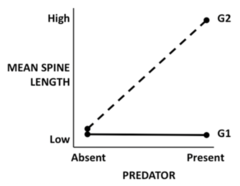
A species of water flea has a spine on its head. Its length is controlled by a single locus. Waterfleas that had different genotypes (G1 and G2) at the spine length locus were grown in two different environments (with and without a predator) and the length of their spine was measured after one week. The results are shown in the graph to the right. Which statement is the BEST interpretation of these results?
a. Individuals with G2 have greater plasticity in spine length than individuals with G1.
b. Individuals with G1 have longer spines in the presence of predators than in the absence of predators.
c. There was very little difference in mean spine length between individuals of the two genotypes when predators were present.
d. For individuals of both genotypes, the length of spines is determined by environment only.
a. Individuals with G2 have greater plasticity in spine length than individuals with G1.

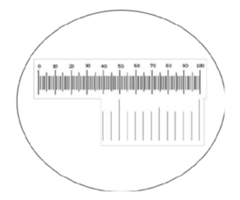
You are calibrating the ocular scale on a compound microscope. Below is what you see in the field of view. The top scale is the ocular scale. The bottom scale is the stage micrometre. The distance between the two tallest lines on the stage micrometre is 1 mm. What is the length of one ocular unit in millimetres (mm)?
a. 1/100 mm
b. 1/50 mm
c. 1/60 mm
d. 1/100 mm only if the microscope is at 4x magnification
a. 1/100 mm
A researcher wants to know if warming oceans will affect blue whale populations. She designs an experiment to test the relationship between blue whale birth rates and ocean temperatures. She predicts that blue whales will have lower birth rates in warmer oceans. What is her null hypothesis?
a. Ocean temperature is positively correlated with blue whale birth rates.
b. Ocean temperature has no effect on blue whale birth rates.
c. Blue whale birth rates decrease in warmer oceans.
d. Ocean temperature has an effect on blue whale birth rates.
a. Ocean temperature is positively correlated with blue whale birth rates
Lecture 15 developed an argument that the evolution of the weasel body is governed by a particular tradeoff. In that argument, what two factors or processes are trading off with each other?
a. Thermoregulation versus hunting proficiency
b. Thermoregulation in hot environments versus thermoregulation in cold environments
c. Body mass versus surface area
d. Surface area versus body fat
a. Thermoregulation versus hunting proficiency
Suppose that you could enlarge an organism without changing its proportions; that is, it would retain the same shape and the same composition. If you enlarged it so that its mass doubled, what would happen to its surface-area-to-volume ratio?
a. It would be unchanged
b. It would decrease
c. It would increase, but by less than a factor of 2
d. It would increase, but by more than a factor of 2
b. It would decrease
Ecologists call all the zebras, elephants, giraffes, plants, and insects living together in a savanna a:
a. population
b. community
c. ecosystem
d. biome
b. community
Which of the following factors could explain why a species has a smaller range distribution than is predicted using ecological niche modelling?
a. The model does not account for biological interactions
b. The species is highly specialized on an animal host that has a restricted distribution
c. The species is a recently introduced biological invader
d. All of the above
d. All of the above
Which of the following conditions would lead to the greatest loss of heat from an animal to its environment?
a. Blood flowing in a countercurrent direction
b. High surface-to-volume ratio in the extremities
c. Having a low metabolic rate
d. Possessing adjustable insulation
b. High surface-to-volume ration in the extremities
What typically is the air in the intertropical convergence zone (ITCZ)?
a. Sinking
b. Rather stationary
c. Rising and sinking at equal rate
d. Rising
d. Rising
In Lecture 14, Prof. Frederickson showed the image below. In the right-hand panel, data are represented by a red ribbon-like shape of varying width. Which of the following is a TRUE statement about this graph?
a. The width of the ribbon represents variation in latitude.
b. The graph shows that temperatures in the northern hemisphere are more variable than in the southern hemisphere.
c. The ribbon is wider in the "roaring forties" than in the corresponding latitude in the northern hemisphere.
d. The graph shows how the Intertropical Convergence Zone moves in different amounts at different latitudes.
d. The graph shows how the Intertropical Convergence Zone moves in different amounts at different latitudes

Which of the following comparisons of latitudinal features is TRUE?
a. The Intertropical Convergence Zone is located further to the north in January than it is in July.
b. Westerly winds prevail around 40 degrees north latitude, but in the southern hemisphere, the equivalent latitude (40 degrees south) is characterized by the easterlies ("the roaring forties").
c. The doldrums and the horse latitudes share the characteristic of having weak, inconstant, and unreliable winds.
d. The Coriolis Effect works in opposite directions in the northern and southern hemispheres, causing easterly trade winds north of the equator and westerly trade winds south of the equator.
d. The Coriolis Effect works in opposite directions in the northern and southern hemispheres, causing easterly trade winds north of the equator and westerly trade winds south of the equator
Select the graph (a through d below) that BEST corresponds to the relationship that you would expect between latitude on the x-axis (from 60 degrees north to 60 degrees south) and the surface area to volume ratio (SA/V) of mammals as expected under Bergmann's rule on the y-axis.
a.

Which rule explains why a house sparrow that we see in Toronto is bigger than a house sparrow found in Florida?
a. Gloger's Rule
b. Allen's Rule
c. Bergmann's Rule
d. Frederickson's Rule
b. Bergmann's Rule
Based on the material you covered in Lab 1, which of the following statements is CORRECT?
a. Insects that exhibit complete metamorphosis have adults and juveniles of very differing appearances.
b. Adults and juveniles of insects that exhibit incomplete metamorphosis use different resources.
c. Beetles exhibit incomplete metamorphosis
d. Insects that exhibit complete metamorphosis are less abundant than insects that exhibit incomplete metamorphosis.
a. Insects that exhibit complete metamorphosis have adults and juveniles of very differing appearance.
The chapter of Why Ecology Matters that was assigned as required reading for Lecture 13 explains that ecologists test what limits a species' distribution using transplant experiments. Successful transplants indicate that a species distribution is limited by:
a. Competition
b. Climate
c. Dispersal
d. Nutrients
c. Dispersal
Wellington, the capital of New Zealand, is located at roughly 40°S in latitude. Auckland, New Zealand's most populous city, is located at 36°S in latitude. Wellington is almost directly south of Auckland (i.e., they are close in longitude). Fill in the blanks in this sentence: As the Earth spins on its axis, Wellington is moving more ___ (slowly/quickly) than Auckland, causing an air mass travelling directly south of Auckland to pass ______ (east/west) of Wellington.
a. quickly, east
b. slowly, west
c. slowly, east
d. quickly, west
c. slowly, east
Based on what you learned in Lab 1, what explains why these four insect orders - beetles (Coleoptera), true flies (Diptera), butterflies and moths (Lepidoptera), and bees, ants and wasps (Hymenoptera) - are the most diverse and abundant insect orders?
a. These insects exhibit complete metamorphosis, which means their juvenile and adult stages have different predators and therefore less predation overall.
b. These insects exhibit complete metamorphosis, which means their juvenile stages do not compete for the same resources as the adult stages.
c. These insects can all act as pollinators and co-evolve with plants
d. These insects exhibit incomplete metamorphosis, which requires less energy for growth and development than complete metamorphosis.
b. These insects exhibit complete metamorphosis, which means their juvenile stages do not compete for the same resources as the adult stages.
Which atmospheric circulation cells are directly involved in forming tropical rainforests?
a. Ferrell Cells
b. Eukaryotic Cells
c. Polar Cells
d. Hadley Cells
d. Hadley Cells
If you cool down by jumping in a swimming pool on a hot summer's day, this is an example of heat loss by:
a. Convection
b. Conduction
c. Redistribution
d. Radiation
a. Convection
According to Why Ecology Matters, why do penguins not live in the Arctic?
a. Other species (e.g., predators, parasites, or pathogens) prevent penguins from colonizing the Arctic.
b. The climate in the Arctic is not suitable for penguins
c. Penguins do not recognize the Arctic as a suitable habitat
d. The tropical oceans limit their dispersal
d. The tropical oceans limit their dispersal.
What is the BEST definition of phenotypic plasticity?
a. A phenotype that can respond in the next generation to changes in its current environment.
b. One genotype that can produce various phenotypes in response to different environments.
c. A phenotype that is capable of change
d. One phenotype that is produced by various genotypes in response to changes in its environment
b. One genotype that can produce various phenotypes in response to different environments.
In Lab 2, you measured the leaf thickness of Impatiens plants grown in the sun and shade. Imagine that you took these sun and shade Impatiens plants and grew them outdoors in a shady garden. Which of the following outcomes is MOST likely to occur?
a. Only the shade plants will evolve thinner leaves
b. After four weeks in the shady garden, the sun plants will have thick leaves and the shade plants will have thin leaves
c. After four weeks in the shady garden, both the sun plants and the shade plants will have thin leaves
d. The offspring of the sun plants will have thick leaves and the offspring of the shade plants will have thin leaves
c. After four weeks in the shady garden, both the sun plants and the shade plants will have thin leaves
One of the thought questions in Part 4 of Struggle for Existenceasks whether it was worse for sailors to get stuck in the doldrums or the horse latitudes. What is the answer?
a. It was worse to get stuck in the horse latitudes because sailors depend on rain for fresh water, and it rains less in the horse latitudes than in the doldrums.
b. It was worse to get stuck in the doldrums because sailors depend on rain for fresh water, and it rains less in the doldrums than in the horse latitudes.
c. It was worse to get stuck in the doldrums because there is less wind in the doldrums than in the horse latitudes.
d. It was worse to get stuck in the horse latitudes because there is less wind in the horse latitudes than in the doldrums.
a. It was worse to get stuck in the horse latitudes because sailors depend on rain for fresh water, and it rains less in the horse latitudes than in the doldrums.
Dry and wet zones alternate every 30 degrees in latitude due to:
i. strong atmospheric circulation at the equator
ii. alternating high- and low-pressure systems
iii. high rainfall in high pressure systems
iv. high rainfall in low pressure systems
i ii and iv
i ii and iii
iv
ii and iii
i ii and iv
What is the difference between a resource and a condition?
a. Organisms consume resources, but do not consume conditions
b. Only conditions (and NOT resources) vary across space and time
c. Only resources (and NOT conditions) can limit a species' geographic range
d. Conditions cause density-dependent reductions in population growth, while resources cause density-independent reductions in population growth
a. Organisms consume resources, but do not consume conditions
A species of waterflea has a spine on its head. Its length is controlled by a single locus. Waterfleas who had different genotypes (G1 and G2) at the spine length locus were grown in two different environments (with and without a predator) and the length of their spine was measured after one week. The results are shown in the graph below. Which statement is the best interpretation of these results?
a. Individuals with G1 have longer spines in the presence of predators than in the absence of predators.
b. Individuals with G2 have greater plasticity in spine length than individuals with G1.
c. For individuals of both genotypes, the length of spines is determined by environment only.
d. There was very little difference in mean spine length between individuals of the two genotypes when predators were present.
b. Individuals with G2 have greater plasticity in spine length than individuals with G1.
The Brandt and Mahsberg article looked at how the dustcoat and backpack affects predation on a reduviid bug. They used three groups of bugs: bugs with a dustcoat only (dustcoat bugs), bugs with a dustcoat and backpack (backpack bugs), and bugs with neither a dust coat nor backpack (naked bugs). They then placed individual bugs into an arena with a predator and measured the survival time of the bug. Which of the following results does NOT reject the null hypothesis of this experiment?
i. Naked nymphs had longer survival time than dustcoat bugs and backpack bugs.
ii. There was no significant difference in survival time between the three groups of bugs.
iii. The backpack bugs had longer survival time than the dustcoat bugs and the naked bugs.
iv. The dustcoat bugs had longer survival time than the backpack bugs and the naked bugs.
i, ii and iv
ii and iv
ii only
i and ii
c. ii only
Why does temperature tolerance breadth change more with latitude in the northern hemisphere than it does in the southern hemisphere? Remember that temperature tolerance breadth is simply the difference between the maximum and minimum temperatures that a species can tolerate.
a. Animals have smaller ears in the southern hemisphere than in the northern hemisphere.
b. Oceans cover more of the Earth's surface in the southern hemisphere than in the northern hemisphere.
c. There are more homeotherms in the southern hemisphere than in the northern hemisphere
d. Animals are larger in the southern hemisphere than in the northern hemisphere.
b. Oceans cover more of the Earth's surface in the southern hemisphere than in the northern hemisphere.
Gloger Rule
Darker birds are found more often in humid environments than in arid ones, especially in the tropics. Accordingly, desert-inhabiting animals tend to be light-colored. This rule is also true for certain mammalian groups, including humans.
Allen's Rule
Body form or shape is linear in warm climates and more rounded and compact in cold climates. Round forms have smaller surface area-to-volume ratios.
Large bodies have smaller surface area-to-volume ratios. States that they will have shorter and thicker limbs at higher latitudes.
Bergmann's Rule
States that organisms at higher latitudes should be larger and thicker than those closer to the equator to better conserve heat.
body size is large in cold climates and small in warm climates.
Fredrickson Rule
This model dictates that an event is not judged by the entirety of an experience, but by prototypical moments (or snapshots) as a result of the representativeness heuristic.
Ferrell Cells
In this cell, the air flows poleward and eastward near the surface and equatorward and westward at higher levels.
Eukaryotic cells
Has a nuclear membrane. It has mitochondria, Golgi bodies, and a cell wall. It also contains locomotory organs such as cilia and flagella. The nucleus has a DNA that carries all the genetic information.
Polar cells
The smallest and weakest cells are the ____________, which extend from between 60 and 70 degrees north and south to the poles. Air in these cells sinks over the highest latitudes and flows out towards the lower latitudes at the surface.
Hadley cells
The low-latitude overturning circulations have air rising at the equator and air sinking at roughly 30° latitude. They are responsible for the trade winds in the Tropics and control low-latitude weather patterns.
Convection
heat transfer mediated by moving fluid (usually air or water)
Conduction
transfer by direct contact with the substrate (e.g., feet lose heat to the ground)
Redistribution
circulatory system redistributes heat among body parts, esp. core to appendages
Radiation
heat transfer by electromagnetic radiation
Evaporation
efficient cooling from wet surfaces
monophyletic group
A single ancestor give rise to all species in that taxon and no species in any other taxon
paraphyletic group
A taxon whose members are derived from two or more ancestral forms not common to all members
Ancestral trait
A trait shared with a common ancestor
Derived trait
A trait that differs from the ancestral trait in a lineage
Homology
Similarity of traits due to shared ancestry
Homoplasy
Similarity of traits as a result of convergent evolution
Coevolution between insects and plants likely drives _______ rates of speciation in herbivores
a. Lower
b. Same
c. Higher
d. negative
c. Higher
Lamarck's view
All organisms have an inherent tendency to become more complex
Population
All the individuals of the same species in one place at one time
Community
All the species living together in one place at one time
Ecosystem
All the species plus the non-living environment