Oct 22nd: Principles of Sensation
 Call Kai
 Learn
 Practice Test
 Spaced Repetition
 Match
 Flashcards
 Knowt Play
1/37

There's no tags or description
Looks like no tags are added yet.
38 Terms
Distinguish the parts of the CNS from the PNS
CNS is the brain and spinal cord
PNS is the nerves reaching the rest of the body
Afferent nerves vs Efferent nerves
Afferent nerves carry information into the CNS
Efferent nerves carry commands out to muscles and glands
Which side of the nervous system do sensory systems belong to, and what is their job?
afferent side
detect a stimulus (a form of energy), convert it into an electrical signal, and send it to the brain.
Write the chain that every sense follows.
Stimulus → receptor → sensory neuron → CNS.
What is a receptor?
A structure tuned to detect one kind of energy.
Give the function of each part of a neuron.
Dendrites
Cell body
Axon
Axon terminal
Dendrites receive incoming signals.
The cell body holds the nucleus and adds up the incoming signals.
The axon carries the outgoing signal.
The axon terminal (synapse) hands the message to the next cell.
In what direction does the signal flow through a neuron?
Dendrites → cell body → axon → synapse.
What is the membrane potential and why does it exist?
small voltage across a cell’s membrane
It exists because charged ions are distributed unequally inside versus outside the cell.
What is depolarization, and what causes it in a sensory neuron?
Depolarization is the inside of the cell becoming less negative.
A stimulus opens ion channels, and ions flow in.
What is an action potential?
all-or-none spike that fires if depolarization reaches threshol
travels the whole length of the axon without shrinking
What drives the action potential, and what happens if that is blocked?
Voltage-gated Na⁺ channels snap open at threshold
if blocked: no action potential can fire or travel
How do neurons pass a message to the next cell?
They communicate across a tiny gap called a synapse.
Match each receptor type to its stimulus.
Photoreceptor
Mechanoreceptors
Chemoreceptors
Thermoreceptors
Nociceptors
Osmoreceptors
Photoreceptors: light
Mechanoreceptors: mechanical force (touch, stretch, sound)
Chemoreceptors: specific chemicals (smell, taste)
Thermoreceptors: temperature
Nociceptors: tissue damage, which produces pain
Osmoreceptors: solute concentration in body fluids
What is the labeled line principle?
The brain knows what a signal means mostly from which receptor and pathway it arrived on.
Outline the role of Ca²⁺ in neurotransmitter release.
The action potential depolarizes the axon terminal.
Voltage-gated Ca²⁺ channels open.
Ca²⁺ rushes in, since there is far more outside than inside.
The rise in Ca²⁺ makes vesicles fuse with the membrane and release neurotransmitter.
Ca²⁺ is pumped back out and release stops.
Why does less Ca²⁺ entry weaken the signal?
less Ca²⁺ means less transmitter and a weaker signal to the next neuron
What are the two ways our body builds the receptors?
The receptor is a neuron
a specialized nerve ending that detects the stimulus directly (smell, touch, pain)
Separate receptor cell
A non-neural cell detects the stimulus, then synapses onto a sensory neuron (vision, hearing, balance, taste)

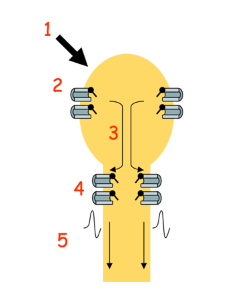
Describe transduction when the receptor is a neuron.
The stimulus arrives at the nerve ending.
Ion channels open (usually Na⁺ flows in).
A small local receptor potential results, which is graded.
If it reaches threshold, the neuron fires action potentials.
The action potentials travel to the CNS.
Describe transduction with a receptor cell plus a synapse.
The stimulus is applied.
The receptor membrane is altered (usually Na⁺ channels open).
The receptor cell’s neurotransmitter release changes.
The neurotransmitter changes the sensory neuron’s membrane potential.
The frequency of action potentials changes.
The action potentials propagate to the CNS.
What is unusual about photoreceptors?
They are “backwards”: light closes their channels.
Compare receptor (graded) potentials with action potentials.

How does the nervous system code stimulus strength?
A stronger stimulus:
opens more channels = giving a larger receptor potential = frequent action potentials.
The brain reads strength as firing frequency (a rate code).
Why can’t intensity be carried by bigger action potentials?
Every action potential is the same size, so intensity is carried only by frequency.
How is stimulus duration coded?
A longer stimulus keeps the neuron firing for longer.
What is a receptive field?
Region of sensory space
when stimulated, changes that neuron’s firing.
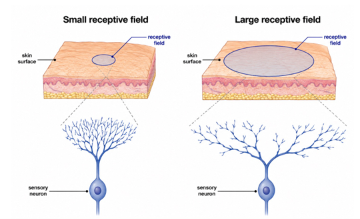
How does receptive field size relate to spatial detail? Give two examples of small fields.
small receptive fields give fine spatial detail (higher acuity)
large fields give coarse detail
What are the olfactory receptors and where are they found?
In the olfactory epithelium, high in the nasal cavity.
The receptor is itself a neuron
What makes smell unique among the senses?
It reaches the cortex without relaying through the thalamus
Humans can recognize thousands of smells. How, with only ~350-400 receptor types?
Each smell activates a different combination of receptors, and the brain reads the pattern (a combinatorial code).
. List the five basic taste qualities.
weet, sour, salty, bitter and umami.
What is a taste cell?
A taste cell is a non-neural receptor cell that detects chemicals and synapses onto a sensory neuron.
Taste vs Flavour
Taste is the five basic qualities
Flavour is taste + smell + texture + temperature.
Name the five brain regions that handle the senses and the role of each.
Cerebrum
Thalamus
Brain stem
Cerebellum
Spinal cord
Cerebrum (cortex): conscious perception
Thalamus: relay station for almost every sense
Brain stem: early processing and routing
Cerebellum: coordination of balance and movement
Spinal cord: entry point for senses from the body
Give the function of each cortical lobe.
Frontal
Parietal
Occipital
Temporal
Frontal: movement and planning
Parietal: body sensation
Occipital: vision
Temporal: hearing
What does the central sulcus separate?
The frontal (motor) lobe from the parietal (sensory) lobe.
State the general plan of a sensory pathway.
Receptor → brain stem or spinal cord → thalamus → primary sensory cortex.
Which sense does NOT relay through the thalamus, and where does it go instead?
Smell. It reaches the olfactory cortex without a thalamic relay.
Match each sense to its primary cortical area.
Taste
Touch / body
Vision
Hearing
Balance
Taste: gustatory cortex
Touch / body: somatosensory cortex
Vision: visual cortex (occipital lobe)
Hearing: auditory cortex (temporal lobe)
Balance: vestibular areas