Sierakowski Qu/est on The Enlightenment, Revolution, France and Napoleon
 Call Kai
 Learn
 Practice Test
 Spaced Repetition
 Match
 Flashcards
 Knowt Play
1/57

There's no tags or description
Looks like no tags are added yet.
58 Terms
The Enlightenment
18th-century intellectual movement emphasizing reason, individualism, and skepticism toward traditional religious and political authority.
Salons
Informal social gatherings hosted often by wealthy women where philosophes, writers, and aristocrats discussed and debated Enlightenment ideas.
Voltaire
French philosophe who championed freedom of speech, religious tolerance, and deism while harshly criticizing the Catholic Church and intolerance.
Jean-Jacques Rousseau
Philosophe who wrote "The Social Contract"; believed society corrupts human nature and argued government must follow the "general will."
Thomas Hobbes
English philosopher who wrote "Leviathan"; argued humans are naturally selfish and violent, requiring an absolute monarch to maintain order.
John Locke
English philosopher who argued humans have natural rights (life, liberty, property) and that governments rule by the consent of the governed.
Adam Smith
Scottish economist who wrote "The Wealth of Nations"; advocated free-market capitalism, the "invisible hand," and laissez-faire economics.
Baron de Montesquieu
French political thinker who wrote "The Spirit of the Laws"; advocated separation of powers and checks and balances among government branches.
Mary Wollstonecraft
English author of "A Vindication of the Rights of Woman"; argued for women's educational and social equality based on reason.
Mary Astell
English writer and early feminist; argued that if absolute sovereignty is not necessary in a state, it should not exist in a family, advocating women's education.
Cesare Beccaria
Italian criminologist who wrote "On Crimes and Punishments"; argued against torture and capital punishment, advocating for fair, speedy trials.
Social contract
An implicit agreement among members of a society to cooperate for social benefits, typically by surrendering some individual freedoms for state protection.
General will
Rousseau's concept representing the common interests and collective good of the entire political community, rather than individual desires.
Equality
The Enlightenment and revolutionary ideal that all citizens share the same basic fundamental rights, legal standing, and civic worth under the law.
Liberty
The state of being free within society from oppressive restrictions imposed by authority on one's way of life, behavior, or political views.
Importance of property
Core Lockean concept defining private property ownership as a fundamental natural right that governments exist primarily to protect.
Tithe
A mandatory tax or tribute (typically 10% of agricultural produce or income) paid by the French peasantry to support the Catholic Church.
Reason
The power of the mind to think, understand, and form judgments logically, treated by Enlightenment thinkers as the supreme arbiter of truth.
Laissez-faire
Economic doctrine arguing that economies function best when governments avoid interfering in markets and private enterprise.
Louis XVI & Marie Antoinette
King and Queen of France whose fiscal mismanagement, resistance to reform, and perceived disloyalty led to their execution during the Revolution.
Third Estate
The vast majority of the French population (about 98%), comprising peasants, urban workers, and the bourgeoisie, who bore the heaviest tax burden.
Ancien Régime
The traditional political and social system of France before the 1789 Revolution, characterized by feudal privileges and absolute monarchy.
Sans-culottes
Working-class Parisian radicals ("without knee-breeches") who drove the Revolution into its radical, violent phase.
Bourgeoisie
The educated, prosperous middle class of the Third Estate (lawyers, merchants, bankers, doctors) who resented aristocratic privileges.
Nobility / Aristocrats
The Second Estate in France, holding vast wealth, land ownership, top government posts, and exemption from most direct taxes.
Women in the French Revolution
Active participants who led the Women's March on Versailles, demanded rights (e.g., Olympe de Gouges), formed political clubs, and fought food shortages.
Civil Constitution of the Clergy
1790 decree subordinating the Catholic Church to the French government, confiscating church lands and turning priests into elected state officials.
Tennis Court Oath
June 20, 1789 pledge by the Third Estate (National Assembly) vowing not to disband until they had drafted a written constitution for France.
Declaration of the Rights of Man and of the Citizen
1789 foundational revolutionary charter declaring all men born free and equal in rights, emphasizing liberty, property, security, and resistance to oppression.
Storming of the Bastille
July 14, 1789 event where an armed Parisian mob attacked a royal medieval fortress and armory, symbolizing the fall of royal tyranny.
July 14, 1789
The official date of the storming of the Bastille; marks the outbreak of the armed popular French Revolution (now France's Bastille Day).
Bread riots
Widespread popular protests and unrest sparked by severe grain shortages, poor harvests, soaring bread prices, and starvation in late 1780s France.
Maximilien Robespierre & Committee of Public Safety
Radical Jacobin leader and the executive governing body created to defend the Republic from internal and external enemies through severe terror.
Jacobins, Girondins, Mountain
Political factions: Jacobins were the broad radical club; Girondins were moderate republicans; the Mountain was the extreme radical faction aligned with Paris workers.
Reign of Terror
Period from 1793 to 1794 where the revolutionary government executed tens of thousands of suspected "counter-revolutionaries" by guillotine.
Napoleon Bonaparte
French general who seized power in a 1799 coup, brought administrative stability, conquered continental Europe, and declared himself Emperor.
Liberal / Moderate Phase (1789-1792)
First revolutionary phase: Constitutional monarchy established, feudalism abolished, Declaration of the Rights of Man issued.
Radical / Terror Phase (1792-1794)
Second revolutionary phase: Execution of the king, Republic declared, Jacobin dictatorship under Robespierre, mass executions via guillotine.
Thermidorian Reaction & Directory (1794-1799)
Third revolutionary phase: Fall and execution of Robespierre, repeal of radical controls, establishment of a corrupt five-man Directory.
Napoleonic Empire Phase (1799-1815)
Fourth phase: Napoleon's Consulate and imperial rule, widespread legal and administrative reforms, continental expansion, and eventual downfall.
Napoleonic Code (Civil Code of 1804)
Uniform French legal system ensuring equality of citizens before the law, religious freedom, and property rights, while curtailing women's rights.
Concordat of 1801
Napoleon's agreement with Pope Pius VII that restored the Catholic Church in France while keeping church property and appointment controls with the state.
The Continental System
Napoleon's economic blockade designed to cripple Great Britain by forbidding continental European nations from trading with the British.
Austria (Map ID)
Central European Habsburg empire east of the German states, governed from Vienna; a primary rival of revolutionary and Napoleonic France.
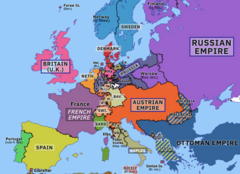
Kingdom of Italy (Map ID)
Napoleonic satellite state in northern/central Italy created by Napoleon, with Milan as its capital and Napoleon as king.

Spain (Map ID)
Iberian Peninsula nation southwest of France across the Pyrenees; site of the bloody guerrilla Peninsular War against French occupation.

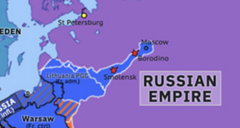
Russia (Map ID)
Massive Eastern European empire ruled by Tsar Alexander I; site of Napoleon's disastrous 1812 invasion.

Confederation of the Rhine (Map ID)
League of German client states created by Napoleon in central Germany that dissolved the thousand-year-old Holy Roman Empire.

Sweden (Map ID)
Scandinavian nation across the Baltic Sea northeast of Great Britain and north of Prussia; joined anti-Napoleonic coalitions.

Kingdom of Naples (Map ID)
Southern Italian peninsula state (including southern Italy mainland) placed under the rule of Napoleon's brother Joseph and later Joachim Murat.

Empire of France / France (Map ID)
Core western European power bordered by the Atlantic, the English Channel, the Pyrenees, and the Rhine.

Great Britain & Ireland (Map ID)
Island kingdom off the northwest coast of mainland Europe; dominant naval power and Napoleon's most persistent adversary.

Paris (Map ID)
Capital city of France, located on the Seine River in northern central France; political epicenter of the Revolution.

Corsica (Map ID)
Mediterranean island north of Sardinia and southeast of mainland France; birthplace of Napoleon Bonaparte.

Prussia (Map ID)
Militaristic northern German kingdom situated along the Baltic coast with Berlin as its capital; key allied opponent against Napoleon.
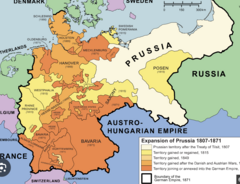
Duchy of Warsaw (Map ID)
Polish state created by Napoleon in 1807 from lands seized from Prussia and Austria to serve as a French buffer against Russia.

Battle of Waterloo (Map ID)
June 18, 1815 site in present-day central Belgium where the British (Wellington) and Prussians (Blücher) permanently defeated Napoleon.

Battle for Moscow / Borodino (Map ID)
September 1812 battle west of Moscow; deadliest single day of the Napoleonic Wars, leading to Napoleon's capture of a burned Moscow.