DIV Lab 10 Conifers
 Call Kai
 Learn
 Practice Test
 Spaced Repetition
 Match
 Flashcards
 Knowt Play
1/31

There's no tags or description
Looks like no tags are added yet.
32 Terms
apophysis
the exposed part of a closed cone
bract
a leaf-like part usually at the base of a flower or inflorescence
cultivar
a blending of the terms ‘cultivated’ and ‘variety’, used to refer to varieties of a species that persist under cultivation, frequently named
dioecious
unisexual, with male and female reproductive structures on separate plants
exserted
extending beyond
fascicle
a small, close bundle or cluster
fascicle sheath
deciduous or persistent bud scales at the base of the fascicle
monoecious
having male and female structures on the same plant
monotypic
with only one representative, e.g. one species in a genus
peltate
shield-shaped and attached by the lower surface to the supporting stalk
pneumatophore
the negatively geotropic roots of some mangrove and swamp plants that project above the level of the water; an aerating organ.
serotinous
of cones that remain closed long after the seeds inside are ripe
stomate
a specialized intercellular space in epidermal tissue bounded by a pair of guard cells which can close the space by changing shape.
umbo
a protuberance on the end (terminal umbo) or apex (dorsal umbo) of the apophysis
whorl
a ring of 3 or more similar structures that radiate from a common point
Name the genera for the family Cupressaceae
Metasequoia, Taxodium, Thuja (Arborvitae), Chamaecyparis (False Cypress), Juniperus (Juniper)
Name the genera for the family Pinaceae
Pinus (Pine), Picea (Spruce), Larix (Larch), Pseudotsuga (Douglas Fir), Abies (Fir), Tsuga (Hemlock)
High northern latitudes (boreal forests)
needle-like leaves and sloping branches
Semi-arid (dry) climates
Sunken stomata and extensive root systems
Pattern of frequent fires
Serotinous cones and thick bark
Members of which genus within the Cupressaceae have dimorphic (with 2 distinct forms) foliage?
Juniperus

Fir
Flat needles and upright cones

Pine
Needles clustered and cones are woody and heavy
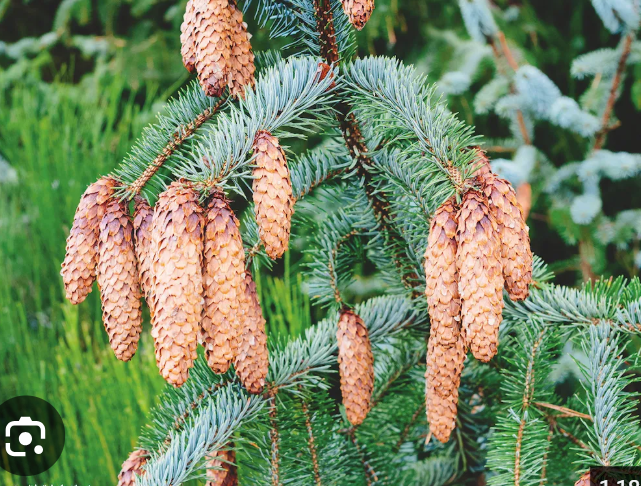
Spruce
Four-sided sharp needles and hanging cones
Name 2 deciduous conifers.
Taxodium and Metasequoia
Name 1 deciduous gymnosperm that is NOT a conifer
Ginko
What is the term used to denote the cluster of needles on pines?
Fascicle
How many needles may be found in these clusters?
2 to 5
What is the name of the portion of a pine cone that is visible when the cone scales are closed?
Apophysis
If there is a ‘prickle’ at the terminus of the umbo, it is said to be
Armed
How would you distinguish between a fir and a hemlock?
Fir needles are longer and lack a distinct stalk and leave a flat circular scar when removed, and hemlock needles are shorter, flattened, and attached to the twig by a stalk.