Phase Diagrams and Alloys
 Call Kai
 Learn
 Practice Test
 Spaced Repetition
 Match
 Flashcards
 Knowt Play
1/58

There's no tags or description
Looks like no tags are added yet.
59 Terms
Define a solution (slide 3).
A single phase (e.g. a solid solution).
Define a mixture (slide 3).
More than one phase.
Define the solubility limit.
The maximum concentration for which only a single-phase solution occurs.

Sugar–water: what is the solubility limit at 20 °C (slide 3)?
65 wt% sugar.
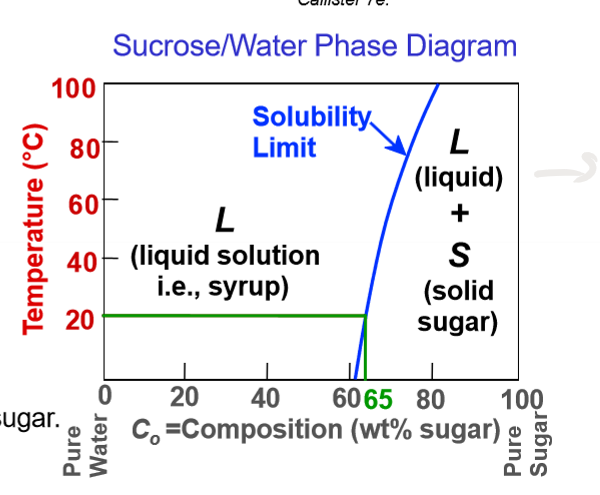
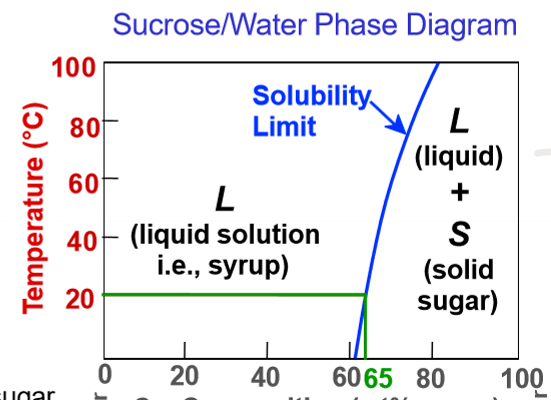
Sugar–water at 20 °C: what do you get if C₀ < 65 wt% sugar? If C₀ > 65 wt%?
Below 65: syrup only (one phase, L). Above 65: syrup + solid sugar (two phases, L + S).

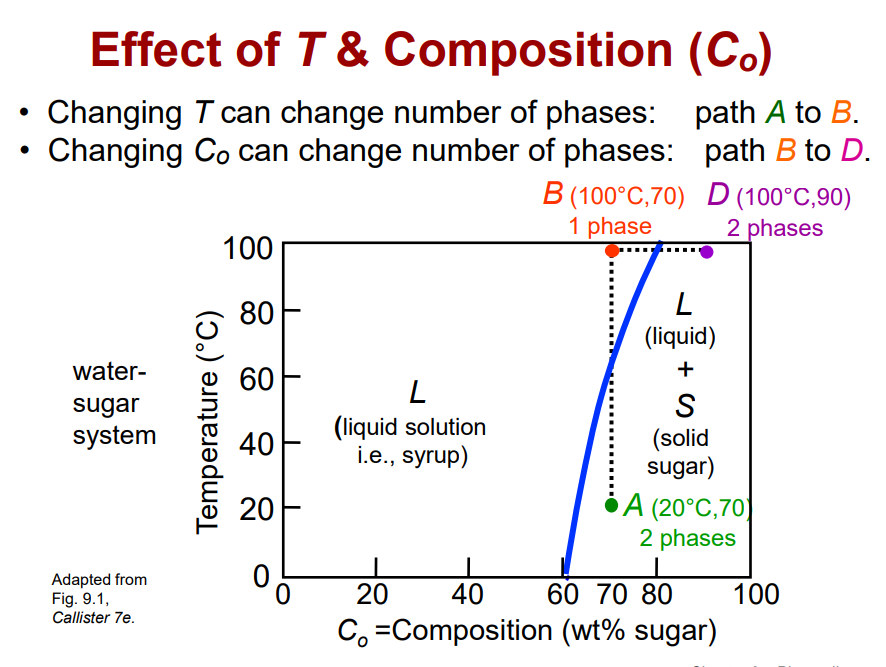
How does sugar solubility change with temperature?
It increases: the solubility limit line moves to higher wt% sugar as T rises.
Slide 6: going from A (20 °C, 70 wt%) to B (100 °C, 70 wt%) changes the phases how?
2 phases → 1 phase. Heating raises the solubility limit past 70 wt%, so all the sugar dissolves.

Two ways to change the number of phases (slide 6)?
Change temperature T, or change composition C₀.
Define a component (slide 4).
The elements or compounds present in the mixture (e.g. Al and Cu).
Define a phase (slide 4)
The physically and chemically distinct material regions that result (e.g. α and β).

Slide 4 Al–Cu micrograph: which phase is darker, which lighter?
α is the darker phase; β is the lighter phase.

What does it mean that a phase is homogeneous (slide 5)?
It has uniform physical and chemical properties throughout.
What happens to properties across a phase boundary?
Physical and/or chemical characteristics change abruptly.
Microstructure is determined by which three things (slide 5)?
The number of phases present;
the proportions of the phases;
the distribution and arrangement of the phases.
What does microstructure determine (slide 5)?
Mechanical properties.
State the equilibrium condition (slide 7).
The Gibbs free energy is at a minimum.
Define metastable (slide 7).
A non-equilibrium system whose rate of approach to equilibrium is extremely slow.
Phase diagrams show phases as functions of which variables (slide 7)?
Temperature, composition and pressure (T, C, P).

What are the axes of a one-component phase diagram such as water (slide 8)?
Pressure (atm, log scale) vs temperature (°C). Composition is fixed so it isn't an axis.

What is the triple point?
The point where solid, liquid and vapour all coexist in equilibrium (where the three phase-boundary lines meet).
Why are Cu and Ni highly soluble in each other (Hume-Rothery)?
Same crystal structure (FCC),
similar electronegativities and
similar atomic radii: the Hume-Rothery rules.

For this course, how many components do phase diagrams have, and what are the independent variables (slide 11)?
Binary: 2 components.
Independent variables T and C₀; P = 1 atm almost always.

What is the liquidus?
The line above which the alloy is entirely liquid.

Where do the liquidus and solidus meet on the Cu–Ni diagram?
At the melting points of the pure components (0 and 100 wt% Ni, circled on the diagram).

How are solid solutions labelled on phase diagrams?
With lower-case Greek letters (α, β, γ …).
What does complete mutual solubility mean for the α field?
The α phase field stretches from 0 to 100 wt% Ni. Due to Cu and Ni having complete solubility, they showcase isomorphism.
How do you find phase compositions in a two-phase field?
Draw the tie line at T; read C_L where it meets the liquidus and C_α where it meets the solidus.

Formulae for the lever rule in terms of compositions:

Write the lever rule using R and S.
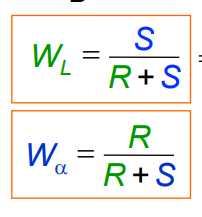
What does S and R represent?
R: Length from edge of liquidus to C(o)
S: Length from edge of solidus to C(o)
R+S = whole line
Quick sense check for any lever rule answer?
The phase whose composition is closer to C₀ is the one you have more of.
Why might you use volume fraction instead of mass fraction (slide 16)?
Phase volume fractions can be measured directly from the microstructure (micrographs).
Define V_α in terms of phase volumes.

Convert mass fractions to V_α.

Convert volume fractions to W_α.

What are metal alloys (slide 18)?
Mixtures of metal types along with other elements, e.g. Fe with carbon.
What two variables define an alloy's microstructure via a phase diagram (slide 18)?
Weight % (composition) and temperature.

Define cast iron (slide 19)
Ferrous alloys with > 2.1 wt% C,
more commonly 3–4.5 wt% C.
low melting (also brittle) so easiest to cast

Two traditional ways to fabricate metals (slide 20)?
Blacksmith hammer (forged) and moulding (cast).

What is a forming operation?
Rough stock formed to final shape.
Hot working: temperature and deformation?
T high enough for recrystallisation; larger deformations.
Cold working: temperature and effects?
Well below T_m; work hardening; smaller deformations.
Three families of fabrication methods on slides 21–26?
Forming, casting, joining.
Forging: how and example products?
Hammering/stamping a blank between dies (often at elevated T). Wrenches, crankshafts.
Rolling: products and conditions?
Hot or cold rolling between rolls.
I-beams, rails, sheet & plate.
Drawing: how and products?
Pulling (tensile force) through a die. Rods, wire, tubing. Die must be well lubricated and clean.
Extrusion: how and products?
A ram pushes a billet through a die. Rods, tubing. Ductile metals, e.g. Cu, Al (hot).
Which forming method uses a tensile force?
Drawing.
Advantages of casting (slide 22)?
Most common,
cheapest method;
good production of shapes;
good option for brittle materials.
Disadvantages of casting (slide 22)?
Weaker products;
internal defects.
Why sand for sand casting (slide 23)?
It withstands > 1600 °C, is cheap and is easy to mould around a pattern.
Sand casting is used for?
Large parts, e.g. auto engine blocks.
Describe investment casting.
Make a paraffin (wax) pattern, encase it in plaster of Paris, melt out the wax, pour metal into the hollow mould.
Investment casting is used for?
Low volume, complex shapes, e.g. jewellery, turbine blades.
Die casting is used for?
High volume, low-T alloys.
Continuous casting is used for?
Simple slab shapes.
Powder metallurgy: which materials and how?
Materials with low ductility.
When is welding used (slide 26)?
When one large part is impractical.
Define the heat-affected zone.
The region in which the microstructure has been changed (by welding heat, without melting).